



The Reading Fervour
Exploring the 20 Most Influential Managerial Books of All Time
If we encounter a man of rare intellect we should ask him what books he read.
– Ralph Waldo Emerson
As February unfolds, the passion for books and reading is reignited even among the busiest soul in this country. For a time-being we are consumed by the great ideas, stories, and romances that are so intelligently and passionately shared in the works of great scholars, poets, novelists and dreamers. While some of these great literary works are appreciated for their own sake, others create massive ripples in contemporary society to change the way we think, to change the way we work.
In 2011, TIME Magazine assembled a list of what may be considered to be the 25 Most Influential Business Management Books of the modern era. From BBF we have brought you a peek into 20 of these paradigm shifting books, ranging from the exemplary “How to Win Friends and Influence People” to groundbreaking tomes like “Guerilla Marketing” and quick reads like the “The One Minute Manager”. Read ahead and beyond, as the old saying goes: reading makes the man. Great books are multidimensional. Such is the case with books about business. They not only teach us the technical aspects of trade and commerce, but they influence our outlook, our strategies, and our direction so we can improve Business Efficiency, create more coherent teamwork, and generate more sales.
1. The Age of unreason
Author: Charles Handy
Year of Publication: 1989
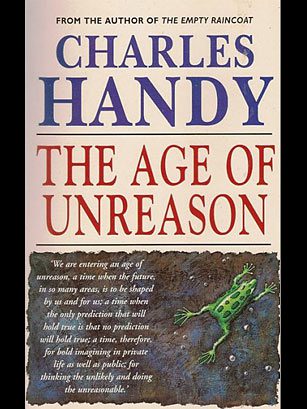 The Age of Unreason is an inspiring vision of an era of new discoveries, new enlightenment and new freedoms.The key words that jump out at you from ‘The Age of Unreason’ are ‘change,’ ‘discontinuity’, ‘upside down thinking’ and ‘uncertainty’. In this book Handy emphasizes that in an era when change is constant, random, and, as he calls it, ‘discontinuous’, it is necessary to break out of old ways of thinking in order to use change to our advantage.
Handy examines how dramatic changes are transforming business, education, and the nature of work. We can see it in astounding new developments in technology, in the shift in demand from manual to cerebral skills, and in the virtual disappearance of lifelong, full-time jobs. Handy maintains that discontinuous change requires upside-down thinking, and discusses the need for new kinds of organizations, new approaches to work, new types of schools, and new ideas about the nature of our society.
2. Built to Last: Successful Habits of Visionary Companies
Author:Jim Collins and Jerry Porras
Year of Publication:1994
 Built to Last is about enduringly, great organizations known as visionary companies that have prospered over long periods of time through multiple product life cycles and several generations of leadership. Visionary companies are able to attaint their phenomenal success by remaining true to their core ideology while still relentlessly pursuing progress. A company’s core ideology comprises its core values but also its purpose, meaning the reason it exists between profits or shareholder value.
In this book, the authors focused on the seven timeless principles of visionary companies: Be clock-builders, not time-tellers; embrace the “and”, reject the “or”; more than profits; walk the talk; preserve the core ideology while stimulating progress; never-ending process; and build the vision.
3. Competing for the Future
Author:Gary Hamel and C.K. Prahalad
Year of Publication: 1996
 So as manager of a company you’ve restructured and reengineered to become leaner and more efficient for the competitive1990s. All that rethinking of current business processes and the wrenching downsizing that resulted has ensured your short-term survival and may even have brought your firm present market leadership. But now what? Competing for the Future offers a masterful blueprint for what your company must be doing today if it is to occupy the competitive high ground of the future, whether this needs to be how to address a target audience, or making the most of the tools, like remote managed it consulting, which are available to many businesses these days. It is both a handbook for industry revolutionaries and a guide to creating the markets of tomorrow.
This book deals mainly with issues that managers have to look through today if they want to create the markets of the future and revolutionize their industries. The authors describe their book as a guide for managers who are willing to focus on the long-term and not only short-term success of the corporation. It has only one mantra,like the authors state predominantly;‘it is not only about making a difference to managers but also about making a difference to customers as well as employees.’
4. Competitive Strategy: Techniques for Analyzing Industries and Competitors
Author: Michael E. Porter
Year of Publication: 1980
 Now nearing its 60th printing in English and translated into nineteen languages, Michael E. Porter’s Competitive Strategy has transformed the theory, practice, and teaching of business strategy throughout the world. Electrifying in its simplicity – like all great breakthroughs – Porter’s analysis of industries captures the complexity of industry competition in five underlying forces. By paying particular attention to the power of suppliers and customers, the threats of new entry and substitutes, and the level of internal rivalry in the industry, Porter argues that it’s possible to identify opportunities and develop strategies that create a profitable, defensible competitive position for your firm.
Porter introduces one of the most powerful competitive tools yet developed: his three generic strategies – lowest cost, differentiation, and focus – which bring structure to the task of strategic positioning. He shows how competitive advantage can be defined in terms of relative cost and relative prices, thus linking it directly to profitability, and presents a whole new perspective on how profit is created and divided. In the almost two decades since publication, Porter’s framework for predicting competitor behavior has transformed the way in which companies look at their rivals and has given rise to the new discipline of competitor assessment.
5. Emotional intelligence
Author: Daniel Goleman
Year of Publication: 1995
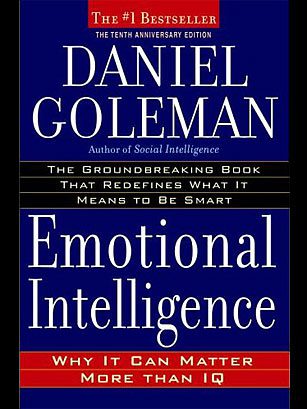 What are the requirements for a successful life?
People have been trying to answer this question for centuries. A lot has been said and much more shall be told in future. Daniel Goleman presented “Emotional Intelligence” as a main factor of success. He rejected the conventional concepts of intelligence, IQ scoring reliability and alertness of mind as elements of success. He argued that self-control, zeal and persistence are the main features of every successful story.
Everyone knows that high IQ is no guarantee of success, happiness, or virtue, unless it is accompanied by Emotional Intelligence, we could only guess why. Daniel Goleman’s brilliant report from the frontiers of psychology and neuroscience offers startling new insight into our “two minds”-the rational and the emotional-and how they together shape our destiny.
Through vivid examples, Goleman delineates the five crucial skills of emotional intelligence, and shows how they determine our success in relationships, work, and even our physical well-being. What emerges thus is an entirely new way to talk about being smart.
6. The Essential Drucker
Author: Peter Drucker
Year of Publication: 2001
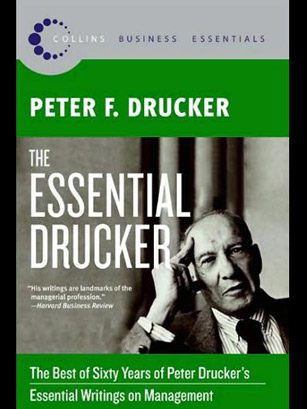 The Essential Drucker by Peter Drucker is a quintessential book dealing with management. It is composed of a selection of pieces from Drucker’s many books over a period of sixty years. His uncanny insight in business has made him one of the world’s preeminent philosophers of business.
The Essential Drucker highlights important topics covered over three major elements of management: the Management, the Individual, and the Society. Drucker brings these three elements together in order to bring about a managerial environment.
Containing twenty-six core selections, The Essential Drucker covers the basic principles and concerns of management and its problems, challenges, and opportunities, giving managers, executives, and professionals the tools to perform the tasks that the economy and society of tomorrow will demand of them.
7. The Fifth Discipline: The Art and Practice of the Learning Organization
Author: Peter Senge
Year of Publication: 1990
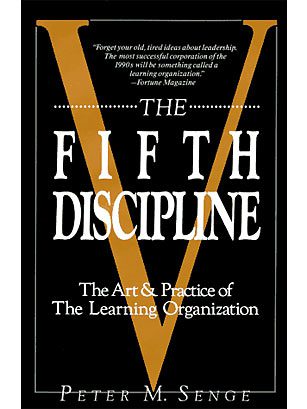 Senior executives are devoting more of their time these days to fostering a culture of learning within their organizations. They realize that many of the recurring problems they deal with would be more quickly and productively resolved if they managed and belonged to a learning organization. Peter Senge’s The Fifth Discipline: The Art and Practice of the Learning Organization, out in a new edition to mark its fifth anniversary, remains the seminal book about the value of creating such a company.
This revised edition is based on fifteen years of experience of putting the book’s ideas into practice. As Senge makes clear, in the long run the only sustainable competitive advantage is your organization’s ability to learn faster than the competition. The leadership stories in the book demonstrate the many ways that the core ideas in The Fifth Discipline, many of which seemed radical when first published in 1990, have become deeply integrated into people’s ways of seeing the world and their managerial practices.
8. First, Break All the Rules
Author:Marcus Buckingham and Curt Coffman
Year of Publication:1999
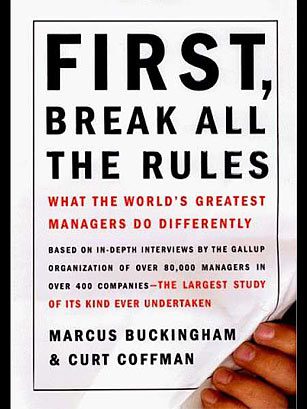 The greatest managers in the world seem to have little in common. They differ in sex, age, and race. They employ vastly different styles and focus on different goals. Yet despite their differences, great managers share one common trait: They do not hesitate to break virtually every rule held sacred by conventional wisdom. They do not believe that, with enough training, a person can achieve anything he sets his mind to. They do not try to help people overcome their weaknesses. They consistently disregard the golden rule. And, yes, they even play favorites. This amazing book explains why.
Marcus Buckingham and Curt Coffman of the Gallup Organization present the remarkable findings of their massive in-depth study of great managers across a wide variety of situations. Some were in leadership positions. Others were front-line supervisors. Some were in Fortune 500 companies; others were key players in small, entrepreneurial companies. Whatever their situations, the managers who ultimately became the focus of Gallup’s research were invariably those who excelled at turning each employee’s talent into performance.
9. The Goal
Author:Eliyahu Goldratt
Year of Publication:1984
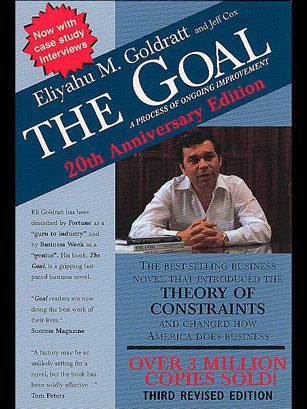 Written in a fast-paced thriller style, The Goal is the gripping novel which is transforming management thinking throughout the Western world. The author has been described by Fortune as a ‘guru to industry’ and by BusinessWeek as a ‘genius’.
This book tells the story of Alex Rogo, who is a harried plant manager working ever more desperately to try and improve performance. His factory is rapidly heading for disaster. So is his marriage. He has ninety days to save his plant – or it will be closed by corporate HQ, with hundreds of job losses. It takes a chance meeting with a colleague from student days – Jonah – to help him break out of conventional ways of thinking to see what needs to be done.
The story of Alex’s fight to save his plant is more than compulsive reading. It contains a serious message for all managers in industry and explains the ideas which underline the Theory of Constraints (TOC). This book has been acclaimed as an internationally recognized leader in the development of new business management concepts and systems, and was known as an educator to many of the world’s corporations.
10. Good to Great: Why Some Companies Make the Leap … and Others Don’t
Author:Jim Collins
Year of Publication:2001
 In what Collins terms a prequel to the bestseller Built to Last he wrote with Jerry Porras, this worthwhile effort explores the way good organizations can be turned into ones that produce great, sustained results. To find the keys to greatness, Collins’s 21-person research team (at his management research firm) read and coded 6,000 articles, generated more than 2,000 pages of interview transcripts and created 384 megabytes of computer data in a five-year project.
In addition to that, Collins’s crew combed through every company that has made the Fortune 500 (approximately 1,400) and found 11 that met their criteria, including Walgreens, Kimberly Clark and Circuit City. At the heart of the findings about these companies’ stellar successes is what Collins calls the Hedgehog Concept; a product or service that leads a company to outshine all worldwide competitors, that drives a company’s economic engine and that a company is passionate about.
While the companies that achieved greatness were all in different industries, each engaged in different versions of Collins’s strategies. While some of the overall findings are counterintuitive (e.g., the most effective leaders are humble and strong-willed rather than outgoing), many of Collins’s perspectives on running a business are amazingly simple and comprises of basic commonsense.
11. Guerilla Marketing
Author: Jay Conrad Levinson
Year of Publication: 1984
 When Guerrilla Marketing was first published in 1983, Jay Levinson revolutionized marketing strategies for the small-business owner with his take-no-prisoners approach to finding clients. Based on hundreds of solid ideas that really work, Levinson’s philosophy has given birth to a new way of learning about market share and how to gain it.
This book will guide marketers into the world of positioning and selling products and services. The authors lead the reader step by step through the process of developing a marketing campaign. They offer detailed descriptions of more than a hundred marketing tools from contests to affinity programs, from direct mail to billboard advertising. In addition, anecdotes, graphics, and rules of thumb are also included. Thus, in the recent completely updated and expanded fourth edition, Levinson offers a new arsenal of weaponry for small-business.
12. How to Win Friends and Influence People
Author: Dale Carnegie
Year of Publication: 1936
 Many forms of media can become dated quite quickly. Even some of the best books, movies and music suddenly lose their luster after a few years whether due to cultural shifts or technological advances. Despite being written in 1937, How to Win Friends and Influence People is not one of those cases.
For over 50 years the advice in this book has carried thousands of people up the ladder of success in their business and personal lives. Now this book has been revised and updated to help a new generation of readers. In an era of social media and real-time communication, it’s never been more important to learn to communicate effectively. Regardless of whether you have recently looked into text messaging for small businesses to communicate with customers, you’re emailing co-workers and staff, or prospective leads on Twitter or Facebook, what you say has never been under more of a microscope while simultaneously being incredibly public.
In 30 eye-opening chapters, Dale Carnegie lays out a method for increasing your likability, more effectively leading others and winning people over to your point of view. Each section is a key pillar to a shift in both your actions and your mindset that can take even the most socially inept and help them become a great leader.
13. The Human Side of Enterprise
Author: Douglas McGregor
Year of Publication: 1960
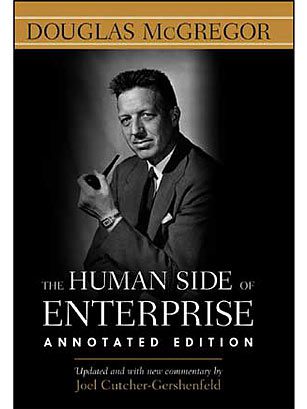 Some of the most innovative thinking on management education and practice was originated by management theorist Douglas McGregor in The Human Side of Enterprise In this book McGregor challenged many of the prevailing managerial assumptions about worker motivation and behavior.
Heralded as one of the most important pieces of management literature ever written, a touchstone for scholars and a handbook for practitioners, The Human Side of Enterprise continues to receive the highest accolades nearly half a century after its initial publication. Influencing such major management gurus such as Peter Drucker and Warren Bennis, McGregor’s revolutionary Theory Y-which contends that individuals are self-motivated and self-directed-and Theory X-in which employees must be commanded and controlled-has been widely taught in business schools, industrial relations schools, psychology departments, and professional development seminars for over four decades.
Now more than ever, the timeless wisdom of Douglas McGregor can light the path towards a management style that nurtures leadership capability, creates effective teams, ensures internal alignment, achieves high performance, and cultivates an authentic, value-driven workplace–lessons we all need to learn as we make our way in this new multidimensional world of the 21st century.
14. The Innovator’s Dilemma
Author: Clayton Christensen
Year of Publication: 1996
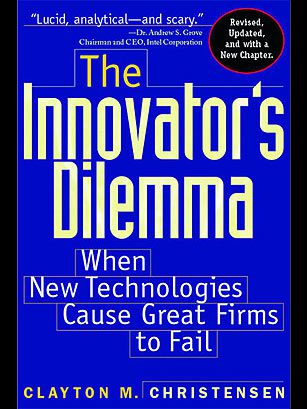 His work is cited by the world’s best known thought leaders, from Steve Jobs to Malcolm Gladwell. In this classic bestseller, innovation expert Clayton M. Christensen shows how even the most outstanding companies can do everything right-yet still lose market leadership.
Or worse, disappear completely. And he not only proves what he says, he tells others how to avoid a similar fate. Focusing on “disruptive technology” — the Honda Super Cub, Intel’s 8088 processor, or the hydraulic excavator, for example — Christensen shows why most companies miss “the next great wave.”
Whether in electronics or retailing, a successful company with established products will get pushed aside unless managers know when to abandon traditional business practices. Using the lessons of successes and failures from leading companies, The Innovator’s Dilemma presents a set of rules for capitalizing on the phenomenon of disruptive innovation. Sharp, cogent, and provocative, The Innovator’s Dilemma is one of the most talked-about books of our time — and one no savvy manager or entrepreneur should be without.
15. Leading Change
Author: John P. Kotter
Year of Publication: 1996
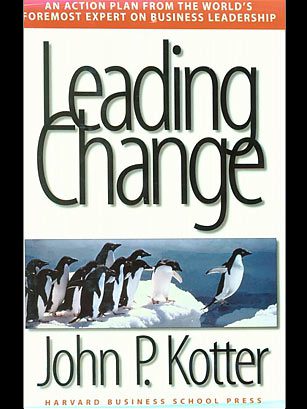 What will it take to bring your organization successfully into the twenty-first century? The world’s foremost expert on business leadership distills twenty-five years of experience and wisdom based on lessons he has learned from scores of organizations and businesses to write this visionary guide. The result is a very personal book that is at once inspiring, clear-headed, and filled with important implications for the future.
The pressures on organizations to change will only increase over the next decades. Yet the methods managers have used in the attempt to transform their companies into stronger competitors — total quality management (be it via quality management software or other in house means), reengineering, right sizing, restructuring, cultural change, and turnarounds — routinely fall short, says Kotter, because they fail to alter behavior. Emphasizing again and again the critical need for leadership to make change happen, Leading Change provides the vicarious experience and positive role models for leaders to emulate.
John Kotter’s now-legendary eight-step process for managing change with positive results has become the foundation for leaders and organizations across the globe. By outlining the process every organization must go through to achieve its goals, and by identifying where and how even top performers derail during the change process, Kotter provides a practical resource for leaders and managers charged with making change initiatives work. Needed more today than at any time in the past, this bestselling business book serves as both visionary guide and practical toolkit on how to approach the difficult yet crucial work of leading change in any type of organization.
16. On Becoming a Leader
Author: Warren Bennis
Year of Publication: 1989
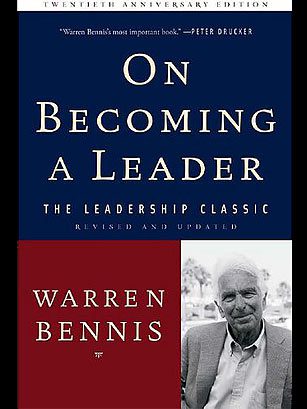 Deemed “the dean of leadership gurus” by Forbes magazine, Warren Bennis has for years persuasively argued that leaders are not born-they are made. Delving into the qualities that define leadership, the people who exemplify it, and the strategies that anyone can apply to achieve it, his classic work On Becoming a Leader has served as a source of essential insight for countless readers.
At the crux of this book is a search to understand how leaders are made. Throughout the book, the author tries to prove through polls and observations that leaders are not born but are made through a combination of nature and nurture. Leaders who excel tend to have similar characteristics which have been developed by a series of experiences in their lives (these include embracing mistakes, taking risks and learning from adversity). Another idea discussed in the book is that of the role of education in making leaders. Bennis notes a number of qualities and abilities that are common amongst the leaders he interacts with. Some of those are relating well to others, trusting others and in turn being trustworthy, the ability to motivate people and to not give up, inspiration and competence in the job. However, he claims that a major problem in business & leadership is the “societal disease of our time” – short term thinking.
So, the book captures the essence of leadership because in a world increasingly defined by turbulence and uncertainty, the call to leadership is more urgent than ever.
17. Out of the crisis
Author: W. Edwards Deming
Year of Publication: 1982
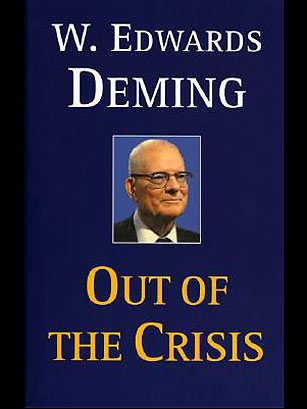 According to W. Edwards Deming, American companies require nothing less than a transformation of management style and of governmental relations with industry. In Out of the Crisis, originally published in 1986, Deming offers a theory of management based on his 14 Points for Management. Management’s failure to plan for the future, he claims, brings about loss of market, which brings about loss of jobs. Management must be judged not only by the quarterly dividend, but by innovative plans to stay in business, protect investment, ensure future dividends, and provide more jobs through improved product and service. In simple direct language, he explains the principles of management transformation and how to apply them.
Dr. Deming best summarizes the purpose of the book: “This book teaches the transformation that is required for survival, a transformation that can only be accomplished by man. A company cannot buy its way into quality – it must be led into quality by top management. A theory of management now exists. Never again may anyone say that there is nothing new in management to teach.”
18. The One Minute Manager
Author: Kenneth Blanchard and Spencer Johnson
Year of Publication: 1982
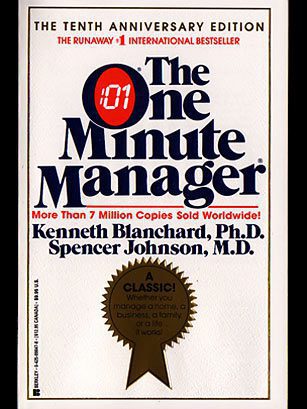 For more than twenty years, millions of managers in Fortune 500 companies and small businesses nationwide have followed The One Minute Manager‘s techniques, thus increasing their productivity, job satisfaction, and personal prosperity. These very real results were achieved through learning the management techniques that spell profitability for the organization and its employees.
The One Minute Manager is a concise, easily read story that reveals three very practical secrets: One Minute Goals, One Minute Praisings, and One Minute Reprimands.
The book also presents several studies in medicine and the behavioral sciences that clearly explain why these apparently simple methods work so well with so many people. That’s why The One Minute Manager has continued to appear on business bestseller lists for more than two decades, and has become an international sensation.
A practical business guide for managers wanting to get the most from their employees introduces a wide range of timely strategies. Itpromotes employee morale and job satisfaction and, in turn, heighten profitability and productivity.
19. Toyota Production System
Author: Taiichi Ohno
Year of Publication: 1988
 In this classic text, Taiichi Ohno — inventor of the Toyota Production System and lean manufacturing — shares the genius that sets him apart as one of the most disciplined and creative thinkers of our time. Combining his candid insights with a rigorous analysis of Toyota’s attempts at lean production, Ohno’s book explains how lean principles can improve any production-oriented endeaver.
A historical and philosophical description of just-in-time and lean manufacturing, this work is a must read for all students of human progress. On a more practical level, it continues to provide inspiration and instruction for those seeking to improve efficiency through the relentless elimination of waste.
20. Who Moved My Cheese?
Author: Spencer Johnson
Year of Publication: 1998
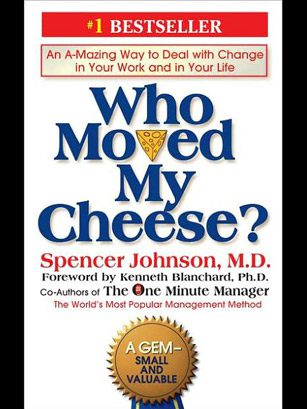 With Who Moved My Cheese? Dr. Spencer Johnson realizes the need for finding the language and tools to deal with change-an issue that makes all of us nervous and uncomfortable.
Most people are fearful of change because they don’t believe they have any control over how or when it happens to them. Since change happens either to the individual or by the individual, Spencer Johnson shows us that what matters most is the attitude we have about change.
The coauthor of the multi-million bestseller, The One Minute Manager, has written a deceptively simple story with a dramatically important message that can radically alter the way we cope with change. Who Moved My Cheese?allows for common themes to become topics for discussion and individual interpretation.
Who Moved My Cheese? takes the fear and anxiety out of managing the future and shows people a simple way to successfully deal with the changing times, providing them with a method for moving ahead with their work and lives safely and effectively. Sometimes simple problems require simple answers. In just 96 pages, this humorous story uses simple metaphors and characters to encourage readers to embrace change and to adapt to new situations with an open mind and a motivated spirit.
Shopping Cart
These books are available at many of the popular online bookstores. You might just ‘add the books you prefer reading to your cart’ and get hands on these books in the most possible convenient way. These e-book stores accept credit cards, preferably MasterCard, American Express and Visa card. You can also make your payments through Visa debit card or your PayPal account.
Some of the popular e-book stores are: Barnes and Noble, Amazon, Kobo, Indigo, Abe books, Half.com, Audible, Alibris, Book depository, better World Books and iBook store.
For people residing in Bangladesh, it is not always possible to purchase through e-book stores internationally. And in that case, the brick-and-mortar stores may come to your rescue. Some of these books are available in PBS; the largest and the first chain book shop in Bangladesh. The other magnum opus stores include Batighar, Gyankosh, Boi Bichitra, Minerva Book store, Papyrus, Sagar Publisher’s, The Book Worm and Words n Pages. You can also order online in Booksbd.com, the largest online bookshop in Bangladesh or make special orders at Ruby Enterprise, the prominent book subscription agent in Bangladesh.
By: Gultekin Binte Azad