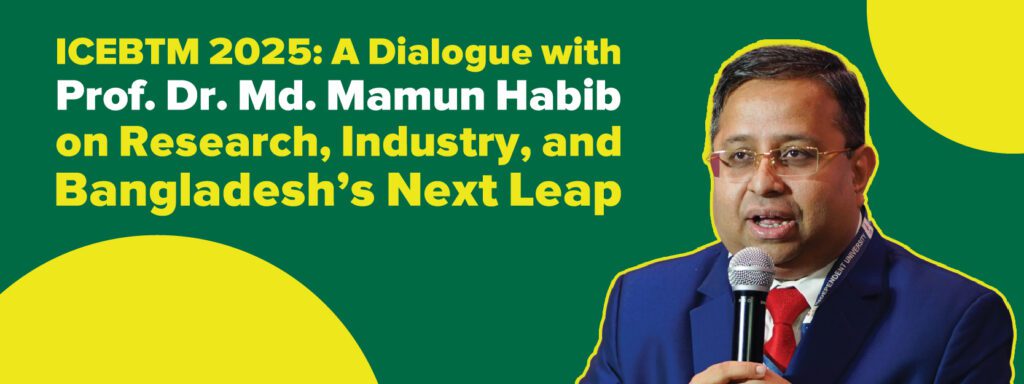
In the rapidly evolving landscape of global business, economics, and technology, the importance of research-driven insights and collaborative knowledge platforms has never been greater. As Bangladesh enters a new era of innovation and strategic transformation, the International Conference on Economics, Business and Technology Management (ICEBTM 2025) serves as a pivotal forum uniting academics, industry leaders, policymakers, and global thinkers.
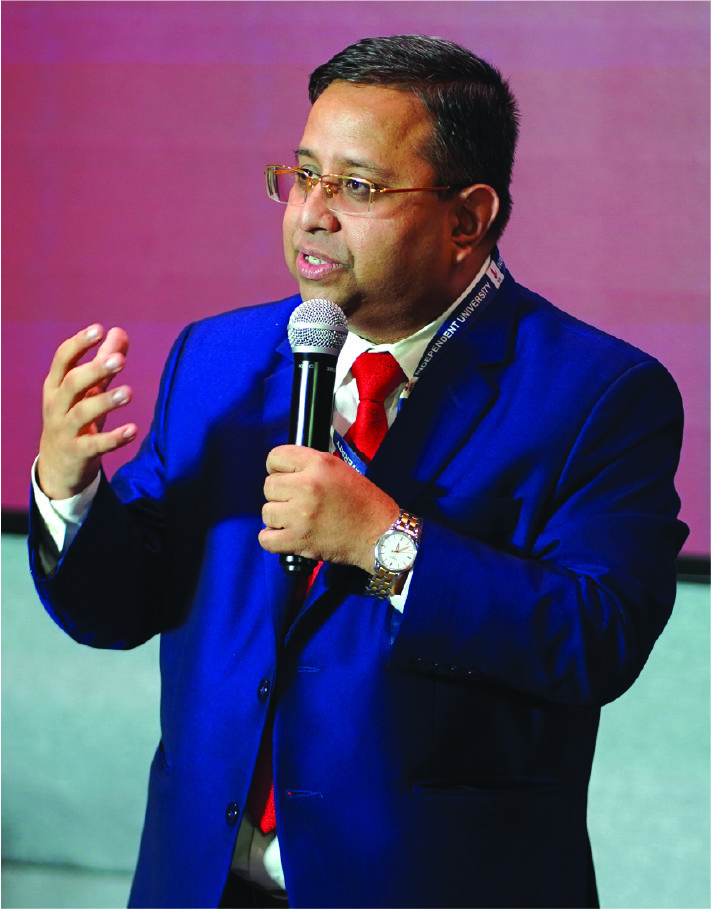
To understand the vision behind this year’s conference and its role in shaping the future of research and industry synergy, Bangladesh Brand Forum spoke with Prof. Dr. Md. Mamun Habib, General Chair of ICEBTM 2025. A distinguished thought leader and advocate for academia–industry collaboration, Prof. Habib continues to champion platforms that cultivate innovation, enhance intellectual capital, and position Bangladesh prominently on the global academic map.
In this conversation, we explore what makes ICEBTM 2025 significant, the themes driving its agenda, and how it aims to inspire the next generation of researchers, entrepreneurs, and leaders.
BBF: ICEBTM is returning with its 2025 edition. What are the core objectives and vision behind this year’s conference?
Prof. Dr. Md. Mamun Habib: The theme of this conference is “Sustainability Focused Industry Trends in Global Research”. We would like to know the industry’s current trends based on global perspectives.
BBF: The world economy is undergoing shifts driven by technology, geopolitics, and sustainability. How does ICEBTM 2025 aim to address these global transformations?
Prof. Habib: In ICEBTM 2025, we have kept a few sessions on IR 4.0, Sustainability, Supply Chain Management, Environmental and Climate issues, where various authors will discuss supply chain disruption, ESG (Environment, Social and Governance), Geopolitics impact on economic, etc.
BBF: ICEBTM 2025 is bringing together an impressive lineup of global and local speakers. Could you tell us about the scale of international participation this year and how such diversity strengthens the conference’s impact?
Prof. Habib: This year, out of five keynote speakers, three are international—representing the UK and Malaysia—while two are local and Non-Resident Bangladeshis (from the USA). Among eight industry speakers, two are international (from the USA and the UK) and six are local. We also have three invited speakers—one from Canada and two NRBs from the USA and UAE. Through such interaction among foreign, local, and NRB participants, ICEBTM 2025 strengthens Bangladesh’s visibility and presence in the global knowledge economy.
BBF: What major economic or policy conversations do you expect to take center stage at ICEBTM 2025?
Prof. Habib: We expect some truly timely discussions this year. Our keynote and industry speakers will explore how AI-driven technologies are reshaping economies, what challenges Bangladesh faces as it approaches LDC graduation, and how ESG commitments are influencing business strategy. We’ll also see conversations around blockchain, digital finance, and other transformative forces that are redefining today’s economic landscape.
BBF: How can the academic research presented at ICEBTM 2025 be translated into real-world policymaking and industry practice?
Prof. Habib: Well, that’s exactly where the true impact of this conference lies. With over 210 research papers being presented in front of both academicians and industry professionals, there’s a rich opportunity for cross-pollination of ideas. You see, when scholars and practitioners engage directly, theories can quickly evolve into actionable strategies. This interaction helps transform academic insights into policies, business models, and solutions that the industry can actually implement.
BBF: One of your long-standing advocacies is academia–industry collaboration. What new models of collaboration will ICEBTM explore this year?
Prof. Habib: You see, our goal this year is to make that collaboration more structured and meaningful. We’ve planned eight industry talks and two special academia–industry discussions that will bring together corporate leaders—about 20 from C-suite roles—and senior academics, including vice-chancellors and professors. These sessions are not just about dialogue; they’re about co-creation. Together, we aim to explore new models for curriculum development, industry-driven research, and skill mapping that directly link academic insight with market realities.
BBF: With rapid progress in AI, automation, and digitalization, what kind of future workforce skills will the conference focus on?
Prof. Habib: Well, the goal is to build a workforce that’s smart, agile, and tech-ready. At ICEBTM 2025, we’ll talk about Industry Revolution 4.0, digital supply chains, and entrepreneurship—areas shaping tomorrow’s jobs. The idea is simple: combine human creativity with technological strength to create people who can adapt, innovate, and lead in a fast-changing world.
BBF: What research themes or breakthrough ideas are you most looking forward to at this year’s conference?
Prof. Habib: This edition is going to be quite exciting. Out of nearly 290 submissions, 212 papers made it through a rigorous peer-review process. Many of them dive into cutting-edge areas—AI in supply chains, fintech innovation, blockchain, green financing, big-data-driven marketing, and global supply chain disruption. These topics really reflect where the world is heading, and I believe they’ll make ICEBTM 2025 a standout edition for both researchers and practitioners.
BBF: How is ICEBTM helping to nurture a culture of innovation among young scholars and researchers?
Prof. Habib: This year, we have around 50 papers coming from young scholars, many of them undergraduate students. It’s inspiring to see their ideas take shape and be presented before seasoned academicians and industry professionals. When students get that kind of exposure, it builds confidence and curiosity. Step by step, this is how a true research culture starts to grow within our academic community.
BBF: As Bangladesh aspires to become a knowledge-based, innovation-driven economy, what role does research-driven leadership play in nation-building?
Prof. Habib: Research-driven leadership is crucial in helping a country navigate change with clarity and purpose. It bridges the gap between academia and industry, allowing ideas to move beyond classrooms and contribute to solving real business and policy challenges. When academicians and practitioners work together, it strengthens the foundation for informed decision-making and sustainable progress.
At ICEBTM, we’re promoting exactly that. Through industry-driven research, curriculum development, and skills mapping, we’re preparing a new generation of leaders who can think critically, innovate confidently, and turn knowledge into enterprise. This approach not only fosters entrepreneurship but also enhances employability—key ingredients for building a resilient, knowledge-based economy.
BBF: Are there any special sessions or workshops that participants should keep an eye on this year?
Prof. Habib: Yes, there are a couple of sessions I’m especially excited about. One is “Meet the Journal Editors,” which gives researchers a chance to interact directly with editors from reputed journals and understand what makes a paper publishable. The other is the “Ph.D. Colloquium and Paper Producing Workshop,” designed for Ph.D. scholars and young researchers—both undergraduate and graduate students. These sessions will help them dive deeper into research methodology, sharpen their writing skills, and connect with mentors who can guide their academic journey.
BBF: Sustainable business practices are no longer optional. How is ICEBTM integrating sustainability into its discussions and academic agenda?
Prof. Habib: Sustainability has become a central part of the conversation this year. Many of our papers focus on financial health and modern supply chains through a sustainability lens—along with studies on HR practices, the sustainability gap in industries, and economic resilience within the RMG sector. These discussions bring sustainability out of theory and place it right where it belongs—at the core of business strategy and decision-making.
BBF: What message would you like to share with the young researchers, business leaders, and students attending ICEBTM 2025?
Prof. Habib: An international conference like ICEBTM is more than a platform—it’s a meeting point for knowledge and opportunity. For young researchers and business leaders, this is a space to connect, collaborate, and challenge themselves. My message would be simple: make the most of this experience. Use it to explore new ideas, meet co-authors and mentors, and start conversations that could shape your future work.
BBF: In one sentence, what do you hope ICEBTM 2025 will leave as its legacy?
Prof. Habib: I hope participants leave with fresh perspectives, sharper insights, and the inspiration to turn their ideas into real-world solutions.
BIO: Prof. Dr. Md. Mamun Habib is a Professor and Head of the Department of Management at the School of Business & Entrepreneurship (SBE), Independent University, Bangladesh (IUB). With over two decades of experience in teaching, research, and consultancy, he has published more than 250 papers, including over 80 indexed in Scopus and Web of Science.
Dr. Habib also serves as a Visiting Scientist at the University of Texas at Arlington and as a Visiting Professor at several international universities across Malaysia, China, the Philippines, and Indonesia. A Senior Member of IEEE and Fellow of CILT (UK), he has delivered keynote speeches at 80+ global conferences and is actively involved in AACSB, ACBSP, and QS accreditation and ranking initiatives. His key research interests include supply chain management, operations, and educational management.