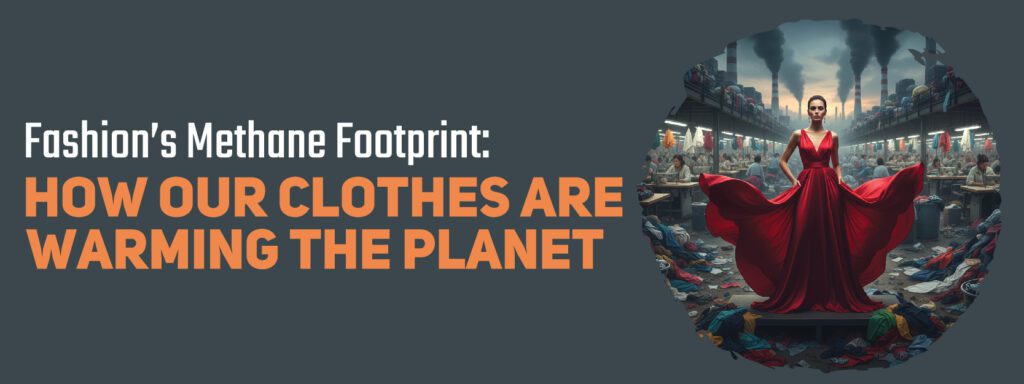
Do we know the actual cost of the comfy clothes we wear on regular basis? We may think that it only takes fabrics, machineries, and labor to fulfill our basic needs of clothing. However, we could only wish that these were the only resources we were using. Another major resource we heavily sacrifice to get desired clothes in the name of fashion is our own WORLD. According to the calculations of Vogue Business, the fashion industry’s current estimated methane footprint is 8.3 million tons per year. The calculations required heavy research and had to overcome various significant gap. We already know that industries are one of the crucial factors of pollution. Fashion industries do not only contribute to carbon footprint and water pollution but also excessively contribute to methane emissions. But what exactly is methane emission and how does it arise from fashion industries?
First, both carbon dioxide and methane are greenhouse gases; yet methane is 86 times more powerful than carbon dioxide which means that it traps more heat and causes global warming. To reciprocate to my own statement in the first para, this is how we are keeping our world on stake for fashion. Methane or CH4 emissions mainly come from animal agriculture through ruminant animals who save up chewed food in stomach and later digests the saved-up food by rechewing. Ruminant animals such as cows, sheep and goats produce methane as a byproduct of their digestive process. Hence, only 4% of animal-derived materials like leather, cashmere and wool are responsible for 75% of fashion industry’s methane footprint shown by Green Queen’s data. This enteric fermentation of animal-based textile adds the hidden methane cost to our clothes just like man-made polyester. By looking at the numbers, it can be said that it is not only impacting the environment but it also is an inefficient approach to produce cloths.
Moreover, man-made polyester has negative environmental effects as materials such as polyester, nylon and acrylic are made from natural resources like petroleum and natural gas. During extraction and production of these materials, methane leaks from wells, pipelines, and refineries directly into the atmosphere. This extraction process is an energy intensive production as the manufacturing process of polyester is powered by burning fossil fuels, it releases heavy greenhouse gases like carbon dioxide along with some methane. Furthermore, polyester garments are disposed in landfills and are not naturally biodegradable material. The break down process takes up to 200 years and meanwhile this material very slowly breaks down in the oxygen-free conditions called anaerobic digestion. This digestion releases methane. Industries globally dispose 92 million tons of textile waste to landfills each year which is creating methane time bombs. Let it be luxury clothes from wool, leather, or fast fashion culture that promotes wastage; they are deliberately contributing to environmental pollution. This dependency on methane emissions may sound unalterable to us because both animal-derived textiles and man-made textiles somewhat produce a greenhouse gas which is 86 times more potent than carbon dioxide.
Despite sounding unalterable, we must come forward to save our world and go for alternatives as both responsible businesses and consumers. The impact of methane is detrimental to our climate because it is a key component in the formation of ground-level ozone. This is causing air pollution and damaging the entire ecosystem. Thus, respiratory illnesses in humans are also rising. According to Environmental and Energy Study Institute (EESI), U.S plans to cut methane emissions by 30% below 2020 data by 2030 as the impact of methane is critical and the world must address it alongside carbon dioxide to meet short-term climate goals and avoid unbearable temperature rises. This one sentence states the significance of reducing methane footprint. It means newly industrialized countries and developing countries with industrial growth like India, Bangladesh should open their eyes and call to act against its raise.
The goal is to create a better economy that eliminates waste, pollution, and global warming for a safe environment. We often talk about sustainability as a forever solution to environmental degradation. Well, sustainability requires efforts of consumer base as well. A well- aware consumer base should acknowledge this issue and believe in “slow fashion” instead of fast fashion. The era of rapidly changing fashion trends and show-off continuously promotes wastage, misutilization of money, pollution, global warming, and economic instability. Although Gen-Z and Millennials have been learning to bring changes in the world, yet it is not enough heard of mainly because the boundary lies with cost and price. Nevertheless, the consumers’ basic principle is buying at a lower price, that is why many businesses have been approaching new strategies to mitigate this issue as socially responsible entities.
Brands must reduce their reliance on virgin wool and leather; especially cashmere in the name of exotic clothes. Bio-based alternatives are being more focused on to reduce carbon and methane footprint. Experts and developers worldwide have been talking about algae, mushrooms, seaweed which are often biodegradable and are grown, not extracted, can be used to develop fabrics. Even though, cancelling polyester is impossible considering the world demand needs to be fulfilled. It however can be recycled using PET bottles that avoids methane-emitting extraction of new petroleum. Using leftover fabric rolls from other manufacturers that would otherwise be sent to landfills to decompose would help being sustainable. Additionally, methane footprint many times is not even reported correctly as industries fail to account for the actual emission during the extraction process.
Across sectors we are already seeing firms attempt to respond by adopting new business models that allow people to be socially responsible and aware. Famous English fashion brand Stella McCartney is pushing bio-based materials like cactus-based leather which uses minimal water and does not rely on the methane-intensive cattle industry for environmental progress. We also see companies focusing on the end of a product’s life like For Days, which runs a zero-waste system and offers a “Take Back Bag” to ensure old clothing is recycled instead of dumped in a landfill. However, shifting an entire global industry is not easy and it needs a push from governments. In Europe, the Netherlands is making policies for a circular economy in Amsterdam. This is a collaboration between government, startups, and research institutes to close the loop on textile waste. France too has recently set up legislation that will impose fines on fast fashion items, with the goal of making them less attractive to consumers and less profitable for companies like Shein.
Moreover, the narrative must tactically diversify to sound positive to consumers. Go from “Don’t buy excess” to “Buy Better, Choose Better & Make it Last.” Trends like thrifting are now encouraged more by environmentally aware internet influencers, celebrities, and popular personas. Education campaigns are necessities for teaching the next generation and enforcing a positive mentality on customers. According to BGMEA, Bangladesh, the world’s one of the major apparel exporters is leading the change in sustainable industrialization by boasting the highest number of LEED-certified green garment factories globally. This movement toward “green factories” demonstrates how producers are responding to both global buyer demands and national commitments to climate action. This small, yet a huge change can make us the Superman of the world and save ourselves from the dangerous future of living in a hell-like heated world.
Author: Sarwa Tahseen Mallik