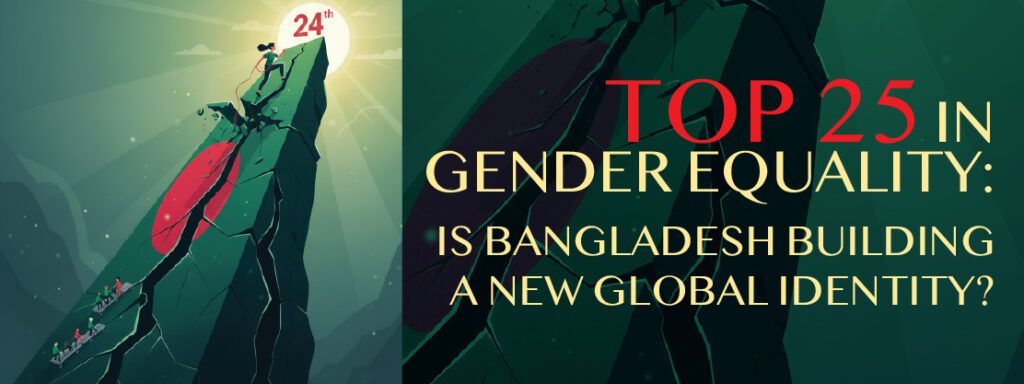
In June 2024, Bangladesh plummeted 40 places to 99th on the World Economic Forum’s Global Gender Gap Index—the steepest fall of any nation that year. Twelve months later, the 2025 report recorded a 75-place surge to 24th—the largest single-year improvement of any country tracked. The parity score jumped 8.6 percentage points to 77.5%. The volatility raises a question the numbers cannot answer: Does this represent a structural transformation or a statistical recalibration?
The answer matters beyond rankings. Bangladesh’s trajectory offers a test case for whether deliberate policy interventions—reserved parliamentary seats, education stipends, microfinance targeting—can bend gender outcomes in resource-constrained environments. The evidence is mixed: genuine gains in political representation and educational access coexist with persistent gaps in economic opportunity, health outcomes, and social norms that constrain women’s agency across the life course. The experiment continues.
The Numbers Behind the Surge
The WEF index tracks four dimensions: Economic Participation, Educational Attainment, Health and Survival, and Political Empowerment. Bangladesh’s leap was driven by political representation. Women in ministerial positions surged from 9.1% to 22.2% between 2024 and 2025. Bangladesh now ranks 3rd globally and 1st in South Asia on political empowerment—a subindex where it had historically lagged behind regional peers.
Educational attainment holds at 94% parity. Economic participation rebounded after data revisions corrected 2017 baseline figures. Globally, with 68.8% of the gender gap closed, the world needs 123 years at current rates to achieve full parity. Bangladesh appears to be accelerating past that trajectory—but the economic participation subindex reveals persistent weaknesses. Women’s labour force participation, while rising, remains below potential. Income inequality between genders widened in 2024 to levels not seen since 2018.
Educational Transformation: From Disparity to Dominance
Secondary school enrollment for girls jumped from 39% in 1998 to 67% by 2017—a transformation driven by the Female Secondary School Assistance Project (FSSAP), which pioneered stipends and tuition waivers in the early 1990s. The programme became a model for conditional cash transfers worldwide. A World Bank-supported expansion reached 2.3 million students, 55% of them girls. Gross female secondary enrollment reached 76.6% by 2023, down slightly from the 2021 peak of 79.7%. The decline signals potential fragility in recent gains.
National literacy climbed from 51.77% in 2011 to 74.66% by 2022—a 23-point gain in eleven years, among the fastest literacy improvements in South Asia. Free education through class 10, textbook distribution from grades 5-12, and stipend programmes narrowed gender gaps to near-parity at primary levels. But completion rates invert at upper secondary: boys complete at 50% higher rates. Early marriage, domestic responsibilities, and mobility restrictions constrain girls’ trajectories as they age. The pattern reveals a structural limitation: policies that successfully bring girls into schools have not addressed the social forces that push them out.
Higher education tells a similar story. Women’s enrollment in tertiary institutions has grown substantially, but remains concentrated in humanities and social sciences. Technical fields—engineering, computer science, advanced manufacturing—show persistent gender imbalances that limit women’s access to the highest-paying sectors of an increasingly technology-driven economy. The skills mismatch between female graduates and labour market demands contributes to underemployment even among highly educated women.
The Economic Engine: Garments, Microfinance, and Structural Limits
The ready-made garment sector generates 84% of export earnings and $47 billion annually. It employs 4 million workers, 58-80% women, depending on measurement methodology. Female labour force participation rose from 15.8% in 1996 to 36.3% by 2017, exceeding the South Asian average of 35%. Garment employment delays marriage and increases educational attainment among young women.
The empowerment narrative faces scrutiny. Minimum wage: 12,500 taka ($113) monthly—far below the $460 living wage. 97.1% of female workers occupy production roles versus 80.8% of men; only 5% hold senior positions. The wage gap averages 10-20%, with women earning 69% of male salaries. Over 60% of the workforce faces unemployment risk by 2041 as automation transforms manufacturing. The industry that lifted millions of women into the formal workforce may soon displace them—a transition that will test whether Bangladesh’s gender gains survive economic restructuring.
Grameen Bank has disbursed $41 billion to 10.8 million borrowers, 97% women. Operating through 2,568 branches across 94% of villages, Grameen achieves 95.5% repayment. Microfinance participation reduced moderate poverty by 5% and extreme poverty by 10%. Women borrowers report 43-72% higher family income than non-participants. The Nobel Prize-winning model has been replicated across developing countries, establishing Bangladesh as a laboratory for poverty alleviation through women’s economic inclusion. The success inspired similar programmes across South Asia, Africa, and Latin America.
Yet microfinance faces its own scrutiny. Critics argue that small loans often fund consumption rather than productive enterprise, creating debt cycles rather than sustained income growth. Average loan sizes remain modest, limiting the scale of businesses women can establish. The model succeeds at survival-level economics but rarely propels borrowers into middle-class prosperity. Women’s control over loan proceeds also varies—in some households, male family members capture the capital while women bear repayment responsibility.
Health Indicators: Progress and Persistent Gaps
Maternal mortality declined 79%—from 523 to 115 deaths per 100,000 live births—between 2000 and 2023, surpassing the global average reduction of 40%. Annual decline rates exceeded 7%. Under-five mortality fell from 239 per 1,000 in 1970 to 65 per 1,000 by 2007; infant vaccination coverage reached 75%. The FY2023-24 gender budget: 175,350.5 crore taka—58.4% for empowerment, 33.5% for public services, 8.1% for labour participation.
Challenges persist. 51% of women marry before age 18—South Asia’s highest rate post-pandemic, up from 33% before COVID-19. Out-of-pocket health spending: 74% of total expenditure, pushing 5 million into poverty annually. Facility delivery rates exceed 50% in Dhaka and Khulna but remain below 40% in Barishal, Mymensingh, and Sylhet. Geographic disparities in health access mirror broader development patterns—urban centers advance while rural areas lag, creating uneven progress across the country.
The pandemic’s impact on child marriage illustrates how quickly gains can reverse. Economic stress, school closures, and reduced enforcement created conditions for families to marry daughters earlier. The spike suggests that progress depends on sustained prosperity and institutional vigilance—neither guaranteed in a developing economy vulnerable to external shocks. Climate-related displacement may create similar pressures in coming decades as coastal and flood-prone communities face repeated disruption.
The Identity Question
Bangladesh’s 2025 ranking reflects both institutional change and methodological recalibration. The 2024 collapse resulted partly from updated baseline data—corrections to 2017 figures. The 2025 rebound incorporates similar revisions. Political gains, however, are tangible: cabinet appointments and legislative representation cannot be dismissed as statistical artifacts. The question is whether political presence translates into policy influence—whether women in government shape decisions or simply occupy seats.
The 24th-place finish validates deliberate intervention—stipends, reserved seats, and microfinance targeting can bend gender trajectories in resource-constrained environments. It also exposes the fragility of rankings that swing 75 places within two years. Building a new global identity demands structural depth, ensuring the next measurement captures progress rather than regression. Bangladesh has assembled the components: educational infrastructure, political quotas, economic pathways, and health systems that have delivered measurable gains. Whether they cohere into sustainable transformation—whether girls educated today become leaders tomorrow, whether women workers advance into management, whether health improvements survive economic shocks—remains the open question. The data suggests a possibility. History will determine the outcome.
Data Sources
WEF Gender Gap Reports: 2025 Report, 2024 Report
Parliamentary Data: Bangladesh Parliament, Dhaka Tribune
Education Statistics: World Bank, CEIC Data, Room to Read
Garment Industry: Economics Observatory, TVET Asia, FSG/H&M Foundation
Microfinance: Grameen Bank Official, Borgen Project
Health Data: UNICEF Bangladesh, UNFPA Bangladesh
Author: Hosen Ankur Andaleeb