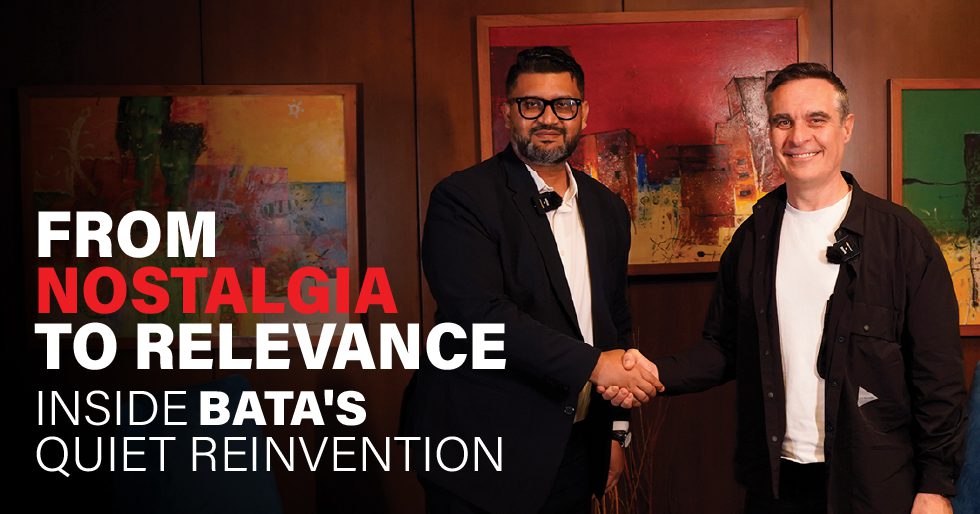
Bata has been making shoes in Bangladesh since 1962. In a country of more than 180 million people, that is not merely a business fact — it is a cultural one. Generations of Bangladeshis have grown up with Bata as their default and reliable shoemaker. The brand carries an emotional equity that most global companies spend decades trying to build and never quite achieve.
Panos Mytaros took over as Global CEO of Bata seven months ago. His arrival marks a deliberate pivot: not away from the heritage, but through it. During a recent and first visit to Bangladesh, he sat down with Sajid Mahbub, Group CEO and Executive Editor of Bangladesh Brand Forum, for a conversation about what it means to lead one of the world’s oldest and most culturally embedded footwear brands into a future shaped by Gen Z, fast-changing consumer preferences, and a marketplace that no longer rewards legacy for its own sake.
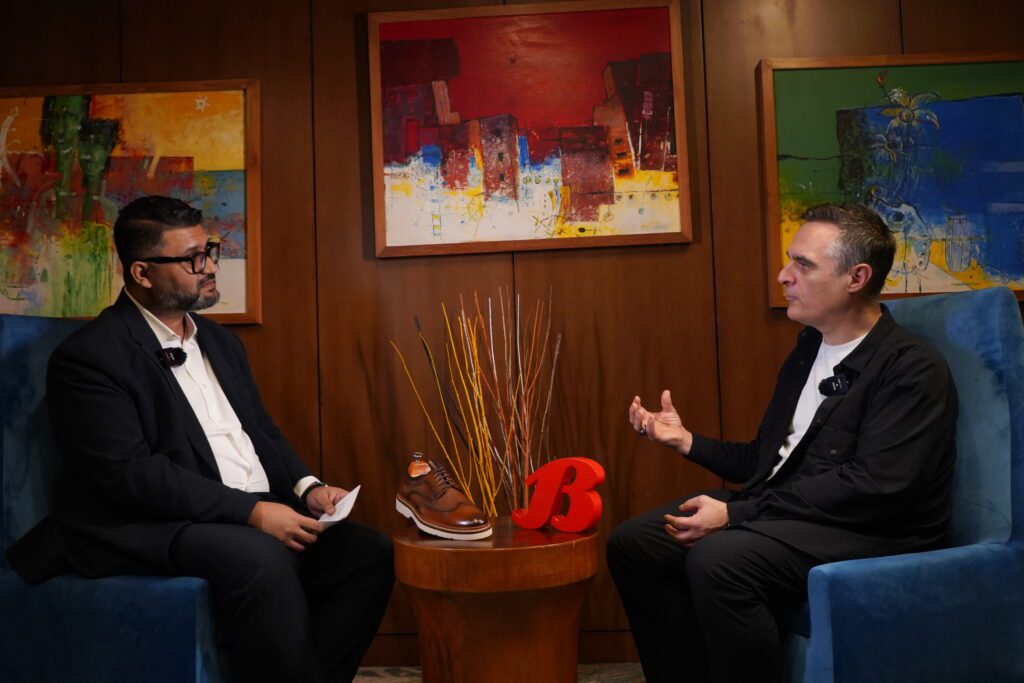
BBF: Since its inception in 1962, Bata has been shaping the footwear industry in Bangladesh. To those of us who see Bata, who believe in the philosophy and innovation of Bata — Bata is not a footwear brand. Bata is, essentially, the nation’s shoemaker. What do you make of that?
Panos Mytaros: This is my first time in Bangladesh, and I can already see very clearly what Bata means to Bangladesh and to the Bangladeshi shoe industry. Bata is not a brand that is simply here to sell shoes. It is a part of the culture.
BBF: You can imagine what it means — a country of 180 million people, and a brand creating solutions for all of them. That is why, in close circles, we call Bata the nation’s shoemaker. This is your first visit to Bangladesh. What dynamics have you observed? What positivity are you taking away from it?
Panos Mytaros: My visit has been very positive. There is a strong traditional environment, with many traditions around celebrations. Celebrations mean a great deal here — to families, to communities. I also see very specific consumer needs that are not exactly the same as in other markets. I notice an extreme loyalty to certain brands, and definitely to Bata. That level of loyalty is something to take seriously. And finally, I see that people here are ready to pay an affordable price for good footwear. It is not simply about the cheapest option. They want quality and affordability at the same time.
BBF: For Bata, there are two key aspects at play right now. The first is emotional equity — a deep, inherited connection with consumers. The second is a rapid transformation driven by technology and changing Gen Z preferences. How is Bata planning to balance those two forces?
Panos Mytaros: Your question is extremely relevant to the Bata of today. Bata has been in Bangladesh since 1962, and as a brand, since 1894 — nearly 132 years. You have to balance the past with the future. The emotional equity is something we do not need to prove. We already have it, here in Bangladesh and in many other markets. But we are living in 2026, and the world changes. Gen Z is here. Gen Alpha is coming. These generations have grown up differently. You cannot simply live in the nostalgia of the past.
The way I see it, our past gives us 50% credibility. But the next 50% — we have to earn by becoming more relevant and more modern today. The combination of the two is something unique to Bata, because many other brands do not have this emotional equity. They try to build something from scratch. We have it. We have to build on it — but only to 50%. The other 50% has to be about being genuinely relevant now.
BBF: Seven months into your role as the Global CEO of Bata, when a new leader steps in, there is usually a diagnosis phase — what to keep, what to stop, what to build from scratch. What has that looked like for you, and where do you see the biggest opportunities?
Panos Mytaros: Bata is big — bigger than I expected. It is a serious responsibility and a very significant brand. My angle, as a CEO, is not primarily economics or finance. For me, those are the result of doing many other things right. My starting point is the consumer. Who do we want to sell shoes to today, tomorrow, and the day after tomorrow — not who did we sell to yesterday?
We need to satisfy the consumers we have. But we also need to bring in new ones — Gen Z and beyond. To do that, we need to invest heavily in brand and product. The brand has to mean something clear. We have to be explicit about what Bata offers. We cannot simply say we have been here since 1962 and expect that to be enough.
At the same time, we need to stop confusing the consumer. Too many offers, too many directions — that creates noise. I see Bata evolving in two clear directions: the world of leather and non-leather shoes, and the world of sneakers. A very clear offer in each. A company that has operated for a long time can begin to talk inward rather than outward — it becomes complicated. The fix is simple. Not easy things. Simple things. And to achieve that, we need to invest in our people and bring in the capabilities that will take Bata into 2030 and beyond.
BBF: Bata is a legacy brand operating across many different markets. How do you maintain authenticity in each market, honour local cultures, serve local consumers, and still keep that simplicity intact?
Panos Mytaros: I have traveled to many Bata markets around the world and observed both the similarities and the differences. What has to remain the same everywhere is the Bata ethos — what Bata stands for. And that is something simple: unreasonably good shoes, made available to everyone, everywhere. Those two words — unreasonably and good — carry a kind of productive contradiction. Good means quality. Unreasonably means at a price that surprises you. We want to democratise quality. We want to be affordable regardless of income level — low, medium, or high. That is the same in every market.
The second part is respecting local demand. That is a genuine differentiator from most global shoe brands. Bata has been in Bangladesh since 1962. We understand what celebrations mean here. We understand that buying behaviour in Bangladesh connects deeply to moments like Eid and other occasions. We need to build products for the people of each country — whether that is Bangladesh, Indonesia, Peru, or Kenya. Global ethos, local heart.
BBF: We have seen Bata expanding into premium segments recently. When consumers hear the word premium, they typically associate it with higher prices. What does “premium” mean for Bata — is it about price, or is it about delivering more value?
Panos Mytaros: The Bata mantra is to make unreasonably good shoes. For a shoe to be unreasonably good, it has to feel good and have quality. Premium is usually connected to price — and economics says that higher quality means higher cost. But for Bata, we want to be affordable. That is precisely the unreasonable in Bata. We defy that economic logic. We need a ladder of prices, yes — but we want our shoes to feel premium, feel high quality, feel unreasonably good, while remaining affordable for everyone. That is the challenge, and that is what makes Bata distinctive.
BBF: Looking toward 2030 and the near future — what will be Bata’s competitive edge? Where do you see the brand?
Panos Mytaros: Bata’s competitive edge is that it is a truly global brand that genuinely understands the local. Most global brands maintain a distance from local demand. We understand local celebrations, local collections, and local connections. We are part of the society in the markets we operate in. That is rare for a brand at our scale.
The second edge is what we make. Unreasonably good shoes at an affordable price. That combination will keep Bata very distinct from most competitors for a long time.
BBF: So if I may conclude by saying — by 2030, Bata is going to be a global shoe manufacturer, but for individual nations?
Panos Mytaros: Yes. Exactly that. A global brand — with many local hearts. That is how I see it.
Interview Transcribed by,
Nadim Ahmed Joy, Executive Content & Publication, Bangladesh Brand Forum