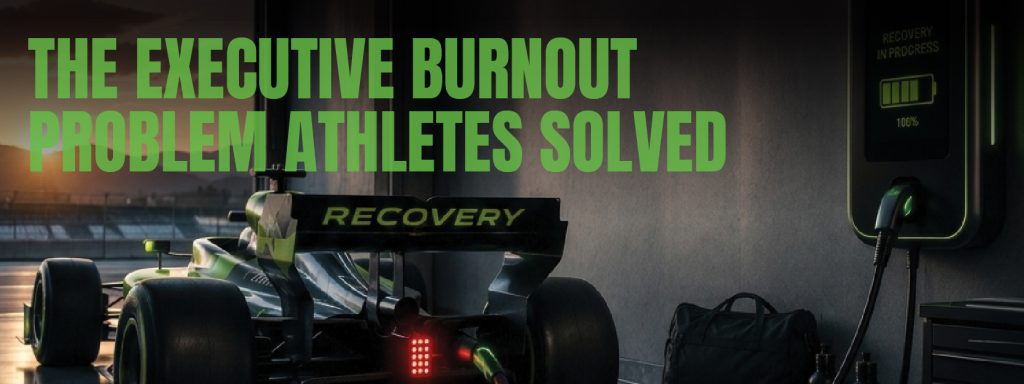
The modern executive has never been more optimised. There are sleep trackers on the wrist, magnesium by the bed, an ice bath in the garage, and a standing subscription to a wellness economy now worth 6.8 trillion dollars. And yet burnout keeps climbing. The World Health Organization classes it as an occupational phenomenon, and surveys routinely find around 80 percent of workers stressed by their jobs, most of them saying it dents their performance. All that optimisation, and people are more depleted than ever.
Elite athletes, who actually perform for a living, look at this and see an obvious mistake. They were taught something most executives never were: recovery is not the reward for the work. It is part of the work.
Where growth actually happens
The science is settled, and a little counterintuitive. The physical adaptation that makes an athlete faster or stronger does not happen during training. It happens in the recovery window afterwards, when the body repairs and rebuilds in response to the stress it just absorbed. Coaches put it in four words: stress plus rest equals growth. Remove the rest, and the same stress that was meant to build you starts to break you down instead. The discipline that manages this balance, periodisation, is one of the most robustly evidenced ideas in all of sports science.
The real enemy of high performance is not stress.
— Jim Loehr & Tony Schwartz, “The Corporate Athlete,” Harvard Business Review
The enemy, in their account, is the absence of disciplined, intermittent recovery. Chronic stress with no recovery window does not forge a hardened high performer; it produces the opposite. And here is the detail every executive should sit with. The clinical symptoms of athletic overtraining are persistent fatigue, disrupted sleep, impaired thinking, low mood, and a weakened immune system. Read that list again. It is, almost exactly, the symptom list for executive burnout. The corporate world has been overtraining for years without ever naming it.
The instrument panel nobody installed
The difference between the two worlds is not effort. Both push brutally hard. The difference is that sport has built an entire system for knowing when to push and when to ease off, and business has not. An athlete’s load is monitored constantly, through heart-rate variability, sleep data, and honest fatigue scores, and when the signals say recover, the programme changes. The executive has no such instrument panel. The only feedback loop is the deadline, and the only response to fatigue is more caffeine and a later night. Studies of athletes find that even one night of poor sleep can slow reaction time by 5 to 10 percent; the boardroom version is a day of decisions made on a measurably slower brain that has no idea it has slowed.
| THE ATHLETE | THE EXECUTIVE |
| Treats recovery as part of the plan | Treats recovery as a sign of weakness |
| Schedules deload weeks and an offseason | “I’ll rest when it’s done” |
| Reads HRV, sleep, and fatigue scores | Reads the deadline, and nothing else |
| Answers fatigue by adjusting the programme | Answers fatigue with caffeine and a later night |
| Knows growth happens in the recovery window | Assumes growth happens during the grind |
| Builds a career of sustained peaks | Builds toward burnout |
| $6.8tn the size of the global wellness economy, even as workplace burnout keeps rising. Executives are buying optimisation and skipping recovery. (Global Wellness Institute) |
The honest objection is that the analogy only stretches so far. An athlete trains toward a handful of competition peaks a year and earns a real offseason, while the executive’s season never ends, the deadlines never fully stop, and no scheduled month off arrives to absorb the year’s accumulated load. That is true, and it is exactly why the lesson matters more for executives, not less. If you cannot take the offseason, you have to build the recovery into the rhythm of the work itself.
That does not mean another gadget. It means treating recovery as a scheduled, non-negotiable part of performance rather than a weakness to apologise for. It means guarding sleep the way an athlete guards it, since it is the highest-leverage recovery tool there is. It means genuine disengagement between bouts of hard focus, deliberately lighter stretches after heavy ones, and the basic literacy to tell being primed to push from needing to back off, a distinction athletes are trained to read and most executives have never learned.
The irony of the optimised executive is that the answer was never one more thing to add. It was permission to stop, on purpose, as a discipline. The athletes worked that out long ago. Performance is not built by the grind alone. It is built in the recovery the grind makes necessary, and the people who schedule that recovery are the ones still standing when the season ends.