Abstract
Artificial intelligence has moved well past its early role as a tool for automating routine tasks and running analytics. It is becoming something more fundamental: a component woven into how organizations create value, talk to consumers, build brands, and make decisions. That shift is why it makes sense to talk about AI-native marketing rather than AI-assisted marketing. The distinction matters. In AI-assisted marketing, artificial intelligence is added onto an existing process. In AI-native marketing, it is part of the process from the start.
This paper works through what that distinction means in practice, and what it implies for marketing strategy, consumer understanding, creativity, customer experience, personalization, organizational design, and brand management. Davenport et al. (2020) showed early on that AI could shape both marketing strategy and consumer behavior, and more recent work by Grewal et al. (2025) suggests that generative AI in particular is reshaping content creation, customer interaction, innovation, and service delivery. At the same time, as AI systems take on more autonomy, they raise real questions about trust, privacy, authenticity, bias, transparency, and accountability – questions this paper treats as central rather than incidental.
The paper proposes a five-part framework for thinking about AI-native marketing: strategy, creativity, customer experience, intelligence, and organization. Its central claim is that competitive advantage will increasingly come not from whether a company uses AI, but from how deeply it has redesigned its marketing systems around human-AI collaboration. The conclusion is a modest one: the future of marketing will not be purely human or purely artificial. It will involve a more intricate negotiation between human judgment, machine intelligence, organizational knowledge, and consumer agency than marketing has had to manage before.
1. Introduction
Marketing has always evolved alongside the technology of its time. Mass media gave rise to mass marketing. Digital channels made marketing measurable and addressable in ways it never had been before. Social media turned consumers from an audience into participants. Data analytics sharpened targeting and personalization to a degree earlier marketers could scarcely have imagined. Artificial intelligence looks like the next turn in that sequence – though it may turn out to be a different kind of turn altogether. Where earlier technologies mostly changed how marketers executed their work, AI has the potential to change how marketing itself gets conceived, organized, and delivered.
That is why the distinction between AI-assisted and AI-native marketing matters. AI-assisted marketing describes AI added onto an existing system: a marketer uses a tool to draft copy, analyze consumer data, or optimize a campaign, while the underlying marketing process stays much as it was. AI-native marketing is a different proposition. It assumes machine-generated intelligence is built into marketing from the ground up – into how insight is generated, how strategy is developed, how creative work gets made, how customers are engaged, how results are measured, and how organizations make decisions.
This is not a hypothetical distinction. Adoption is moving quickly. Stanford’s AI Index Report 2026 found that 88% of surveyed organizations used AI in 2025, up from 78% the year before, with marketing and sales functions within consumer goods and retail among the heaviest adopters.
The marketing research literature has already established that AI shapes both strategy and consumer behavior (Davenport et al., 2020). More recent work has pushed the conversation toward generative AI specifically – technology that can produce text, images, and video while also supporting customer interaction, product development, and innovation (Grewal et al., 2025). Cillo and Rubera (2025) make a similar argument, pointing to generative AI’s reach across both innovation and marketing processes.
The argument this paper makes is that these developments amount to more than the arrival of another marketing tool. They mark the emergence of a genuinely new paradigm, one in which intelligence itself becomes an organizational capability rather than a feature bolted onto existing ones.
2. From Digital Marketing to AI-Native Marketing
It helps to see marketing’s evolution as a series of paradigms, each organized around a different capability.
Mass marketing relied on standardized messages pushed through mass media, and its advantage was scale. Digital marketing introduced measurable, two-way interactions through new channels, and its advantage was accessibility. Data-driven marketing put customer information at the center of segmentation and targeting, and its advantage was precision. AI-assisted marketing automated pieces of that process for efficiency. AI-native marketing, the paradigm this paper is concerned with, treats intelligence itself as the dominant capability, and its advantage is adaptability.
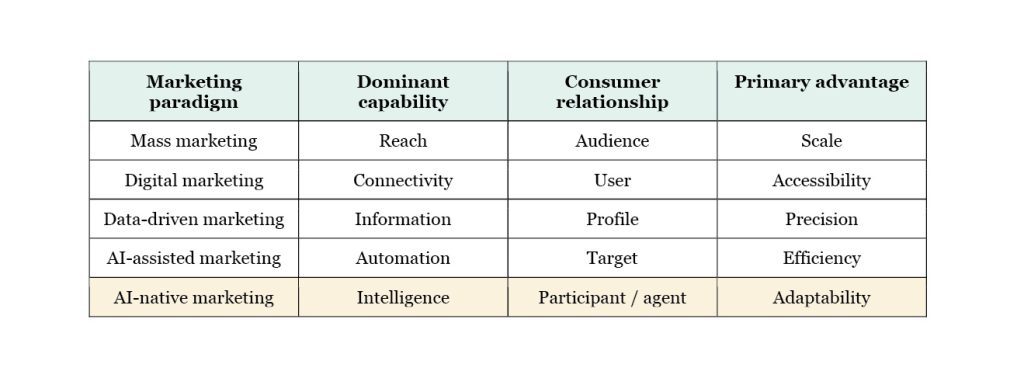 The real difference between AI-assisted and AI-native organizations shows up in the question each one tends to ask. An AI-assisted organization asks, “Where can we use AI?” An AI-native organization asks a harder question: “How should marketing be designed if intelligent systems are available throughout the value chain?” That is a shift from adopting a technology to redesigning the organization around it.
3. Literature Review
3.1 Artificial Intelligence and Marketing
Davenport et al. (2020) were among the first to argue that AI could meaningfully influence marketing strategy and customer behavior, rather than simply automate isolated tasks. Their framework distinguished between different levels of machine intelligence and different types of marketing tasks, and it suggested – correctly, it now seems – that AI’s reach would extend well beyond narrow automation.
Mustak et al. (2021) took a broader view, using a scientometric analysis to map the research that had already accumulated around AI and marketing. Their review surfaced recurring themes: customer sentiment, satisfaction, electronic word of mouth, market performance, brand management, loyalty, trust, customer relationships, services, and strategic marketing. Read alongside Davenport et al.’s work, this body of research supports treating AI as a broad marketing capability rather than a specialized tool confined to one function.
3.2 Generative AI and Marketing
Generative AI complicates the picture further, since it creates new content rather than simply analyzing what already exists. Grewal et al. (2025) argue it is likely to reshape how marketers talk to customers, produce content, conduct research, develop products, and deliver services. Cillo and Rubera (2025) reach a similar conclusion from a different angle, identifying generative AI’s implications across both innovation and marketing processes, while noting – fairly – that this remains a young research area with more open questions than settled answers.
The practical implication is worth sitting with. Marketing departments have traditionally been organized around distinct functions – research, strategy, creative, media, CRM, analytics – each with its own tools and processes. Generative AI threatens to blur those boundaries, replacing separate functions with more integrated, intelligence-driven systems.
3.3 AI and Consumer Trust
None of this happens without friction. AI-native marketing runs into a genuine tension between personalization and trust.
Frank et al. (2023) found that consumers who already trust a company are more willing to adopt its AI-powered services, but that relationship weakens as the AI becomes more autonomous. Lefkeli et al. (2024) found something related but distinct: across several experiments, consumers reported lower brand trust when they disclosed information to an AI system rather than a human, partly because they assumed their information would reach a wider audience and felt a stronger sense of being exploited.
Together, these findings are a useful corrective. AI-native marketing cannot be judged purely on efficiency, conversion rates, or productivity gains. Trust has to be treated as a core part of the AI-native brand experience, not a side concern.
3.4 AI and Brand Authenticity
Generative AI also unsettles some familiar assumptions about creativity and authenticity. Research comparing AI-disclosed and human-written brand communications has found that simply disclosing AI authorship does not necessarily damage perceived brand authenticity or brand attitude (“To Disclose or Not Disclose…,” 2023). Consumers, in other words, do not appear to reject AI-generated content on principle. Their reaction seems to depend more on the quality, relevance, and transparency of what they are shown, and the context in which they encounter it.
That reframes the strategic question. It is no longer really “Should brands use AI?” The more useful question is where AI should participate in the creation of brand meaning, and where it should not.
4. Defining AI-Native Marketing
For the purposes of this paper, AI-native marketing is defined as a marketing paradigm in which artificial intelligence is embedded into the fundamental architecture of marketing strategy, intelligence, creativity, customer experience, decision-making, and organizational operations, while human judgment continues to carry responsibility for purpose, meaning, and accountability.
Three things in that definition are worth pulling apart.
Embeddedness. AI here is integrated into the marketing system itself, not bolted on as an isolated tool that a team dips into occasionally.
Intelligence, in a fuller sense than automation. AI contributes not just to execution, but to prediction, interpretation, generation, experimentation, and decision support – activities that used to be considered exclusively human work.
Human accountability. AI-native marketing is not a euphemism for fully autonomous marketing. Human judgment remains essential for setting purpose, navigating ethics, understanding culture, setting strategic direction, and being accountable when things go wrong.
5. The Five Dimensions of AI-Native Marketing
The paper’s argument rests on five dimensions that, taken together, distinguish AI-native marketing from AI-assisted marketing: strategy, creativity, customer experience, intelligence, and organization. None of the five outranks the others – the framework works better as a set of equally weighted points than as a sequence, which is why Figure 1 arranges them as a star rather than a pipeline. The three that follow in detail below – strategy, creativity, and customer experience – are the ones most visible to a consumer; intelligence and organization, covered in Sections 7 and 11, are what make the other three possible in practice.
Figure 1. The five dimensions of AI-native marketing.
5.1 AI-Native Strategy
Traditional marketing strategy tends to move in a fairly linear sequence: research leads to insight, insight leads to strategy, strategy becomes a campaign, the campaign gets executed, and results get measured, usually well after the fact.
AI-native marketing can turn that sequence into something closer to a continuous loop: sensing the market, interpreting what is happening, predicting what comes next, creating a response, activating it, learning from the results, and adapting – again and again, without waiting for a formal review cycle. The strategic advantage here comes from shrinking the distance between a market signal and an organization’s response to it.
AI is genuinely good at this part. It can process enormous volumes of behavioral, transactional, social, and contextual data and surface patterns that would be difficult for a human team to spot on its own. But prediction is not the same thing as judgment. AI can indicate what is likely to happen; it takes a human to decide which of those likely outcomes is actually worth pursuing. This distinction echoes a broader argument in the economics of AI – that as machine prediction becomes cheaper and more abundant, the relative value of human judgment rises rather than falls (Agrawal et al., 2019).
5.2 AI-Native Creativity
The most visible changes are likely to show up in creative work. Generative AI can already produce dozens of creative directions, script variations, visual concepts, and content adaptations faster than any human team could manage alone. Grewal et al. (2025) single out content generation as one of the areas where generative AI will have the most obvious impact on marketing.
It would be a mistake, though, to treat AI-native creativity as a synonym for automated creativity. If anything, the more content an organization can generate, the more the competitive advantage shifts away from production capacity and toward creative direction – toward the judgment calls about what is actually worth making.
In a world where nearly every competitor can produce hundreds of pieces of content on demand, the scarce resource is not output. It is the ability to answer harder questions: what deserves to be made in the first place, what the brand actually stands for, which cultural tensions are worth engaging with, which ideas are genuinely distinctive rather than merely plausible, and, just as importantly, what should never be handed over to automation.
The creative organizations that come out ahead may end up spending less time producing assets and more time orchestrating a mix of intelligence, culture, technology, and human imagination.
5.3 AI-Native Customer Experience
The traditional customer journey assumes a fairly orderly sequence of stages: awareness, consideration, purchase, experience, loyalty. AI is making that journey considerably less orderly.
Consumers increasingly interact with conversational agents, recommendation engines, and AI assistants that shape discovery, comparison, and purchase decisions well before a brand’s own channels come into play. In many of these interactions, the consumer is not dealing with the brand’s marketing directly at all – they are dealing with an intelligent intermediary standing in for it.
That raises an uncomfortable but important question: if an AI agent is the one recommending a brand to a consumer, who is actually doing the marketing – the brand, or the agent? AI-native marketing has to account for this by optimizing not just for human attention, but for how a brand gets discovered and recommended by machines on a consumer’s behalf.
6. From Personalization to Individualization
Digital marketing gave us personalization. AI-native marketing points toward something more granular: dynamic individualization.
Traditional personalization tends to sort consumers into predefined segments – “young urban professionals interested in technology,” for instance. AI-native systems can work with far more granular signals, potentially thousands of behavioral and contextual cues, and adapt content, offers, and experiences on the fly, moving the unit of analysis from the segment down to the person, then the context, then the specific moment.
This creates a genuine ethical tension, not just a technical challenge. The more precisely a brand understands an individual, the more valuable the resulting experience can be, but also the more room there is for consumers to feel surveilled, manipulated, or exposed. AI-native marketing has to hold relevance, convenience, privacy, and trust in balance at the same time. A system that maximizes relevance at the expense of trust may win in the short term and lose the relationship altogether.
7. The AI-Native Organization
None of this can be achieved by simply purchasing AI software. It requires the organization itself to change.
Traditional marketing departments are usually structured around specialized functions – brand, creative, media, digital, CRM, research, analytics – each with its own budget and reporting line. AI-native organizations tend to organize instead around intelligent workflows that cut across those old boundaries: insight intelligence, creative intelligence, customer intelligence, and growth intelligence.
That changes what a marketer actually does day to day. The marketer of the past was primarily a producer and coordinator, moving briefs through a production pipeline. The digital marketer became a data-enabled optimizer, tuning campaigns against dashboards. The AI-native marketer is closer to an orchestrator, managing the interplay between human and machine intelligence rather than simply directing either one.
That role calls for a different mix of skills: AI literacy, prompt and interaction design, data interpretation, strategic judgment, creative direction, a willingness to experiment, an understanding of AI governance, ethical decision-making, and genuine facility working alongside machines rather than merely operating them.
8. The New Role of the CMO
AI is likely to reshape the Chief Marketing Officer role as much as any function it touches.
The CMO has historically managed brand, customer relationships, communication, and growth. The AI-native CMO has to manage all of that plus two things that used to sit elsewhere: technology and trust. That expanded remit means marketing leadership has to become considerably more interdisciplinary – a CMO now needs a working understanding of data architecture and AI capability alongside the usual fluency in consumers and brands, plus real engagement with organizational design and responsible AI practice.
The central leadership question this raises is not really about technology at all: how can an organization become more intelligent without becoming less human?
9. The Human Advantage in an AI-Native World
None of this argues that AI eliminates the importance of human contributors, but it does relocate where that importance sits.
Machines are increasingly good at processing information, generating alternatives, spotting patterns, predicting outcomes, automating repetitive work, and optimizing decisions within a defined objective. People remain distinctly better at supplying meaning, empathy, cultural interpretation, moral judgment, strategic purpose, imagination, and accountability – the things that do not reduce neatly to an objective function.
That suggests the most useful frame is not “human versus AI” but “human plus AI,” where the competitive edge comes from the quality of the collaboration between the two rather than from choosing one over the other.
10. Responsible AI-Native Marketing
Expanding AI’s role in marketing also expands the list of things that can go wrong: algorithmic bias, misinformation, privacy violations, intellectual-property disputes, manipulation, confidently stated but false information, opaque decision-making, inconsistent brand voice, over-automation, and, ultimately, consumer distrust.
The U.S. National Institute of Standards and Technology’s AI Risk Management Framework lays out characteristics that trustworthy AI systems should have – validity, reliability, safety, security, accountability, transparency, explainability, privacy, and fairness – and its companion generative AI profile offers more specific guidance for managing risk across the AI lifecycle.
For marketing organizations, the practical takeaway is that governance should not sit entirely with the technology or legal departments. Marketing leaders need to be directly involved in deciding what counts as an acceptable use of AI in their own function, since they are the ones closest to the consumer relationship it affects.
11. Proposed Conceptual Framework
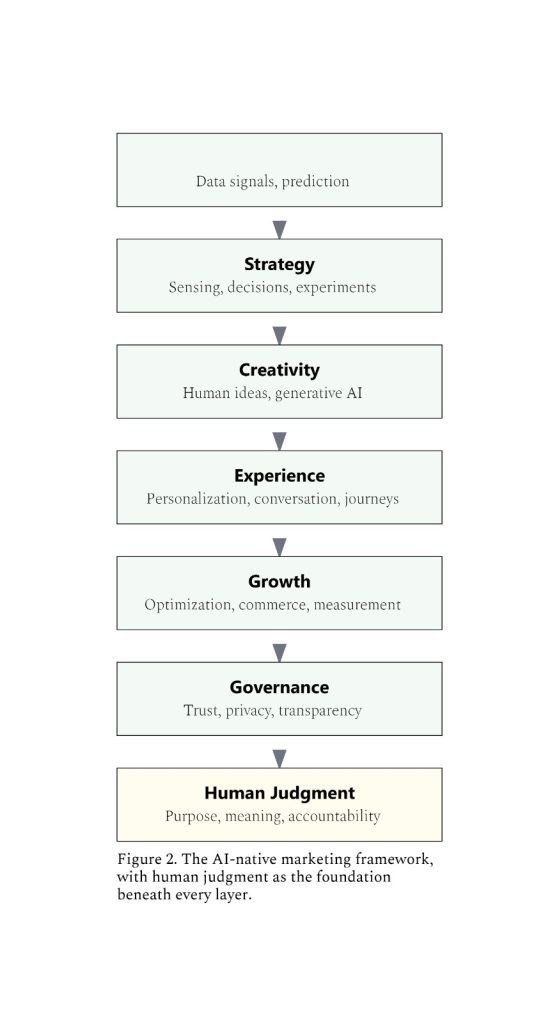
Figure 2 sets out the AI-native marketing architecture proposed in this paper. Intelligence – consumer data, market signals, predictive analytics – feeds into strategy, understood as continuous sensing, decision support, and experimentation. Strategy in turn feeds creativity, where human imagination works alongside generative AI and cultural intelligence. Creativity shapes customer experience – personalization, conversational interaction, adaptive journeys – which drives growth through optimization, prediction, commerce, and measurement. Governance, covering trust, privacy, transparency, and accountability, runs beneath all of it.
Figure 2. The AI-native marketing framework, with human judgment as the foundation beneath every layer.
What sits underneath the whole structure, and what the diagram is really trying to show, is human judgment. AI supplies scale, speed, and computational power. People supply purpose, meaning, values, and accountability – and without that foundation, the rest of the architecture has nothing to stand on.
12. Research Propositions
The literature reviewed above points toward several propositions worth testing empirically.
Proposition 1. Organizations that integrate AI across marketing functions, rather than confining it to isolated operational tasks, will show greater marketing agility.
Proposition 2. The relationship between AI adoption and marketing performance will be mediated by how well an organization integrates human and machine intelligence, rather than by the extent of AI adoption alone.
Proposition 3. Higher levels of AI-driven personalization will increase perceived relevance, but may reduce consumer trust where consumers sense inadequate transparency or excessive use of their data.
Proposition 4. Human oversight will positively moderate the relationship between generative AI adoption and perceived brand authenticity.
Proposition 5. As AI-native capabilities mature, competitive advantage will shift from content production toward strategic and creative orchestration.
Proposition 6. Organizations with stronger AI governance capabilities will be better positioned to convert AI adoption into durable brand value, rather than short-term efficiency gains.
13. Managerial Implications
The rise of AI-native marketing carries several practical implications for marketing leaders.
Do not start with the tools. It is tempting to begin by asking which AI platform to buy. It works better to identify the actual marketing problem first, and redesign the workflow around it before selecting any technology.
Build an operating model, not a set of experiments. AI needs to move past individual pilot projects and become part of how marketing routinely works, or its benefits stay isolated to whichever team happened to try it first.
Invest in people, not just infrastructure. AI literacy should become a baseline marketing capability across the function, not a specialist skill confined to a data team.
Protect what is genuinely human about creative work. AI should expand what is creatively possible rather than replace the distinctive thinking that gives a brand its identity.
Treat trust as a performance metric in its own right. AI effectiveness needs to be judged on business outcomes and on consumer trust together, not on business outcomes alone.
Put governance in place early. Organizations should have clear policies covering data use, transparency, intellectual property, brand safety, bias, and the boundaries of human oversight, ideally before problems force the issue.
14. Conclusion
Marketing has always absorbed new technologies as they arrived. What is happening with artificial intelligence looks like something more fundamental than that pattern suggests.
The important shift is not that marketers now have better tools at their disposal. It is that intelligence itself is becoming part of the marketing system rather than something applied to it from outside. AI-native marketing, in that sense, marks a move from marketing that is merely enhanced by technology to marketing that is designed around intelligence from the start.
The organizations that come out ahead are unlikely to be the ones that use the most AI. They will be the ones that understand where AI genuinely creates value, where human judgment remains irreplaceable, and how to get the two working together rather than in competition.
The future of marketing, on this account, is unlikely to be fully automated. It is more likely to be intelligently augmented – a partnership rather than a replacement.
The question worth carrying forward is not “How do we use AI in marketing?” It is closer to this: if intelligence is available everywhere, what should marketing actually become?
References
Agrawal, A., Gans, J. S., & Goldfarb, A. (2019). Exploring the impact of artificial intelligence: Prediction versus judgment. Information Economics and Policy, 47, 1–6. https://doi.org/10.1016/j.infoecopol.2019.05.001
Cillo, P., & Rubera, G. (2025). Generative AI in innovation and marketing processes: A roadmap of research opportunities. Journal of the Academy of Marketing Science, 53, 684–701. https://doi.org/10.1007/s11747-024-01044-7
Davenport, T., Guha, A., Grewal, D., & Bressgott, T. (2020). How artificial intelligence will change the future of marketing. Journal of the Academy of Marketing Science, 48, 24–42. https://doi.org/10.1007/s11747-019-00696-0
Frank, D.-A., Jacobsen, L., Søndergaard, H. A., & Otterbring, T. (2023). In companies we trust: Consumer adoption of artificial intelligence services and the role of trust in companies and AI autonomy. Information Technology & People, 36(8), 155–173. https://doi.org/10.1108/ITP-09-2022-0721
Grewal, D., Satornino, C. B., Davenport, T., & Guha, A. (2025). How generative AI is shaping the future of marketing. Journal of the Academy of Marketing Science, 53, 702–722. https://doi.org/10.1007/s11747-024-01064-3
Lefkeli, D., Karataş, M., & Gürhan-Canli, Z. (2024). Sharing information with AI (versus a human) impairs brand trust: The role of audience size inferences and sense of exploitation. International Journal of Research in Marketing, 41(1), 138–155. https://doi.org/10.1016/j.ijresmar.2023.08.011
Mustak, M., Salminen, J., Plé, L., & Wirtz, J. (2021). Artificial intelligence in marketing: Topic modeling, scientometric analysis, and research agenda. Journal of Business Research, 124, 389–404. https://doi.org/10.1016/j.jbusres.2020.10.044
National Institute of Standards and Technology. (2023). Artificial intelligence risk management framework (AI RMF 1.0). U.S. Department of Commerce. https://doi.org/10.6028/NIST.AI.100-1
National Institute of Standards and Technology. (2024). Artificial intelligence risk management framework: Generative artificial intelligence profile. U.S. Department of Commerce. https://doi.org/10.6028/NIST.AI.600-1
Stanford Institute for Human-Centered Artificial Intelligence. (2026). AI Index Report 2026. Stanford University.
Author
Bangladesh Brand Forum