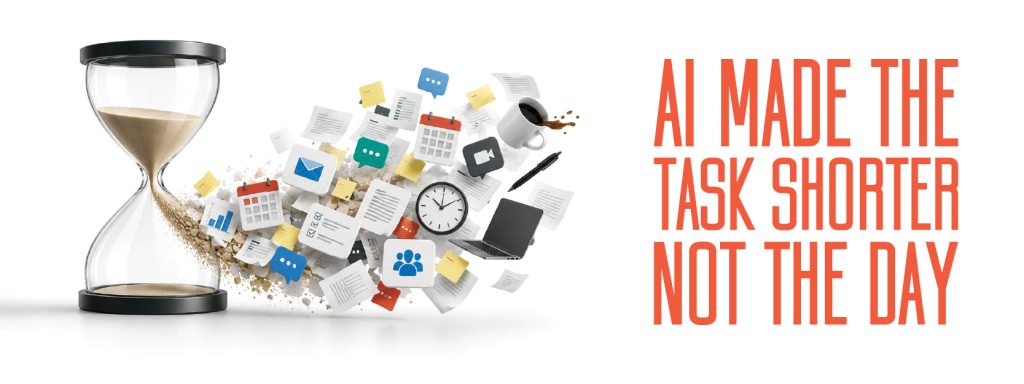
You have probably had the experience by now. A tool drafts the email in nine seconds flat, you feel briefly magnificent, and then somehow the day still ends with a queue of things undone and a mild headache. The tool worked. The day did not get shorter.
ActivTrak decided to test that properly rather than ask people how they felt about it. The firm took 10,584 users and compared what they actually did with their time across the 180 days before they adopted AI tools and the 180 days after. This is behavioural measurement rather than a survey, which matters, because people are famously unreliable narrators of their own working days.
The results are not what anyone was promised. Time spent on every category of work went up, by somewhere between 27 and 346 percent depending on the task. Email took 104 percent longer. Chatting and messaging climbed 145 percent. Time in business management tools rose 94 percent. There was not one activity category in which AI saved its users any time at all.
ActivTrak’s own summary is unusually direct for a workplace report. The prevailing assumption, it notes, is that AI handles the repetitive work and everyone does more with less effort. It calls this a compelling story, and then says plainly that it is not what the behavioural data shows.
So where did the time go?
Into coordination, mostly. Collaboration time surged 34 percent, reaching around 52 minutes a day, while multitasking rose 12 percent to roughly an hour and a half. Meanwhile focus efficiency, the share of the working day spent in uninterrupted concentration, slipped to 60 percent. That is a three-year low, down from 63 percent in 2023.
The detail that stings most is the length of a single stretch of concentration. The average focused session now lasts 13 minutes and 7 seconds, down 9 percent in two years. Cognitive science tends to put the useful window for hard problems nearer ninety minutes, so what we are describing is not a slightly worse version of deep work. It is a different activity wearing the same name.
And the output figures make it worse rather than better, because they look fine. Productive hours actually rose 5 percent, to six hours thirty-six minutes a day, even as the average workday shrank. More is getting done. It is simply a different kind of more.
Nobody is burnt out. Plenty are bored.
Here the data does something genuinely unexpected. By the conventional measures, workplaces improved. Burnout risk fell 22 percent, to just 5 percent of employees. Overutilisation dropped 42 percent. Three-quarters of employees maintained healthy working patterns, the highest level in three years.
At the same time, disengagement risk rose 23 percent, to nearly one employee in four. These are not people who have checked out from exhaustion. They are chronically under-challenged, which is what happens when the interesting fifteen percent of a job gets handed to software and the coordination overhead expands to fill the gap.
The weekend has quietly noticed too. Saturday productive hours are up 46 percent, and Saturday starts have crept forward to 7:11 in the morning. Whatever AI is doing to the working week, compressing it is not on the list.
One finding here should settle an argument that has run for five years. Splitting the data by location, office-only workers post the highest focus efficiency at 64 percent, while remote-only workers log the most productive time at seven hours and one minute a day. The people doing worst on both counts are hybrid workers who split a single day between home and office. They work the longest hours and get the least out of them, which suggests the problem was never the building. It was the commute sitting in the middle of the workday.
The uncomfortable explanation
None of this means the tools are useless. Individual users do report saving around 2.2 hours a week, and across AI-exposed industries the productivity gains are real. The problem is what happens next to the time that gets freed.
Every AI output is a thing somebody now has to read, check, edit, circulate and discuss. Faster drafting produces more drafts. More drafts produce more review cycles, more messages about the review cycles, and more meetings to resolve the messages. The organisation absorbs the efficiency and converts it into volume, which is the oldest trick in industrial history and nobody saw it coming this time either.
The average organisation now runs seven AI tools, up from two, and 83 percent use six or more. Each one arrived promising to save time. Collectively they have produced a workday with more outputs, more notifications and shorter windows in which to think.
Adoption itself is not the issue, and it is not slowing down. Eighty percent of employees now use these tools, against 53 percent two years ago, and once people start they keep going: monthly retention runs at around 92 percent. Average time spent inside AI tools has risen eightfold. People are not abandoning the software because it does not work. They are staying because it does, on the narrow task, while the day around the task quietly fills back up.
What actually helps
Almost nothing on the tool side. The fix is a governance question, which is duller than the technology and considerably more effective.
Decide what the time saved is for, and protect it before it gets colonised. Cut a meeting for every hour AI gives back, or the hour simply becomes more meetings. Measure focus efficiency rather than output volume, since output is exactly the number that looks healthy while the capacity to do hard work erodes underneath it. And notice that the person on your team who seems fine but slightly flat may not need a holiday. They may need something difficult to do.
Sources: ActivTrak, 2026 State of the Workplace, and its analysis of 10,584 users across 180 days before and after AI adoption, as reported by Fortune (March 2026) · ActivTrak workplace benchmarks on focus efficiency, collaboration time, multitasking, burnout and disengagement risk · Federal Reserve Bank of St. Louis, on average time savings among generative AI users.