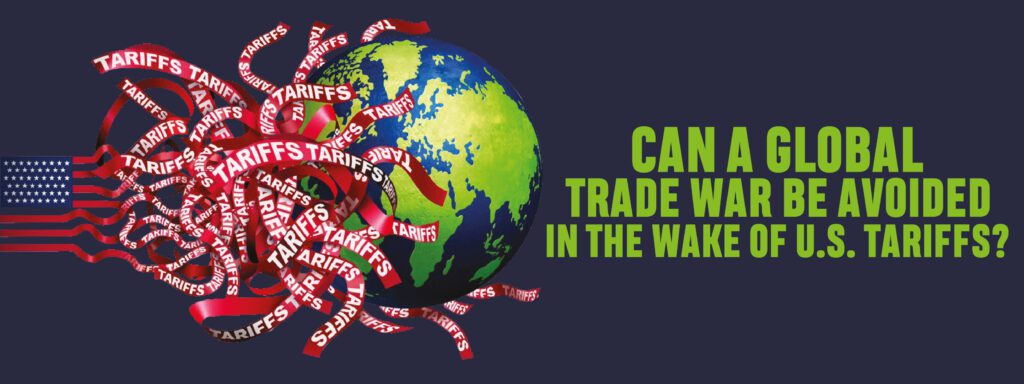
On April 2, 2025, President Donald Trump announced sweeping new tariffs that imposed a 10% baseline on nearly all U.S. imports, and a floundering 145% tariff on goods from China; however, he very recently proposed to bring it down to 80%. The decision aimed at reshaping global trade in favor of U.S. interests, sparked tensions in global markets, and cost the world’s stock exchanges at least $5 trillion in just two days. The sheer scale and abruptness of the announcement ignited fears of a concerning global recession and the possibility of a full-scale trade war reminiscent of the 1930s.
To add more to this dramatic economic fallout, the S&P 500 fell by 10% within 48 hours—its worst performance since the pandemic crash of 2020—while other global indices followed suit. Investors hurried to restructure portfolios and hedge against what many said would be a lengthy era of geopolitical and economic upheaval. Business morale plummeted across industries, with companies that rely significantly on global supply chains being impacted the worst. Small and medium-sized enterprises in the U.S., especially those dependent on imported raw materials and intermediate goods from China, reported significant cost increases. With thin margins already, many were forced to scale back operations or consider layoffs, compounding fears of job losses in an election year.
This led the World Trade Organization (WTO) to quickly revise its 2025 global merchandise trade forecast downward. Where earlier projections had anticipated 3.0% growth, the new figure was a mere 0.2%, reflecting both the immediate disruptions caused by the tariffs and the broader sense of uncertainty gripping markets. North America, heavily influenced by U.S. trade policy, is expected to suffer the steepest decline, with a projected 12.6% drop in exports. These statistical shifts represent the unfortunate fraying of global economic relationships built over decades.
As for the international reaction, it has been mixed. China responded swiftly, implementing a 125% tariff on a wide range of American goods. Beijing’s countermeasures were both symbolic and strategic, targeting sectors like agriculture and energy that are politically sensitive in the U.S. The tit-for-tat escalation evoked memories of the previous U.S.–China trade tensions, which had already strained bilateral relations in the late 2010s and early 2020s. Meanwhile, the European Union took a more measured approach. While expressing strong concern, Brussels refrained from implementing retaliatory tariffs, instead advocating for de-escalation and renewed dialogue through multilateral platforms.
Other nations, such as Canada, Japan, and Mexico, voiced apprehension but adopted a ‘tread water’ approach. For many of these countries, the cost of retaliation could outweigh the symbolic satisfaction of pushing back. Despite the chaos, several potential paths remain open that could help avoid a global trade war. First, diplomatic engagement is already underway. The U.S. administration has signaled a willingness to negotiate individual trade deals, particularly with traditional allies. Talks with the United Kingdom and Switzerland have progressed relatively quickly, and reports suggest these nations may be granted exemptions or lower tariffs in exchange for concessions on market access and investment protections. These bilateral negotiations could serve as models for broader de-escalation.
Second, a 90-day pause was announced shortly after the tariffs took effect, applying to most U.S. trading partners with the notable exception of China. While the move was largely symbolic, it provided much-needed breathing room for stakeholders to regroup and for policymakers to assess the economic fallout. During this window, several countries have stepped up diplomatic efforts, hoping to use the pause as a foundation for more permanent solutions.
Third, modern supply chains are greatly interconnected, in contrast to the 1930s. The disruption of one node can ripple across entire industries and prolong trade hostilities. For example, a garment factory in Dhaka might rely on high-quality cotton yarn sourced from India, specialized dyes and chemicals imported from Germany, and sewing machine parts shipped from Japan. If tariffs or trade disruptions affect any of these crucial links, the factory’s production could face significant delays or even halt, impacting their ability to fulfill orders for international retailers.
Moreover, institutions such as the WTO, though weakened in recent years, still offer a venue for arbitration and conflict resolution. While the organization has struggled with enforcement issues, its role in de-escalating disputes and coordinating trade norms remains valuable. Reinvigorating the WTO’s authority could be essential to preventing future conflicts and stabilizing the rules-based global trade system.
Nevertheless, there are several critical challenges to consider. The most pressing is policy unpredictability. The Trump administration has oscillated between aggressive posturing and conciliatory rhetoric, making it difficult for businesses and governments alike to develop long-term strategies. The resulting uncertainty discourages investment, depresses consumer confidence, and may ultimately lead to a self-fulfilling slowdown in growth.
Another issue is the uneven impact of the tariffs. While the U.S. may be attempting to revitalize domestic manufacturing and reduce its trade deficit, the short-term burden disproportionately falls on developing nations. Many of these countries, like ourselves, depend heavily on exports to the U.S. for income and employment, especially our RMG sector. If they experience a sudden drop in trade revenue, it could destabilize their economies, trigger political unrest, and create spillover effects that damage global markets. As for Bangladesh, our excessive dependence on the RMG sector for exports is very likely to pose problems for us. With Bangladesh scheduled to graduate from its LDC status and consequently lose its GSP privileges, we need to take urgent steps to diversify our export base, focus on signing Free Trade Agreements (FTA) with suitable economies, and diplomatically engage with US policymakers.
Additionally, there is always the risk that the situation could spiral out of control. If negotiations with China break down or if another major economy decides to retaliate in kind, the global trade system could fragment. A return to widespread protectionism would not only undermine economic growth but could also erode international cooperation on pressing global issues like climate change, digital governance, and financial regulation.
Author: Tasfia Tahiat Umme