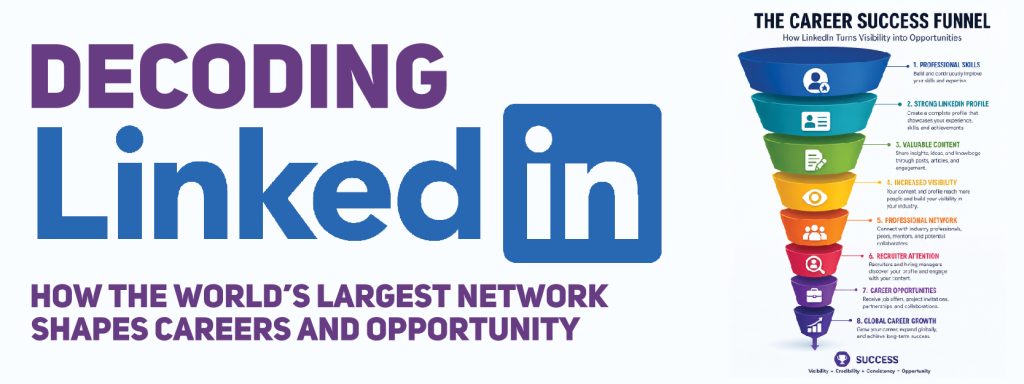
There was once a time when resumes were contained in folders, business cards in wallets, and networking consisted of uncomfortable chats at conferences while drinking coffee. Now, however, much of the system has been condensed into one online destination: LinkedIn.
From its launch in 2003 as a simple networking portal, LinkedIn has grown to become so much more: a global market of talent, influence, ideas, and opportunity. With over a billion members worldwide, LinkedIn is not only a place to find work but an engine of personal brand development, recruitment, and thought leadership, and, increasingly, a reflection of modern career building.
In many ways, LinkedIn is becoming the professional layer of the internet.
Beyond the Digital CV
For many years, LinkedIn was seen as a digital resume that people only updated while on the hunt for a job. That idea is no more.
In today’s world, recruiters are evaluating digital presence. Companies are looking at candidates’ communication style, the ideas they discuss, their involvement in industry discussions, and even their digital presence itself. A good LinkedIn profile serves as a digital portfolio of credibility.
This marks a paradigm shift in the way business is conducted. There is a high degree of flexibility, an interdisciplinary nature, and visibility that characterize careers today. While experience and education matter, there is an equal need for visibility.
“Your personal brand is what people say about you when you are not in the room.”
— Jeff Bezos
A designer in Dhaka can work with a startup in Singapore. A marketer can reach out to get mentoring from professionals. A freelancer can create their portfolio with clients worldwide without ever having to enter a traditional office environment. LinkedIn has leveled the playing field for professionals like never before. The outcome is a kind of career mobility based on reputation rather than proximity.
The Rise of Personal Branding
Probably the most important aspect of LinkedIn’s development is its role in turning professionals into content producers.
Back then, business executives had to depend on their company’s PR team to create their image. Today, founders, managers, consultants, and even students are creating their own brand using articles, posts, videos, and comments. Expertise that used to be confined within office walls is now published daily online. This trend has affected the notion of influence in professional circles.
An idea, stated well and consistently enough, will have more impact on your career than any networking event you could ever attend. One post can get you an invitation from a recruiter, investor, collaborator, or a speaking engagement. What you say and how you say it matter just as much as what you do. LinkedIn has established an effective creator economy for professionals.
And unlike other social media that are driven by entertainment, LinkedIn values credibility, relevancy, and actionable insights. The topics being discussed on LinkedIn include leadership, organizational culture, artificial intelligence, productivity, sustainability, and innovation, among others. In most sectors, thought leadership has become a competitive edge. The takeaway is clear: Professional success is not just about capability; it is also about communication.
“In today’s job market, visibility is no longer optional; it is part of professional credibility.”
Recruitment Has Changed Forever
LinkedIn has changed the game when it comes to recruiting. Historically, recruitment involved lots of job postings and applications. These days, recruiters hunt for candidates well in advance of any vacancy announcements. Skill sets, recommendations, endorsements, activity levels, and social connections all play a role in identifying talent.
Proactive recruitment is the new norm. For businesses, LinkedIn opens up the world’s talent pool. For individuals, there is never a moment without opportunities, even if they are not actively looking. It has increased the level of competition but also opened up new avenues.
Recent global recruitment surveys show how deeply LinkedIn now influences career growth and hiring decisions. More than 90% of recruiters actively use LinkedIn to discover talent, while professionals with complete and active profiles are significantly more likely to receive job opportunities and recruiter outreach. The findings also reveal that Gen Z professionals increasingly view online visibility and personal branding as essential components of long-term career success.
The online persona of the candidate is now capable of having as much impact on the hiring decision as the interview performance itself. Those profiles that have positioning, quantifiable accomplishments, and genuine interactions will always be noticed by the recruiters.
In other words, LinkedIn has made career development a continuous process.
Case Study: From Local Graduate to Global Opportunity
In 2023, a marketing graduate from Bangladesh started writing short articles on topics such as branding, consumer behavior, and digital trends on LinkedIn. While initially there was little engagement with the posts, regularity and consistency slowly helped the profile become more visible among people in the marketing community.
Months later, recruiters and agency managers were engaging with the content, and one post on consumer behavior among the Generation Z population attracted the attention of a Singaporean startup entrepreneur. This led to a collaboration between the two individuals, which resulted in a permanent working relationship.
The key point here is that the individual did not benefit from any famous university degrees or networks; he benefited from visibility and consistency.
This particular case illustrates a growing trend in the professional world, where LinkedIn is now being used as a tool for finding talented professionals rather than just for job-seeking.
The Algorithm of Ambition
LinkedIn is an algorithmic system, like all other digital platforms. Increasingly, algorithms determine visibility on the platform.
Engaging content reaches more people. Content that resonates emotionally becomes viral. Regular posting increases visibility. Hence, LinkedIn has its own culture, vocabulary, and behavior. This presents opportunities but also challenges.
On the one hand, the platform makes visibility possible without the need to belong to any particular institution. People can build influence based on their knowledge. On the other hand, the constant struggle for engagement may lead to performative professionalism in terms of polished success stories and productivity stories.
Occasionally, the platform finds itself crossing the line between professional knowledge and personal performance.
Although this may be true, LinkedIn is different in that it not only has visibility but also delivers results. Unlike other forms of vanity metrics used by other social networking sites, the engagement done on LinkedIn usually translates into something tangible, such as job interviews, partnerships, sales, and business success.
LinkedIn in the age of AI
As AI transforms industries, LinkedIn has also been undergoing changes. Recruitment algorithms powered by AI now offer faster analysis of skill sets and compatibility. The platform itself is beginning to recommend paths based on the behavior of its users. The professional users themselves are leveraging AI to perfect their profiles and applications.
LinkedIn has also become one of the important platforms that are needed in order to get insights into the future of work. Topics such as automation, reskilling, working from home, or other related aspects of digital transformation are discussed daily on LinkedIn. LinkedIn can be considered a document of how different industries respond to disruption.
The people who succeed in such a scenario are not those who have the loudest megaphone but those who are adaptive. Work in the future will be much more connected, digital, and transparent than it has ever been. And in the future of work, LinkedIn will not be a site where users go to, but a space where professional identities are constantly being constructed.
“Opportunities don’t happen. You create them.”
— Chris Grosser
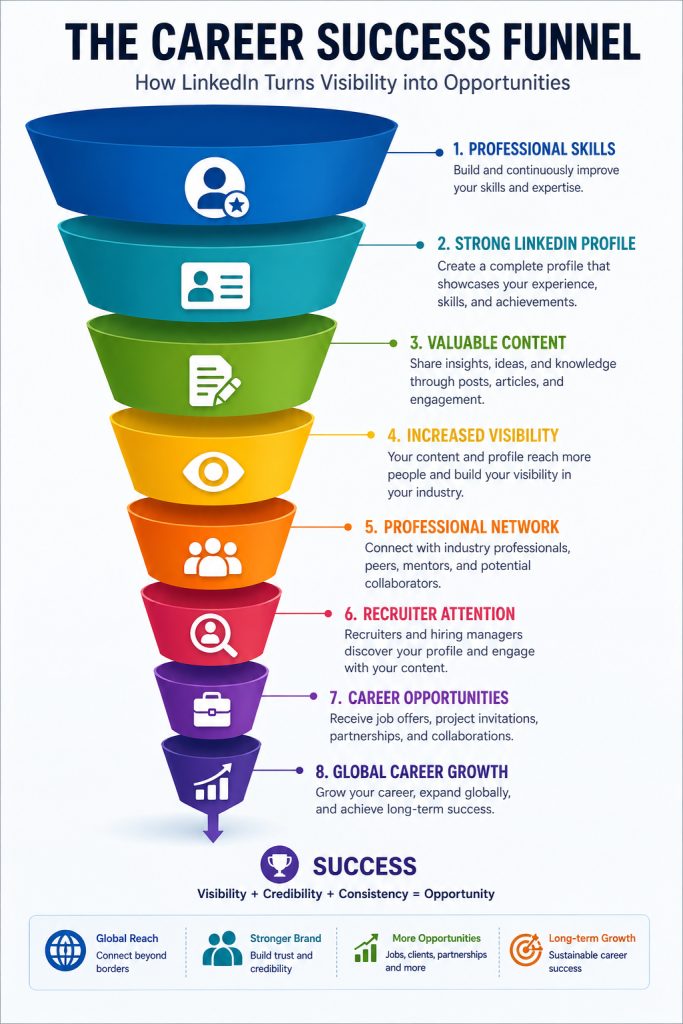
The strength of LinkedIn cannot be found in algorithms, recruitment technologies, or networking. Instead, it is based on its ability to translate visibility into opportunities. One post can change one’s career path. One connection can lead to international cooperation. Being authentic can create credibility more quickly than a conventional resume can.
The most important aspect of LinkedIn may be the culture that it represents. The manner in which professionals market themselves, firms find talent, and ambition is expressed has been radically altered because of this medium. Success in one’s career does not take place just in offices anymore but online.
In many respects, LinkedIn is no longer an observer of the future of work. Instead, it is helping shape this future.
Author: MD. Nadim Ahmed