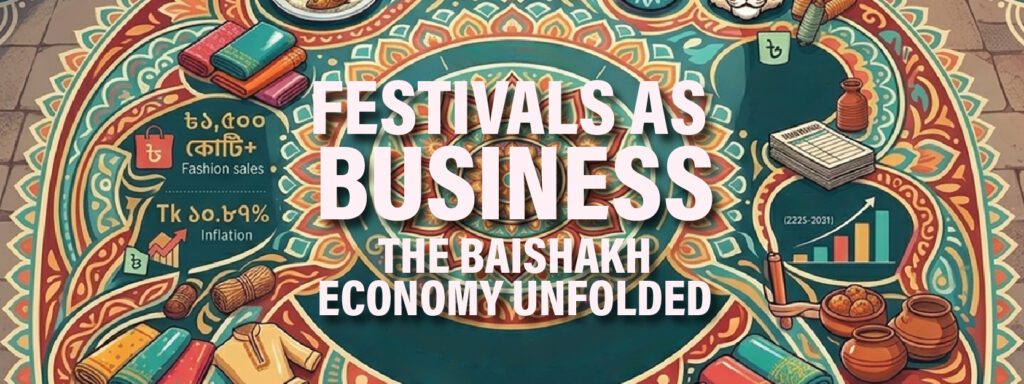
THE NEW YEAR THAT MOVES MARKETS
Every April, something extraordinary happens to Bangladesh’s economy. Showrooms that had been quiet suddenly overflow with shoppers. The scent of fresh-fried hilsa and fermenting panta bhat fills neighbourhood lanes. The deep red and white of sarees and panjabis splash across every high street from Tejgaon to Sylhet Sadar. Corporate gift hampers stack up in warehouses. bKash and Nagad servers strain under a surge of peer-to-peer transfers. Street vendors count their fastest-ever single-day earnings. Bangladesh, in the days flanking Pahela Baishakh — the first day of the Bengali New Year — is in full commercial bloom.
What began as a Mughal-era administrative practice of synchronising tax collection with the harvest calendar has quietly become the nation’s second-largest retail festival, a multi-thousand-crore engine of consumer spending that every brand, every retailer, every street hawker and every platform founder now plans for twelve months in advance. Yet the full scale of the Baishakh economy — its depth, structure, cultural logic, and untapped potential — has rarely been assembled into a single, coherent picture.
1. ROOTS AND RITUAL: UNDERSTANDING PAHELA BAISHAKH
The origins of Pahela Baishakh are inseparable from money. When Mughal Emperor Akbar commissioned the Bengal Sana calendar in 1556 — later refined by royal astronomer Fathullah Shirazi — the aim was to align the tax-collection cycle with the agricultural harvest. Landlords collected dues (khajana) from tenants on the first day of Baishakh, and the occasion was marked with sweets, celebrations, and the reopening of merchant account books (halkhata). The festivity was thus, from its very inception, a commerce-laden rite.
That economic DNA survived the colonial era, survived Partition, and deepened dramatically after Bangladesh’s independence in 1971. With a newly sovereign nation anxious to assert its Bengali cultural identity distinct from West Pakistan, Pahela Baishakh acquired fresh national resonance. Aarong was founded in 1978; Kay Kraft, Anjan’s, Rang and a wave of lifestyle brands followed in the 1990s. They understood, instinctively, that the festival’s emotional charge — nostalgia, pride, communal joy — could be converted into commercial energy. The red-and-white palette became a brand language. The mangal shobhajatra became a media moment.
Today, Pahela Baishakh is observed by every demographic: urban professionals in Gulshan, fishing families in Khulna, diaspora Bangladeshis in London and New York. Culturally, it occupies the rare position of being genuinely non-denominational — it belongs to Hindus, Muslims, Buddhists and Christians alike — which is precisely what makes it Bangladesh’s broadest, most commercially potent annual occasion.
2. THE NUMBERS: SIZING THE BAISHAKH ECONOMY
Reliable aggregate figures for Pahela Baishakh spending are harder to pin down than they should be — a symptom of the largely informal character of Bangladesh’s festival economy. But the data points that do exist are striking.
Fashion and Apparel: The Festival’s Biggest Winner
The Bangladesh Fashion Entrepreneurs Association estimated in a 2012 survey that local fashion houses generate roughly Tk 6,000 crore in annual sales. Of that figure, more than 50 percent arrives during Eid-ul-Fitr and at least 25 percent — Tk 1,500 crore or more — during the Baishakh season, making it the year’s second-largest fashion event. Given the decade of retail expansion, urbanisation, and the rise of brand culture since 2012, current Baishakh apparel revenues are estimated to be substantially higher.
Individual brand signals confirm the pattern. Aarong, the country’s most recognised lifestyle retail chain, reports that over 40 percent of its annual turnover of approximately Tk 1,000 crore arrives during Pahela Baishakh and Eid combined. In 2025, with Baishakh and Eid falling nearly two weeks apart — giving consumers the luxury of separate shopping occasions.
“In previous years, Baishakh celebrations and the purchase of new dresses accounted for an estimated one-fourth of annual sales by local fashion outlets.” — The Daily Star, April 2025
The fashion landscape for Baishakh has its own grammar. Natural fabrics — cotton, linen, khadi, taant — dominate. The iconic red-and-white palette remains culturally potent, though younger designers now experiment with mustard, coral and earthy tones. Jamdani sarees, tangail saris and muslin-based kurtis sell at a premium. New entrants — co-ord sets, Farshi salwars, fusion silhouettes — have broadened the market’s demographic reach beyond middle-aged women to include Gen Z shoppers. Brands compete ferociously for shelf space and social media impressions in the six-week run-up to April 14.
Food Economy: From Panta Bhat to Premium Dining
The food dimension of Baishakh is as much tradition as transaction. The ritual morning meal of panta bhat (water-soaked rice), mashed potato, fried hilsa, pickles, and green chillies is both deeply personal and profoundly commercial. Hilsa — the national fish and a Baishakh symbol — witnesses a predictable price spike every April. In 2025, wholesale hilsa prices at Jatrabari market rose by Tk 250–300 per kilogram in the days leading up to the festival, yet demand remained inelastic.
Sweetmeat consumption spikes sharply. Before the pandemic disrupted the pattern, sweets worth approximately Tk 50 crore were sold across Bangladesh each year around Baishakh.
Hotels, restaurants, and food delivery platforms have built entire campaign architectures around the occasion. The Dhaka restaurant scene launches Baishakhi tasting menus. Cloud kitchens run hilsa specials. Pathao Food and Foodpanda Bangladesh report festival-period spikes in order volumes. Branded corporate iftars and Baishakh brunches have merged into a single premium hospitality season in Dhaka’s five-star corridor.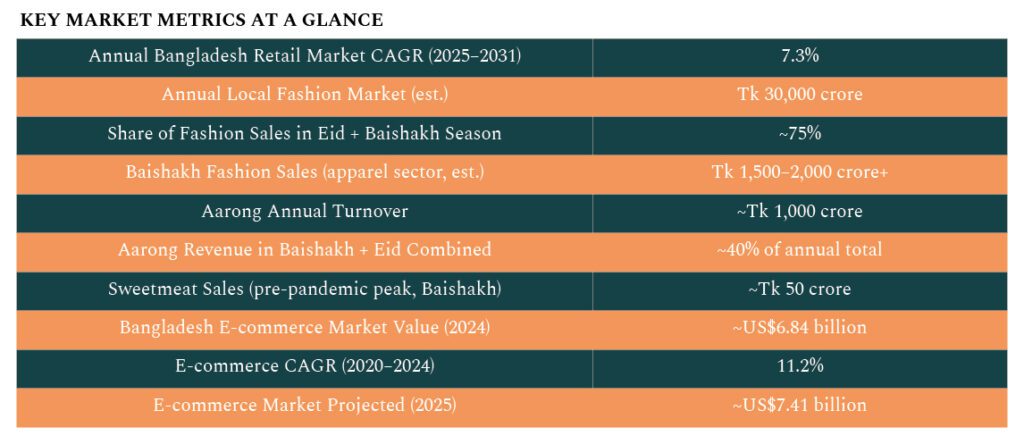
3. BRANDING BAISHAKH: HOW BUSINESSES MARKET THE MOMENT
No marketing calendar matters more to Bangladeshi consumer brands than the thirty-day window flanking Pahela Baishakh. The festival’s emotional richness — pride, belonging, nostalgia, shared identity — offers precisely the kind of cultural gravity that brand managers spend careers trying to manufacture artificially elsewhere. Here, it is ready-made.
The Campaign Architecture
Preparation begins in January. Fabric sourcing, design finalisation, and production runs for artisans in Narayanganj, Rajshahi, and Tangail are completed months in advance. A single bad harvest of festival-ready motif fabrics can leave a brand scrambling in April. By February, digital creative teams are pitching Baishakh concepts to CMOs. By early March, advertising campaigns are locked, influencer contracts signed, and social content calendars approved.
Television and digital remain the dominant channels, but the content strategy has shifted. Brands that once relied on simple product showcases now invest in emotional storytelling. Aarong consistently produces culturally resonant brand films — short narratives about artisan communities, familial connection, and the continuity of craft — that generate organic social sharing well beyond paid reach.
Influencer marketing has become central. Lifestyle creators on Facebook and Instagram — many with audiences of 500,000 to 2 million — post Baishakh outfit lookbooks, ‘unboxing’ videos of corporate hampers, and morning-of-Baishakh food spreads that function as powerful, trusted advertising. The algorithmic advantage of video content on Facebook (still Bangladesh’s dominant social platform) means a well-produced Baishakhi reel can reach multi-million users organically.
Digital Commerce and the Baishakh Basket
Bangladesh’s e-commerce sector — valued at approximately US$6.84 billion in 2024 and growing at 6.8 to 11.2 percent annually — has absorbed the Baishakh opportunity with notable speed. Daraz Bangladesh runs dedicated Baishakh Mega Sales campaigns, offering flash discounts, bKash-powered cashback deals, and free delivery windows.
Mobile financial services have been the infrastructure that made digital Baishakh commerce possible. By December 2024, mobile financial transactions in Bangladesh reached 17.37 trillion taka — close to half the country’s annual economic output. Platforms like bKash, Nagad, and Rocket have integrated seamlessly into e-commerce checkouts, allowing even rural consumers to participate in the Baishakh digital economy. In March 2025, the month overlapping Eid-ul-Fitr preparations, MFS transaction volumes peaked between Tk 153,757 crore and Tk 178,127 crore — a direct reflection of festival-driven spending.
E-commerce transactions in Bangladesh jumped approximately 64 percent in FY 2024–25 over the prior fiscal year. Card-based e-commerce transactions reached Tk 20.35 billion in February 2025 alone — a 23.6 percent year-on-year rise. The Baishakh window is now a recognised spike event for every major platform, warranting pre-festival inventory build, server capacity expansion, and logistics pre-positioning.
Challenges: Inflation, Informality, and the SME Squeeze
The Baishakh marketing machine runs on optimism, but it operates within structural constraints. Persistent inflation — Bangladesh’s general inflation rate reached 10.87 percent in September 2025 — has compressed real consumer purchasing power, particularly for lower-middle-class households that make up a large share of the festival-fashion market. Brands walk a tightrope between aspirational messaging and price-point accessibility.
Small fashion retailers and individual artisans face a more acute version of this squeeze. Unlike the Aarongs and Kay Krafts of the sector, who can absorb unsold festival inventory through multi-season markdown strategies, boutique makers producing batik or hand-embroidered Baishakhi pieces are left with unsellable stock if the festival is disrupted — by a pandemic, a political crisis, or simply by an unusually poor weather day (as Dhaka’s April heat and occasional pre-monsoon rains can suppress street foot-traffic dramatically). The overlap of Baishakh with Ramadan in 2024 is a case study: with consumers channelling discretionary spending towards Eid, Baishakh fashion sales took a measurable hit despite cultural enthusiasm for the festival remaining intact.
4. BEYOND BAISHAKH: THE FULL FESTIVAL ECONOMY OF BANGLADESH
Pahela Baishakh may be the flagship, but Bangladesh’s festive economy is a year-round phenomenon. The Daily Star’s economic analysis estimated that the market surrounding Eid-ul-Fitr alone can reach nearly Tk 2 lakh crore — a figure that dwarfs Baishakh’s standalone contribution and underscores the sheer scale of the broader festival ecosystem.
Eid-ul-Fitr: The Colossus
Eid-ul-Fitr is, by every measurable dimension, the largest consumer event in Bangladesh. Over 50 percent of annual fashion sales are concentrated in the Eid season. The entire national retail sector — from mega malls in Dhaka to village markets in Sylhet — restructures itself around the month of Ramadan and its culmination. The cultural logic is irresistible: new clothing is a near-universal Eid expectation, and gift-giving extends across family, community, and employer-employee relationships.
The Baishakh-Eid calendar relationship is critical for brands. When the two festivals fall close together — as they did in 2024, separated by just two days — consumer spending is cannibalised and brands are forced to choose which campaign to invest in. When they fall far apart, as in 2025 (nearly two weeks), both festivals benefit from undivided consumer attention and separate shopping missions. This calendar arithmetic is now actively tracked by fashion brand CFOs.
Eid-ul-Azha: The Rural Economy’s Festival
Eid-ul-Azha generates an estimated Tk 1 lakh crore in economic activity — centred on the livestock trade, slaughter services, refrigeration, transport, and food consumption. Approximately 11 million animals are sacrificed nationally each year, creating a concentrated, short-duration supply chain of enormous scale. The festival injects liquidity into rural Bangladesh in ways that Pahela Baishakh, more urban in its commercial orientation, does not. The leather sector — once a billion-dollar-plus export industry, now generating approximately Tk 800–900 million annually — is almost entirely dependent on hides collected during Eid-ul-Azha.
Durga Puja: The Hindu Bengali Economy
For Bangladesh’s Hindu community — approximately 8–9 percent of the population — Durga Puja is the year’s defining cultural and commercial occasion. The Daily Star estimated the Durga Puja market in Bangladesh at roughly Tk 20,000 crore, encompassing spending on mandaps, decorations, clothing, bangles, sweets, and handicrafts. The festival drives demand for gold jewellery, sarees of specific regional varieties, and artisanal goods from specific weaving communities.
The cross-border comparison is instructive. In West Bengal, India — a culturally adjacent community — the Durga Puja economy reached an estimated Rs 65,000 crore (approximately US$7.3 billion) in 2025, contributing an estimated 2.58 percent to the state’s GDP and employing over 100,000 workers seasonally. UNESCO’s 2021 recognition of Durga Puja as an Intangible Cultural Heritage of Humanity elevated its global cultural profile — and opened tourism possibilities that Bangladesh’s version of the festival has barely begun to explore.
Pohela Falgun and the Emerging Spring Economy
Pohela Falgun — the first day of spring, falling in February — has undergone a rapid commercial transformation over the past decade, driven largely by urban youth. The festival’s colour palette (yellow, orange, white) has generated a dedicated fashion sub-season, particularly for women’s wear. As Prothom Alo reported, Pohela Falgun has emerged as a third lucrative festival for the fashion industry, now joining Eid and Baishakh in brand planning calendars. Valentine’s Day, falling within a day of Pohela Falgun, amplifies the gifting and dining economy. Together, the spring cluster — Pohela Falgun, Valentine’s Day, and their adjacent occasions — is estimated to drive a market worth more than Tk 15,000 crore through fashion, gifts, dining, and cultural events.
5. WHAT THE WORLD KNOWS: LESSONS FROM GLOBAL FESTIVAL ECONOMIES
Bangladesh does not operate its festival economy in a vacuum. Across the globe, several cultures have transformed their most significant celebrations into industrial-scale economic events. Their experiences — in structure, in digital evolution, in global reach, and in the strategic mistakes they have avoided — carry direct relevance for Bangladesh.
China’s Spring Festival: The World’s Biggest Commercial Migration
The Chinese Spring Festival — Chinese New Year — is perhaps history’s most economically consequential single annual event. The 40-day Chunyun travel period generates what authorities describe as the largest human migration on Earth: 3 billion trips annually. But the commercial numbers are what stun.
Retail and catering sales during the Spring Festival holiday week alone reached over US$140 billion in 2023, according to China’s Ministry of Commerce. In 2024, domestic tourism income during the festival reached 632.7 billion yuan (approximately US$87 billion), up 47 percent year-on-year. Alibaba reported over US$60 billion in gross merchandise value during its Spring Festival campaign period. Over 10 billion digital ‘hongbao’ (red envelopes) were sent via WeChat during the 2024 holiday week — a digital ritual that simultaneously drives platform engagement and peer-to-peer liquidity transfer.
The Spring Festival’s economic intelligence lies in its layering. Gift-giving, travel, hospitality, entertainment (the 2024 box office during the 7-day holiday reached US$1.11 billion, a record), digital payments, and food all operate as reinforcing sectors rather than competing ones. The ecosystem has been built deliberately, over decades, by both state and platform actors. Bangladesh has none of this institutional architecture — yet.
India’s Diwali: From Festival of Lights to Festival of Commerce
India’s Diwali offers perhaps the most directly relevant global parallel for Bangladesh’s Pahela Baishakh. Both are culturally rooted South Asian celebrations with deep ritual significance, both have a fashion-and-gifting heartland, and both now operate as mega retail events with a strong e-commerce overlay.
In 2025, the Confederation of All India Traders estimated Diwali season sales of nearly Rs 5.4 lakh crore (approximately US$61.6 billion) in goods and Rs 65,000 crore in services — record figures that outperformed all prior years. E-commerce alone generated US$6.5 billion in the first week of Diwali sales in 2024, a 26 percent increase over the prior year. Platforms like Amazon’s Great Indian Festival and Flipkart’s Big Billion Days have turned Diwali into a month-long commercial season, not merely a five-day religious event.
The key structural insight from Diwali’s evolution is the formalisation of the festival economy’s supply chain. Indian brands — jewellery houses, apparel chains, electronics retailers, automobile manufacturers — plan production cycles, marketing budgets, and discount architectures 12–18 months in advance. Approximately 30 percent of India’s annual car sales occur during the Diwali season. The festival has become an economic policy tool: India’s GST restructuring ahead of the 2025 Diwali was explicitly designed to stimulate festive consumption, and it contributed to a 4.6 percent rise in sales tax revenue in October 2025 alone.
Thanksgiving and the Western Commercial Season
The Western festival economy — centred on Thanksgiving, Black Friday, and Christmas — operates on a different cultural basis but offers equally instructive lessons. The US holiday retail season (roughly November–December) typically accounts for 20–40 percent of annual retail revenue for many categories. In 2024, US holiday retail sales were projected to exceed US$900 billion.
The most transformative Western festival-economy innovation has been the globalisation of Black Friday — originally a single-day American post-Thanksgiving shopping event — into a worldwide commercial phenomenon. Daraz Bangladesh now runs its own ‘11.11’ campaign modelled on Alibaba’s Singles’ Day, and ‘12.12’ sales events have emerged as well. This demonstrates that Bangladesh’s digital retail sector is already absorbing and adapting global festival-economy tactics, even if it has not yet systematically exported its own.
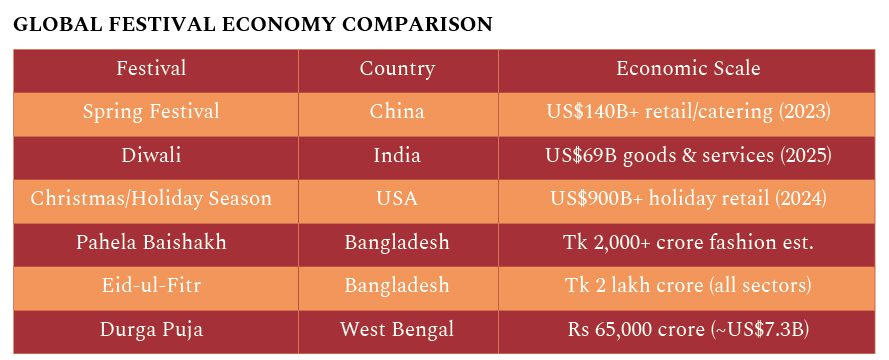
The comparison is humbling — but also revealing. The gap between Bangladesh’s festival economy metrics and those of its peers is not merely a function of GDP; it is also a function of institutional investment, branding strategy, and the formalisation of informal economic activity. India’s Diwali economy has grown tenfold since 2019, from Rs 0.5 lakh crore to an expected Rs 4.25 lakh crore in 2024. The trajectory is instructive.
6. CONSUMER BEHAVIOUR: WHO IS BUYING AND WHY
Understanding who drives the Baishakh economy is as important as understanding how large it is. The consumer profile of Pahela Baishakh is undergoing a generational shift — one that has significant implications for brands, platforms, and policymakers alike.
The Urban Middle-Class Core
The engine of Baishakh commercial activity is the urban middle class, concentrated in Dhaka, Chattogram, Sylhet, Rajshahi, and their satellite towns. These households have the disposable income, the brand exposure, and the cultural motivation to spend meaningfully on clothing, food, and experiences for the festival. Their brand loyalties are largely established.
Generation Z: The Digital-First Festival Consumer
The most significant shift in Baishakh consumer behaviour over the past five years has been the emergence of Gen Z as a purchasing force. This cohort — broadly defined as those born between 1997 and 2012, meaning they are now 14–29 — approaches Pahela Baishakh through an entirely different lens than their parents. They discover brands on Instagram and TikTok. They research products on Facebook groups. They purchase via Daraz or directly through brand apps. They pay with bKash.
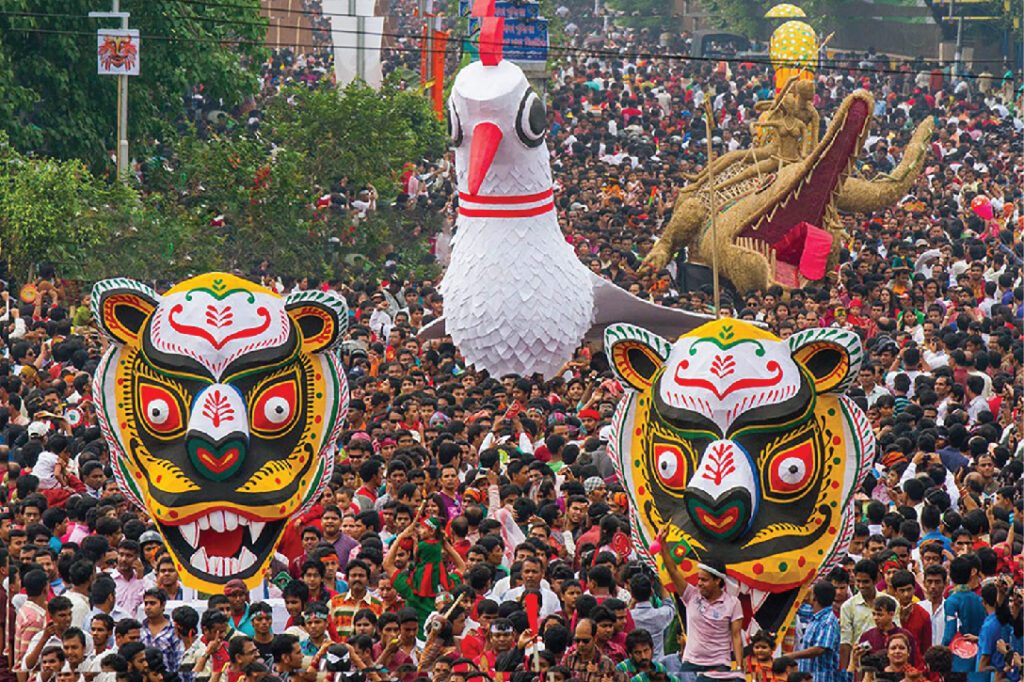
For Gen Z, Pahela Baishakh is as much a social-media event as a cultural one. The morning procession at Dhaka University’s Faculty of Fine Arts — the mangal shobhajatra — generates millions of social media impressions. Festival outfit selfies flood Instagram. Food documentation of the ritual panta-hilsa breakfast circulates on Facebook. Brands that understand how to plug into this organic content ecosystem gain disproportionate reach. Those that do not find their expensive television campaigns generating noise without resonance.
Women as the Primary Purchase Decision-Maker
Across all demographic segments, women remain the central purchase decision-maker for Baishakh. They select clothing — for themselves, their children, and often their partners. They choose the caterer or the restaurant. They decide which brand’s hamper to order for the in-laws. Brands that have historically treated Baishakh as a women’s fashion event have been correct; what has changed is the complexity and channels through which that decision-making now occurs. A purchasing decision that once happened in a showroom now begins weeks earlier with a social media advertisement and traverses multiple digital touchpoints before concluding at checkout.
Rural Consumption: The Underestimated Market
Bangladesh’s Baishakh economy is frequently discussed in urban terms, but the festival’s cultural meaning is equally deep in rural and peri-urban Bangladesh. Village fairs (Baishakhi melas) remain vibrant, providing economic opportunities for rural artisans, craftspeople, and food vendors. Handloom weavers in communities across Rajshahi, Tangail, Narayanganj and Pabna calibrate their production cycle around the Baishakh and Eid demand windows. Mobile financial services have increasingly connected rural Baishakh consumers to digital commerce — particularly through Facebook-based boutique sellers who ship nationally.
7. BRANDING BANGLADESH: BAISHAKH AS A GLOBAL CULTURAL ASSET
The most ambitious frontier of the Baishakh economy is not the domestic retail season — it is the festival’s potential as a global cultural brand. Here, the benchmarks set by India’s Diwali and China’s Spring Festival are both inspiring and instructive.
The Diaspora Opportunity
Approximately 13 million Bangladeshis live outside the country — one of the world’s largest diasporas. This community, concentrated in the UK, USA, Middle East, Malaysia, Italy, and Australia, observes Pahela Baishakh with varying intensity but consistent emotional attachment. Diaspora Baishakh events in London, New York, and Sydney attract thousands of attendees, generate significant local economic activity, and offer Bangladeshi brands a ready-made international platform. Yet no Bangladesh fashion brand has established meaningful global retail presence. No Bangladeshi food brand has built a Baishakh product range marketed to international audiences. The diaspora market for authentic Baishakhi goods — jamdani sarees, Tangail cotton, speciality sweets — is almost entirely served by informal channels and individual suitcase commerce.
UNESCO Recognition and Soft Power
The mangal shobhajatra — the vibrant procession led by Dhaka University’s Faculty of Fine Arts each Pahela Baishakh — was inscribed on UNESCO’s Representative List of the Intangible Cultural Heritage of Humanity in 2016. This recognition, comparable to the status Durga Puja achieved in 2021, positions Pahela Baishakh as a globally recognised cultural event. Countries that have leveraged UNESCO cultural heritage status for tourism, brand building, and diplomatic soft power have generally seen measurable economic returns. Bangladesh has, to date, underinvested in translating this recognition into a tourism and brand-building strategy.
The opportunity is concrete. Bangladesh’s inbound tourism infrastructure remains underdeveloped relative to its cultural wealth. A well-packaged ‘Baishakh experience’ — combining the mangal shobhajatra, rural mela visits, artisan workshop tours, and authentic hilsa breakfasts — could command premium prices from international travellers seeking off-beaten cultural authenticity. This is precisely the model that Durga Puja tourism in Kolkata has begun to develop, and that the Songkran festival in Thailand has executed at scale for decades.
8. THE UNFINISHED AGENDA: POLICY GAPS AND STRUCTURAL DEFICITS
The festival economy of Bangladesh — with Pahela Baishakh at its centre — already works. The demand is real, the cash flow is measurable, the cultural energy is inexhaustible. What is missing is not enthusiasm; it is institutional architecture.
The Informality Problem
A significant share of Baishakh economic activity — from street vendor transactions to artisan payments to informal courier deliveries — flows through cash-based, unrecorded channels. This informality has two consequences. First, it deprives policymakers of the data they need to understand and support the festival economy. Second, it deprives participants — particularly artisans, micro-retailers, and food vendors — of the financial services (credit, insurance, savings) that would allow them to invest in scale and quality.
The rise of mobile financial services is beginning to address this, but the transition from cash to digital is uneven. E-commerce penetration in Bangladesh stands at only 3–5 percent of total retail — a reminder that most Baishakh commerce still happens at physical counters, bazaars, and melas, where data capture is minimal.
The Import Leakage
One of the most significant structural weaknesses of Bangladesh’s festival economy is import leakage. A substantial share of cosmetics, toys, gift items, fashion accessories, and electronics sold during Baishakh and Eid is imported — primarily from China. While the festival market expands, much of the value it generates flows out of the domestic economy rather than circulating within it. Bangladesh once earned over US$1 billion annually from leather and leather goods exports; that figure has declined to US$800–900 million, partly because the processing capacity for Eid-ul-Azha hides remains underdeveloped.
Developing domestic substitutes for imported festival goods — working with manufacturers of cosmetics, handicrafts, and gift items — would allow Baishakh to become a stronger multiplier of domestic industrial activity, rather than primarily a demand stimulus for foreign producers.
The Digital Infrastructure Gap
Internet penetration in Bangladesh stood at only 44.5 percent in early 2025, leaving more than half the population offline and disconnected from the digital festival economy. A sharp VAT increase on e-commerce platform commissions — from 5 to 15 percent — introduced recently has added costs to the ecosystem at precisely the moment when it needs support to expand. The absence of a finalized cross-border e-commerce policy further constrains the sector’s ability to source globally and serve diaspora customers internationally.