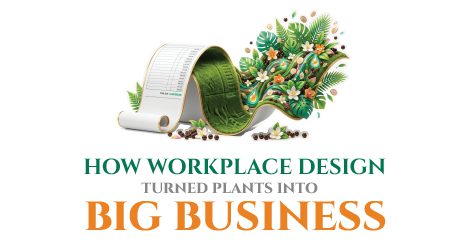
Somewhere in a corporate lobby in Dhaka, Kuala Lumpur, or London, a living wall is being installed today. Not a poster of a forest. Not a green-painted accent wall. An actual wall of plants, irrigation built into the structure, species selected by a biophilic design consultant, and maintained under a monthly service contract. The invoice will run to tens of thousands of dollars. The CFO approved it.
The office plant has had a remarkable career. It started as a pot in a corner, something the receptionist watered on Fridays. It is now a procurement category, a design discipline, a subscription business, and a talent retention strategy — all at once. The global indoor plants market is valued at $13.61 billion in 2026, with forecasts ranging between $16 billion and $30 billion by 2032, depending on the methodology. The biophilic design market — the broader discipline of which plants are the most visible part — will reach $3.14 billion by 2028, growing at 10.2% annually.
None of this happened by accident. It happened because businesses started taking seriously what the research had been saying for years: the physical environment people work in directly affects how well they work. And once that argument won in the boardroom, the plant stopped being a decoration and became infrastructure.
The science behind it is consistent and has been building since the 1980s. People who work near plants report lower stress levels, better mood, and fewer headaches. Studies have linked biophilic design to a 15% improvement in productivity and creativity. The WELL Building Institute found in 2022 that 84% of respondents believe biophilic design improves employee wellbeing. A CBRE survey from the year before found that 75% of office occupants would pay extra for biophilic design features, which is an extraordinary number when you consider that most people have never used that phrase out loud.
The EPA’s figure that people spend roughly 90% of their time indoors does a lot of work in this conversation. It reframes the question from “why add plants?” to “why wouldn’t you?” If the quality of indoor environments affects health, focus, and mood, and people spend nearly all their time indoors, then the investment case for designing those environments well is straightforward. Plants are one of the most cost-effective tools available. They filter air, reduce noise, lower cortisol levels among nearby workers, and make a space feel less like a machine and more like a place a person might want to be.
The return-to-office problem plants are solving
The surge in demand that has turned plants into a serious corporate expenditure has one primary driver: the return-to-office push. As companies have competed to persuade hybrid workers to choose the office over their home desk, the physical environment has become a competitive argument. And the office has a problem that the plant is ideally positioned to solve.
A home office can have good broadband. It can have a comfortable chair and a decent monitor. What it almost certainly does not have is a living wall, a curated planting scheme, a moss installation, or the kind of considered natural environment that a professional designer can build into a corporate space. Biophilic design is one of the few things an office can offer that a kitchen table cannot. Employers are using it as exactly that.
In 2026, office design teams are treating greenery as a foundational element rather than a finishing touch. Plants, living walls, and natural textures are what designers call a new neutral — the baseline expectation for a workspace that wants to be taken seriously, rather than an upgrade. Requests for living walls, custom office planters, and lush greenery installations are running at levels that specialist firms describe as transformative compared to even three years ago.
A pot plant became a procurement category
The professionalisation of workplace greenery is the part of this story that most people outside the industry have not noticed. Plants in offices are no longer ordered from a garden centre and forgotten. They are specified by biophilic design consultants at the earliest stage of a fit-out project, procured through specialist vendors, installed by dedicated teams, and maintained under ongoing service contracts that include plant replacement, irrigation management, and seasonal rotation.
Living walls are now architectural features in their own right. A large installation in a corporate headquarters lobby — floor-to-ceiling, built-in irrigation, species chosen for air-purification performance and visual impact — can cost as much as a premium conference room fit-out. The market for these installations has its own supply chain, its own specialist contractors, and its own design software. It is not a niche.
Alongside living walls, the moss wall has become a significant category. Preserved moss panels require no water and no maintenance. They deliver the biophilic aesthetic and the acoustic benefits of natural materials without the operational overhead of live plants. Corporate clients who want the look without the service contract buy moss. The segment has grown fast enough that dedicated manufacturers now supply hospitality, retail, and corporate clients at scale.
Plant rental and leasing have also matured into a serious business model. Companies supply, install, and maintain plants on monthly subscription contracts, handling everything from watering schedules to replacements when plants decline. For businesses that want the benefits of workplace greenery without managing it themselves, the rental model removes the operational barrier entirely. The plant becomes a utility, billed monthly alongside the cleaning contract and the coffee machine.
The pandemic accelerated all of this in ways that are still playing out. Houseplant demand rose 18% during lockdowns as people sought comfort and connection at home. More significantly, years spent noticing what their living environment actually felt like changed what people expected from the spaces they work in. Workers who had surrounded themselves with plants at home for two years of remote work came back to offices with a new reference point. Employers who had neglected the physical environment found it harder to make the case for employees to come in.
That shift is permanent. Gen Z has deepened it further. In 2026, 41% of Gen Z consumers identify as plant collectors rather than casual owners. They have grown up treating plants as design objects, status signals, and wellness tools simultaneously. They notice when an office lacks them.
Sources: Mordor Intelligence — Global Indoor Plants Market Report (Jan 2026) · Data Bridge Market Research — Indoor Plants Market Forecast 2032 · Global Market Insights — Biophilic Design Market Report (2023) · WELL Building Institute — Biophilic Design Survey (2022) · CBRE — Office Occupant Survey (2021) · Lawrence Group — Office Design Trends 2025 · Axiom — 2026 Gardening Outlook Study · Garden Media Group — 2026 Garden Trends Report · Spaces Taylored — Plants in the Workplace (2026) · Greenscape Design & Decor — Greenery Office Trends 2026 · Plant Solutions — The Science Behind Biophilic Design in Office Spaces