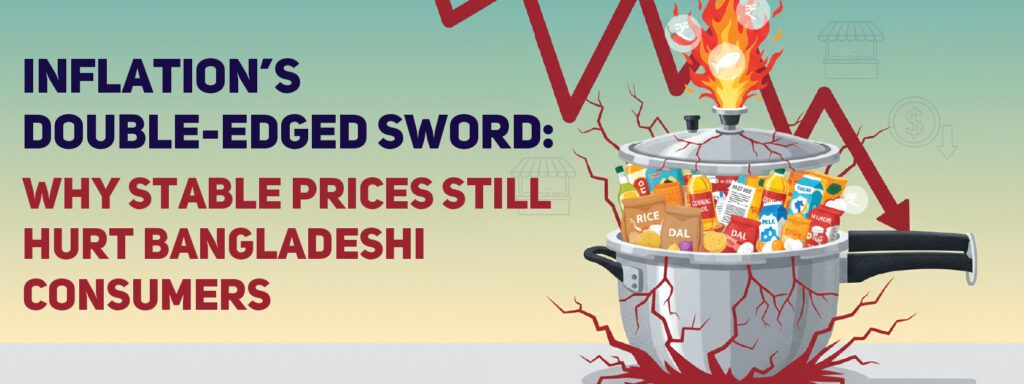
“Inflation is easing”, so why does it still feel so hard?
Headline inflation in Bangladesh has cooled from last year’s double-digit peaks, but most households don’t feel any relief at the bazaar or when paying utility bills.
In September 2025, the Bangladesh Bureau of Statistics (BBS) reported point-to-point inflation at 8.36%, up slightly from 8.29% in August, well below the highs seen in 2024, but still elevated for ordinary consumers. Even the central bank acknowledges the pressure: despite a dip to 8.48% in June 2025, average inflation for FY2024-25 was about 10%, the highest in at least a decade, prompting Bangladesh Bank to keep its policy rate at 10% for July–December 2025.
This article explains the paradox. “Stable” prices in macro terms don’t automatically translate into comfort for households. Past shocks have left scars on purchasing power; some prices are sticky on the way down; wages lag; energy and currency dynamics keep non-food costs high; and expectations, what economists call inflation psychology, remain fragile.
The illusion of stability
When economists say prices are “stable,” they mean inflation is no longer accelerating rapidly, not that prices have returned to their previous levels. In Bangladesh, food inflation that spiked above 14% in mid-2024 gradually eased through early 2025, before settling around 7.6% by July–September 2025. Yet that still means food cost levels are much higher than two years ago, even if their rate of increase has slowed.
This is why celebratory headlines can mislead. In September 2025, both food (7.64%) and non-food (8.98%) inflation ticked up, reminding us that “stable” is not the same as “low” or “affordable.” Moreover, the World Bank projects inflation will ease only gradually, remaining elevated in the near term before declining further with tighter policy and easier import conditions.
The double-edged sword of inflation
Edge 1: Yesterday’s inflation permanently eroded purchasing power
Inflation’s first edge is simple arithmetic. A 10% rise last year and “only” 8% this year add up to a cumulative hit to real incomes. Bangladesh’s average inflation in FY2024-25 was about 10%, meaning a family’s taka bought roughly one-tenth less than a year earlier, and that loss doesn’t reverse automatically when inflation cools.
Wages have not kept up. For months on end, the BBS Wage Rate Index (WRI) shows nominal wage growth below inflation, implying negative real wage growth for low-paid workers across agriculture, industry, and services. As of mid-2025, analysts counted dozens of consecutive months in which inflation outpaced wages, forcing households to cut back on protein and switch to cheaper foods. Bangladesh Bank’s own analysis admits that while the wage-inflation gap narrowed in Q4 FY25, real wages remained negative, confirming that purchasing power has yet to recover.
Edge 2: Structural vulnerabilities keep costs high even when global prices are calm
Bangladesh is import-dependent for key commodities and energy. The taka has depreciated significantly since FY2021; in 2025, the USD/BDT rate hovered around Tk 121–122 per dollar, amplifying the local-currency cost of imports and pushing up prices across the supply chain. The central bank’s recent monetary policy documents and local analyses also note that taka depreciation has had a substantial pass-through to domestic prices, keeping Bangladesh’s inflation higher than regional peers.
At the same time, administered energy prices rose. In February–March 2024, the government raised electricity tariffs by about 8.5% on average and increased gas tariffs for power and captive power users, steps meant to reduce subsidies but which filtered through to transport, manufacturing, and household utility bills. In April 2025, new industrial and captive gas connections faced a further 33% tariff hike, increasing production costs for energy-intensive sectors such as textiles and steel, which tend to be passed on to consumers.
Why consumers still hurt despite “stable” inflation
1) Sticky essentials and non-food pressures
Economists talk about downward price stickiness once prices climb, they don’t fall easily. In Bangladesh’s CPI, non-food inflation stayed close to 9% through mid-2025, driven by clothing, rent, and energy-related items. Even as food inflation cooled from 2024 highs, non-food categories kept household budgets tight. September 2025 data show non-food inflation at 8.98%, indicating that cost pressures are broad-based.
2) Wages lag, especially for informal workers
The Wage Rate Index tracks 63 low-paid occupations. The pattern since 2023: wage growth below inflation for over three years, meaning real incomes fell even as nominal pay rose. That’s the meat of the discomfort households feel when inflation is “lower” but not low. BBS’s monthly CPI/WRI bulletins document the nominal wage upticks, but the gap with CPI is what matters for consumption and it is still there.
3) Currency pass-through keeps import-heavy baskets expensive
A large share of household budgets’ food oils, wheat, sugar, pulses, milk powder, and fuel is imported. With the taka around Tk 122 per USD for much of 2025, even modest global price declines translate into smaller, slower relief at the checkout counter. Bangladesh Bank’s MPS and local analyses explicitly link elevated domestic prices to the taka’s depreciation and the import content of consumption.
4) Utilities and the energy cost floor
Frequent tariff adjustments, part of a necessary fiscal consolidation and IMF-supported reforms, created a higher cost floor for businesses and households. The February–March 2024 rounds raised electricity and gas tariffs; the April 2025 BERC decision lifted gas tariffs for new industrial and captive users by 33%. Even if international LNG prices fluctuate, this domestic tariff structure limits how quickly retail prices can fall.
5) Expectations and household psychology
After two years of 9–12% inflation, households expect high prices to persist. That expectation itself can be inflationary, as firms pre-emptively set higher prices and consumers rush to make purchases. The World Bank’s 2025 update notes inflation remains elevated. It will likely ease only with sustained policy discipline and better import access, a realistic, but gradual path that does not reset expectations overnight.
Policy blind spots: Why macro victories don’t feel like relief at home
Headline vs. Household: Policymakers target headline CPI, but families care about food, rent, transport, utilities, and school costs, items with disproportionate weight in their budgets. With non-food inflation near 9% and utility tariffs ratcheting up, the lived experience diverges from the macro narrative.
Wages and labor markets: Monetary tightening can dampen demand and inflation, but it doesn’t automatically lift real wages, especially in informal labor markets, where bargaining power is limited and indexation is absent. BBS and media analyses show real wage declines persisting through early to mid-2025.
Exchange rate transmission: The move toward a more flexible, market-based exchange rate and the end of administered caps are necessary reforms, yet the pass-through to domestic prices can keep inflation sticky for a while, especially in an import-dependent economy. Bangladesh Bank’s MPS and IMF staff reports flag this trade-off. They advise keeping the policy rate at 10% until inflation clearly trends toward the 5–6% target range.
Poverty impacts: Multiple sources indicate that prolonged high inflation slowed poverty reduction and, in some estimates, pushed more people into extreme or moderate poverty in FY24–FY25, because food absorbs over half of poor households’ budgets. The World Bank’s updates warn that while inflation may moderate with reforms, the near-term burden on poor and vulnerable groups remains substantial.
The way forward: Practical steps that turn stability into relief
1) Protect real incomes for the most vulnerable
- Scale up and sharpen safety nets during food price spikes, with better targeting through digital ID and mobile money to reduce leakages. International assessments emphasize that food price shocks have been the main driver of hardship; cushioning them delivers the fastest welfare gains.
- Consider temporary wage indexation for public works and selected low-wage programs, so wages adjust when the CPI breaches a threshold (e.g., >8%). BBS WRI shows low-paid workers have borne the brunt of real wage erosion. 2) Tame non-food inflation at its roots
- Energy pricing + efficiency. Continue moving toward cost-reflective energy prices, but pair tariff hikes with time-bound, targeted relief for small firms and low-use households, and tackle system losses (theft, leakage) that inflate costs. Recent tariff reforms help fiscal sustainability; addressing inefficiencies ensures consumers aren’t overpaying for waste.
- Logistics and market competition. Non-food inflation remains high, partly due to bottlenecks and concentrated wholesale markets. Improving transport corridors, storage, and market information can compress margins that consumers pay. World Bank analysis links elevated inflation to weak market competition and transmission.
3) Secure food supply and smooth price cycles
- Rice and wheat policy. Permit timely private imports when domestic harvests are at risk; maintain adequate public stocks to stabilize expectations. Economists warn that relying solely on monetary tools won’t fix supply-side inflation.
- Climate resilience. Floods in 2024 added to food volatility; investments in resilient storage, irrigation, and early-warning systems reduce future spikes. IMF staff reports and development updates note that shocks have compounded inflation persistence.
4) Keep monetary policy credible—but coordinate it better
- Hold the line on the policy rate until inflation expectations clearly fall toward 5–6%, as advised by IMF reviews and consistent with Bangladesh Bank guidance. Premature easing risks undoing gains.
- Let retail interest rates transmit policy. Removing caps and avoiding unsterilized liquidity injections into weak banks improves transmission and reduces the risk of fueling credit booms that reignite inflation.
5) Manage the exchange rate transition
- Stable, flexible FX. A market-based regime with clear communication cushions one-off shocks. Given the Tk 121–122 per USD range in 2025, policy should aim to prevent abrupt overshooting that would re-ignite imported inflation.
- Ease import frictions for essentials. The MPS signaled easing import restrictions on key foods; timely LCs for essentials help bring down spot prices felt by consumers.
6) Reignite growth where it supports disinflation
- Private investment at low gear. Tighter money has curbed demand, but growth must revive through reforms that don’t fuel inflation financial sector cleanup, better tax policy, and trade facilitation. The World Bank’s 2025 update projects a gradual recovery if reforms proceed.
- Export competitiveness under higher energy costs. Pair tariff rationalization with energy efficiency and targeted incentives so firms don’t simply pass higher costs to consumers. Analysts warn that the April 2025 gas tariff change weighed on energy-intensive exports; mitigation matters.
What this means for a Bangladeshi household
Even if monthly CPI is steady, the food basket remains expensive relative to 2022; rent and utilities sit on a higher plateau; the taka’s weaker value keeps imports dear; and the wage likely hasn’t caught up. This is why “inflation is down” doesn’t feel like “life is affordable.” The data confirm it: 8.36% inflation in September 2025, 10% on average in FY25, non-food near 9%, USD/BDT ≈ 122, and real wages still negative.
There is light ahead. The World Bank expects inflation to moderate further over the next 1–2 years if reforms stay on track, and the IMF suggests a path toward lower inflation as policy remains tight and supply frictions ease. But turning macro stability into household relief needs coordination: market management for food, smarter energy pricing, competition enforcement, wage and safety-net support, and a steady, yet flexible macro framework.
Conclusion: Stability ≠ Relief (yet)
Bangladesh has taken hard steps toward a tight monetary policy, exchange rate reform, and energy subsidy rationalization. Those are necessary to tame inflation and rebuild credibility. But for households, the real test is when income catches up and essentials become reliably affordable.
Until then, inflation remains a double-edged sword. One edge is dulling headline rates are off their highs. The other is still sharp sticky non-food costs, currency pass-through, and wage lag keep cutting into living standards. The policy agenda is clear: protect real incomes at the bottom, fix supply bottlenecks and market power, keep monetary policy credible, and manage the FX transition smoothly.
When those pieces lock together, “stable prices” will finally mean relief at the kitchen table.
Sources (selected)
- Bangladesh Bureau of Statistics (BBS): Monthly CPI/WRI dashboards and September 2025 inflation. [tbsnews.net], [bbs.gov.bd]
- Bangladesh Bank / Monetary Policy: Policy rate at 10% (July–Dec 2025), stance and transmission. [thedailystar.net]
- IMF Reviews (June 2025): Inflation persistence, policy guidance, macro outlook under ECF/EFF/RSF. [imf.org]
- World Bank (2025): Bangladesh Development Update; inflation and growth outlook; poverty impacts. [worldbank.org]
- Exchange rate: USD/BDT trends and monthly averages in 2025. [theglobaleconomy.com], [exchange-rates.org]
- Energy tariffs: 2024 electricity and gas price hikes; April 2025 gas tariff changes. [cpd.org.bd]
- Wages vs. inflation: Wage Rate Index coverage and media analyses. [thedailystar.net]
Author: Abu Yousuf Abdullah