Bangladesh Grows a Fortune in Fruit and Lets a Third of It Rot. Closing the Processing Gap May Be Its Largest Overlooked Industry.
Mango, jackfruit, pineapple and guava pour out of the orchards each season, far faster than the country can sell or store them. The waste is staggering. So is the opportunity buried inside it.
Every summer, Bangladesh performs the same costly ritual. The orchards of Rajshahi and Chapainawabganj fill with mangoes, the jackfruit trees of the central districts bend under the weight of the national fruit, and within weeks far too much of it is rotting in the heat. Prices collapse at the peak of the season, farmers sell at a loss or watch the surplus spoil, and a country rich in fruit quietly imports processed juice and pulp from abroad. It is a paradox of plenty, and inside it sits one of the largest untapped industrial opportunities in the economy.
The issue is not how much fruit Bangladesh grows. It is how little of it the country manages to keep. The gap between the two, counted in spoiled harvests and forgone foreign exchange, is also the measure of the prize.
A harvest the country cannot keep
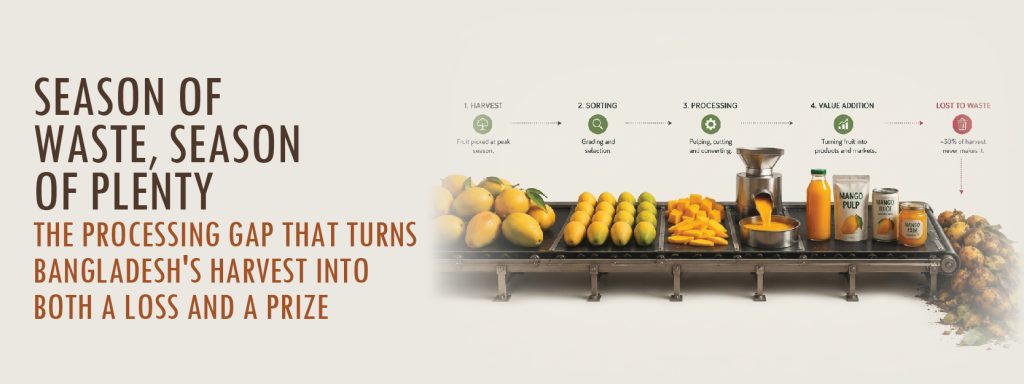
The raw numbers are striking. In 2024-25 Bangladesh produced about 7.52 million tonnes of fruit, according to Invest Bangladesh, part of more than 40 million tonnes of fruit and vegetables a year. Yet the Food and Agriculture Organization estimates that close to 30 percent of that produce is lost after harvest, before it reaches a paying customer.
For individual crops, the waste runs deeper. Bangladesh is the world’s second-largest producer of jackfruit, its national fruit, and a 2023 assessment found that roughly 45 percent of the harvest, about 500,000 tonnes, is lost each year for want of storage and processing. Mango, where the country ranks around seventh in the world, loses somewhere between a fifth and two-fifths of its crop along the supply chain, with one Bangladeshi value-chain study putting the figure near 34 percent, much of it because the main growing districts sit far from the consumption centres of Dhaka.
Converted into money, the loss is enormous. At a fruit-processing roundtable held in Dhaka in late June 2026, experts estimated that Bangladesh forfeits between Tk 25,000 crore and Tk 50,000 crore worth of fruit every year, purely because it cannot process and store what it grows.
| Tk 25,000–50,000cr the value of fruit Bangladesh loses every year for want of processing and storage. (Industry roundtable, Dhaka, June 2026) |
The 2.7 percent problem
Behind the waste sits a single, stubborn statistic. Bangladesh processes only a tiny share of what it grows. A widely cited benchmark puts the national processing rate at about 2.7 percent, the lowest in Asia, against 15.3 percent in the Philippines and rates running from 25 to as high as 90 percent for many crops in Japan and the United States. More than three-quarters of the country’s agricultural output leaves the farm entirely unprocessed.
The shortfall shows up in the wider economy. Agro-processing has contributed only around 2 percent of GDP, a share that has barely shifted since the mid-2000s, even though national policy set a target of 5 percent. The sector is not small for lack of raw material. It is small for lack of the machinery, cold storage, and capital that turn a perishable mango into a shelf-stable product worth selling all year round.
The headroom is the whole story: where peers process a quarter to nine-tenths of some crops, Bangladesh processes a fraction.
| THE SCALE OF THE GAP | |
| Fruit produced, 2024-25 | 7.52 million tonnes |
| Fruit and vegetables lost after harvest | ~30% |
| Jackfruit harvest wasted each year | ~45% (≈500,000 t) |
| National produce-processing rate | ~2.7% (lowest in Asia) |
| Agro-processing share of GDP | ~2% (static since mid-2000s) |
| Annual fruit loss to weak processing | Tk 25,000–50,000 crore |
Sources: Invest Bangladesh; FAO; Bangladesh Ministry of Commerce; industry estimates, 2026.
Why the fruit rots
The causes are well understood, and most of them are fixable. The first is the cold chain, or the absence of one. Without enough refrigerated storage and transport, fruit picked at the seasonal peak has nowhere to wait, so it must be sold or lost within days.
The other barriers compound the first. Seasonal gluts crater prices exactly when supply peaks. High-interest financing makes it hard for small processors to invest in equipment. And only about 12 percent of the country’s processors are certified to international safety standards such as ISO or HACCP, which shuts them out of the high-value export markets where the real margins sit. None of these is a law of nature. Each is an investment waiting to be made.
The opportunity hiding in the loss
Here is the part that should interest investors, because the same figures that describe a problem also describe a market. Agro-processing suits Bangladesh unusually well. A small fruit-processing plant can be set up for somewhere between 50,000 and 100,000 dollars, a fraction of the two to five million a mid-sized garment factory demands, and it runs on crops the country already grows rather than on imported inputs.
The momentum is already building. Bangladesh’s processed-food sector has expanded by around 8.3 percent a year since 2020, comfortably ahead of the roughly 5 percent growth of the ready-made-garment industry that dominates the economy. The food-processing sector is now valued in the billions of dollars, and its leading firms are proving the export model works.
We are required to develop a premium-quality product range.
— Kamruzzaman Kamal, Director (Marketing), PRAN-RFL Group
There is a ready beachhead, too. Bangladesh’s diaspora of some 15 million people, concentrated in the United Kingdom, the United States, the Gulf, Italy, and Malaysia, already buys home brands abroad, and PRAN’s success selling mango juice to non-Bangladeshi shoppers in the Middle East shows how an ethnic-aisle product can cross into the mainstream. The global agro-processing market is worth well over 4 trillion dollars; capturing even a sliver would reshape the country’s export mix.
| WHY THE OPPORTUNITY IS REAL NOW | |
| Entry cost | $50k–100k plant vs $2–5m for apparel |
| Sector growth | ~8.3% a year since 2020 (vs ~5% RMG) |
| Tax | Reduced corporate tax for investment before 2030 |
| Export incentive | 20% cash on local-pulp juice exports (Nov 2024) |
| Market access | Duty-free entry to 52 markets, incl. EU and Gulf |
| Global market | Agro-processing worth over $4 trillion |
Sources: The Business Standard; Bangladesh Bank; Invest Bangladesh, 2024–26.
What the leaders already show
PRAN-RFL is the clearest proof of concept. Widely described as one of the country’s most diversified exporters, it ships nearly 1,500 products, most of them agricultural and processed-food goods, to around 145 countries. Its exports reached close to 450 million dollars in 2024-25, up about 12 percent on the year, making it the only non-garment group in Bangladesh’s top ten exporters, with a stated ambition of 2 billion dollars by 2030. Additionally, the FAO has worked with Bangladeshi jackfruit growers under its one-country-one-priority-product programme to raise yields and cut waste at the source.
The regional benchmarks show how much room remains. Thailand, through its village-enterprise OTOP scheme, exported 5.88 billion dollars of fruit in 2022, including the processed jackfruit that Bangladesh lets spoil. Vietnam exported some 62 billion dollars of food in 2024; Bangladesh’s agro-processing exports, at roughly 1.2 billion dollars, are a sliver of that. The gap is not a verdict. It is a map of where Bangladeshi exporters can still go.
Closing the gap
Capturing the prize calls mostly for the unglamorous infrastructure of a modern food industry: cold storage near the orchards, affordable finance for small processors, accredited testing labs, and certification support to clear the safety bar that Western retailers demand. The policy direction is already encouraging. The Export Promotion Bureau has earmarked 15 million dollars to build 50 village processing clusters fitted with packaging and cold storage. In November 2024 the central bank restored a 20 percent cash incentive on exports of juices and drinks made from locally sourced fruit pulp. Investors who enter before 2030 qualify for years of reduced corporate tax, and Bangladeshi processed food already enjoys duty-free access to 52 markets, including the European Union and the Gulf.
The raw material is already in the ground, harvested every year whether the country is ready for it or not. What Bangladesh has lacked is not fruit but the means to keep it, and that is exactly the kind of gap that rewards the people who move first. Turn even a portion of the annual loss into product on a shelf, and a seasonal embarrassment becomes a year-round industry. The harvest is ripe. For now, it is also undersold.
Author: TASNIM SAFWAN