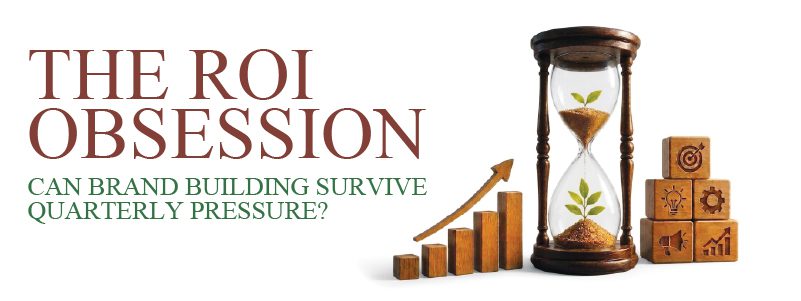
Every quarter, boardrooms in Bangladesh reverberate with questions like: How much sales did the campaign generate? What was the ROI? How much revenue was generated through Facebook ads? Marketing partners start showing dashboards laden with clicks, impressions, conversions, and cost-acquisition. If they fail to achieve enough numbers, budgets are quickly shifted towards campaigns delivering faster results.
In this mad dash for short-term gain, there is one important investment that is becoming increasingly neglected — brand building.
The irony is striking. Companies live and die by quarterly earnings, but consumers have long memories; they trust brands over the course of years, not weeks. So the question stands: is there hope for brand building in a climate of short-term ROI pressure (in this case, Bangladesh)?
Bangladesh’s New Marketing Reality
Bangladesh has made impressive strides in economic development in the last ten years. The presence of a fast-growing middle class, high internet penetration, and prevalence of smartphones and social media has led to changes in how companies interact with their customers.
Currently, the use of Facebook, YouTube, TikTok, and Google Ads allows companies to track clicks and conversions almost instantly. Whether a company holds a flash sale via its e-commerce website or a telecommunications company promotes its data packages, the success of marketing efforts is measured through results.
This shift has made performance marketing the preferred choice for many organizations. After all, numbers speak loudly in quarterly business reviews.
However, the numbers do not always tell the whole story.
The Cost of Chasing Quick Wins
Performance marketing is very efficient in producing instant results. But very few times does it create another precious thing: a loyal customer.
Think about how competition works in Bangladesh. The banks have the same range of financial products to offer. Internet packages are pretty much alike for all mobile operators. There is not much difference between the products offered by FMCGs.
They stay because they trust a brand.
“People do not buy goods and services. They buy relationships, stories, and magic.”
— Seth Godin
That relationship cannot be created through a single promotional campaign. It requires consistency, credibility, and emotional connection.
What the Research Tells Us
The research clearly shows the importance of investing in the brand over the long run.
The seminal study “The Long and the Short of It,” conducted by marketing experts Les Binet and Peter Field, proves that corporations will benefit more from a balanced approach involving both long-term brand building and short-term sales activation. It is recommended that many consumer brands invest around 60% of their marketing budgets in brand building and 40% in sales activation.
In addition, the Nielsen Annual Marketing Report 2024 revealed that:
ROI is still the top marketing goal for marketers.
Most marketers keep investing more in digital performance channels because success can be better measured. On the other hand, there is an opinion among many marketers that overemphasis on ROI will damage brand equity and business growth.
Despite being international surveys, the results hold true for Bangladesh because the firms in Bangladesh focus more on promotional strategies to earn quick sales rather than focusing on brand communication strategies.
“What gets measured gets managed”
— Peter Drucker
Lessons from Bangladesh
There have been numerous examples from Bangladesh where the brands have managed to survive fierce competition by building brands rather than just relying on promotional strategies.
Big organizations in telecommunications, FMCG, pharmaceuticals, finance, and consumer products have always focused not only on advertisements but also on storytelling, building customer trust, service, and social responsibility. In times of economic instability, such well-known brands usually gain greater customer trust compared to their young rivals who use mostly sales promotions and online advertising.
The above example proves that promotions bring customers, whereas brands retain them.
The Invisible Asset
Unlike a factory or equipment, a brand cannot be completely captured in a company’s balance sheet. But it can be the most important competitive edge that a company possesses.
What makes people in Bangladesh willing to pay a premium price for a well-known brand when there are other available choices that are cheaper?
What makes people suggest some companies to their family and friends without even asking?
What makes people forgive some brands for their mistakes but never go back to some other brands after just one mistake?
The answer is reputation.
A Literary Reflection
The struggle of ROI versus brand building can be compared to an allegory of the hare and the tortoise.
Performance marketing is the hare: fast, full of energy, and able to achieve quick successes.
Brand building is the tortoise: patient and consistent.
The quarterly report glorifies the hare.
History will remember the tortoise.
The same example can be used as a metaphor for business nowadays. The firm that cares about quick sales alone is like a farmer harvesting crops every season without renewing the soil. In the end, there will be less and less of a harvest despite the efforts of the farmer.
Beyond the Dashboard
Data has been a great addition to marketing. Companies should definitely track their ROI and be responsible for all of their marketing expenses.
Still, not all of the most beneficial results that businesses generate can be quantified right away. Trust cannot be determined instantly. Reputation cannot be squeezed into a spreadsheet. Love for the brand cannot be measured solely with the help of click-through rates.
“The aim of marketing is to know and understand the customer so well that the product or service fits them and sells itself.”
— Peter Drucker
And that is why the comprehension of customers involves not only numbers but also imagination.
The Way Forward for Bangladesh
With the emergence of Bangladesh as a higher-income country, it is time for its companies to look further ahead than the immediate bottom line. It will not be enough to have successful campaigns or promotions to beat competitors regionally and internationally. They will need to create brands that inspire admiration, trust, and recall.
The most successful companies from Bangladesh will probably be those that manage to achieve a balance between short-term success and long-term reputation and make use of data-driven decision-making without being data-driven.
“ROI must continue to guide companies’ decisions, but must not be everything.”
The debate is not whether ROI matters; it certainly does. Businesses need to make money, keep their stockholders happy, and maintain financial discipline. What’s more difficult is making sure the drive for immediate success does not come at the cost of long-term value.
The future business leaders of Bangladesh are not going to be the firms that sell the most products today. They’re going to be the businesses that gain the most trust over the decades to come.
Author: MD. NADIM AHMED