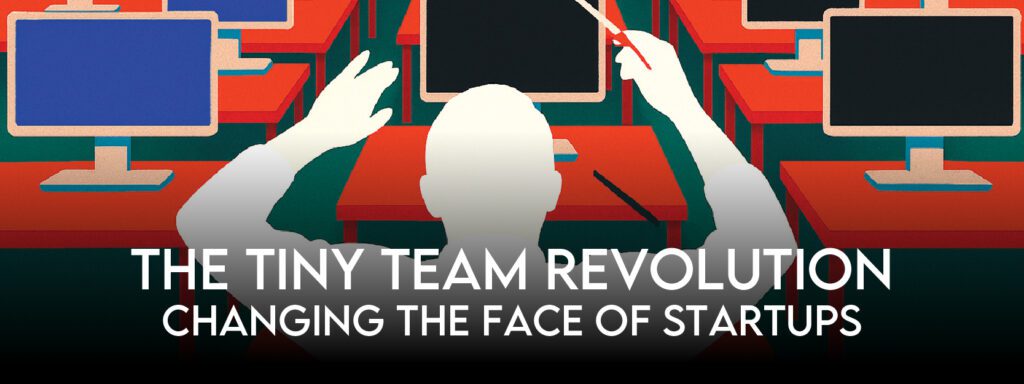
What if the next billion-dollar startup didn’t come from a Silicon Valley skyscraper, but from a small apartment? Traditionally, scaling up a business required hundreds of people to manage operations, logistics, customer relations, and more. Today, however, AI models can easily automate what used to be the work of entire departments. A single founder with the right tools can now replace layers of management — think of it as piloting a battleship with a joystick. It gives you the power and control you need. And the best part is that if you’re early in your career, you could be the one steering the battleship.
We are witnessing a fundamental shift in how successful companies are being built. Increasingly, companies are maintaining small teams and achieving profitability earlier than ever in their lifetimes. Much of this is driven by the rise of AI tooling. These companies are generating millions in revenue with teams smaller than most startups’ engineering departments. The age of bloated teams and endless hiring rounds is over. Welcome to the era of tiny teams.
But don’t confuse tiny with weak. Small teams are sharp, agile, and free from bureaucracy. They move fast, without waiting for approvals or navigating layers of management that slow things down. Large companies certainly have resources, but tiny AI startups have velocity. And in a world where speed beats size, velocity is everything.
Global Perspective on AI Startups with Tiny Teams
One of the biggest differences between the next ten years and the last ten will be how much a single person or a small group of highly capable people can accomplish. This is a bigger deal than it might sound. When individuals are empowered with more knowledge, better tools, and greater resources, the change becomes profound. What one person or a small team can achieve will be truly remarkable.
Industry heavyweights like OpenAI CEO Sam Altman forecast the emergence of several one-person unicorns. AI has the potential to amplify individual strengths, as AI tools enable teams of all sizes to undertake diverse business responsibilities without expanding. Carta claims that solo founders now comprise 35% of the 2024 cohort, representing an increasingly significant portion of the startup ecosystem.
Globally, numerous companies are achieving remarkable feats with very few people. Many startups are even using AI to invent AI itself, scaling through the same technology they create. Sectors like fintech, e-commerce, healthcare, SaaS, and even defence technology are all being transformed by AI-powered ventures.
Cursor by Anysphere
Launched in 2023, Cursor reached $200 million in annual recurring revenue (ARR) within just 21 months, powered by a team of only 20 people. The company has rapidly become a leader in AI-powered coding tools, proving how small teams can build at a massive scale.
Bolt by StackBlitz
Founded in 2024, Bolt achieved $40 million in ARR in just two months with a lean team of 15. Its browser-based development platform demonstrates how AI and automation can dramatically accelerate both product development and business growth.
Lovable
Established in 2024, Lovable grew to $17 million in ARR within two months, driven by a compact team of 15. By leveraging AI to streamline software creation, the company exemplifies how tiny teams can swiftly turn ideas into revenue-generating products.
Midjourney
Founded in 2021, Midjourney reached $200 million in ARR in just two years with a team of only 11. Its success in AI-generated art has made it one of the most striking examples of how small, highly skilled teams can revolutionise creative industries.
Why Smaller Teams Are Thriving in AI Startups
The shift towards smaller teams is particularly evident in AI-driven startups, and this model is proving remarkably effective. While artificial intelligence reshapes how companies operate, many emerging ventures are discovering that staying lean offers distinct advantages. It allows them to move faster, innovate more boldly, and reach profitability sooner than their predecessors.
Vertical AI Specialisation
AI startups are focusing on vertical AI applications tailored to specific industries rather than developing foundational AI models. These solutions provide highly personalised, AI-driven products that target niche industries such as healthcare, finance, legal tech, and recruitment. Startups operating in these specialised markets face less competition and deliver higher-value products that attract investment and enable early market dominance.
For example, startups are now using AI to automate financial modelling for hedge funds or to streamline legal document analysis, securing lucrative contracts with corporate clients. Rather than competing with OpenAI or Google to build general-purpose AI, these firms are leveraging AI to their strategic advantage.
Agility in Execution
The agility of small teams enables them to pivot when necessary and iterate quickly — a crucial advantage in a rapidly changing field. Faster decision-making results in shorter product development cycles. With fewer layers of bureaucracy, teams can respond swiftly to market shifts and customer feedback. This operational nimbleness gives small AI firms a decisive edge over larger rivals, who often struggle to adapt quickly due to organisational inertia.
Lower Burn Rate and Higher Efficiency
AI startups are learning to use their resources wisely. Instead of building large, costly teams, they focus on what truly drives growth. Customer acquisition fuels early revenue, while investments in cloud infrastructure enable efficient scalability. Hiring top talent only for critical roles ensures maximum impact with minimal waste. This focused approach reduces the financial burden of maintaining large, redundant workforces while remaining lean and highly efficient.

Challenges AI Startups with Tiny Teams Face While Scaling
While small AI teams excel in speed and innovation, scaling introduces new hurdles that can slow progress and strain resources. Maintaining the balance between agility and scalability becomes a defining challenge as these startups grow.
Scaling AI Infrastructure
As user bases expand and AI models grow more complex, startups must scale their infrastructure accordingly. Many struggle to manage data pipelines, cloud costs, and backend performance at scale. To stay ahead, founders must invest early in skilled AI engineers and infrastructure leads capable of building robust, future-ready tech stacks.
The Talent Bottleneck
Hiring the right people remains one of the toughest challenges in AI. Startups need experts in machine learning, data science, and AI ethics — yet top-tier talent is scarce. Partnering with specialised recruiting firms can help secure skilled professionals faster and avoid costly hiring delays.
Maintaining Product Focus
Growth often brings pressure to cater to individual client demands, which can dilute a product’s core value through over-customisation. Successful founders stay disciplined with their product roadmaps and prioritise scalable solutions. This approach ensures they serve a broader market without losing direction.
The Changing Roles Within AI Startups
AI doesn’t merely remove the need for staff — it multiplies output. One researcher can train models that write, design, and analyse. Another engineer can launch features worldwide overnight through cloud computing. A strategist can test a thousand market ideas in parallel without hiring anyone new. It’s like having a legion of efficient interns who never rest.
But this raises an uncomfortable question: if one person can achieve what once required a hundred, what happens to the hundred? Corporate middle layers are already crumbling. Routine work is disappearing by the day. The corporate ladder many aspired to climb may soon no longer exist. For those at the start of their careers, this can feel both terrifying and liberating.
Jobs are not vanishing — they are shifting. The winners will be those who learn to command AI rather than compete against it. It’s a choice between being replaced and being the one who replaces. Corporate life trains people to specialise — to be the finance expert, the cloud architect, the marketing lead. Tiny AI startups, however, don’t want specialists; they want hybrids — individuals who can design, code, and pitch all in the same week. Being good at just one thing is no longer enough.
For career changers and newcomers, this is exciting. You’re entering a time when flexibility outweighs experience. It’s your chance to showcase your unique mix of skills. Big companies measure output per employee. AI startups measure output per algorithm. That’s why headlines now read, “Five engineers built a product with one million users.” The traditional growth model — hiring more to do more — is breaking down. The new model is training smarter systems to achieve more. The larger the model, the less human effort it requires.
The ambition behind these tiny AI teams is audacious. They don’t simply aim for market share — they aim to redefine how industries operate. Healthcare, finance, education, and other human-intensive sectors are all ripe for disruption. A small group of people, armed with AI, can rebuild these industries from scratch. It may sound dramatic, but history suggests otherwise. Airbnb didn’t own hotels, nor did Uber own cars. And now, AI startups don’t need massive workforces — they just need courage and code.
The Road Ahead
AI empowers startups to innovate at unprecedented speed, but it’s not a guaranteed formula for success. Scaling still requires human expertise, strategic hiring, and long-term planning. Founders of small AI startups must balance efficiency with sustainability to avoid both premature expansion and stagnation.
Investors, too, should evaluate whether a startup’s team structure supports its long-term goals before investing. The winning startups will be those that remain agile while laying the foundations for scalable, sustainable growth.
Author: Irtiza Zaman