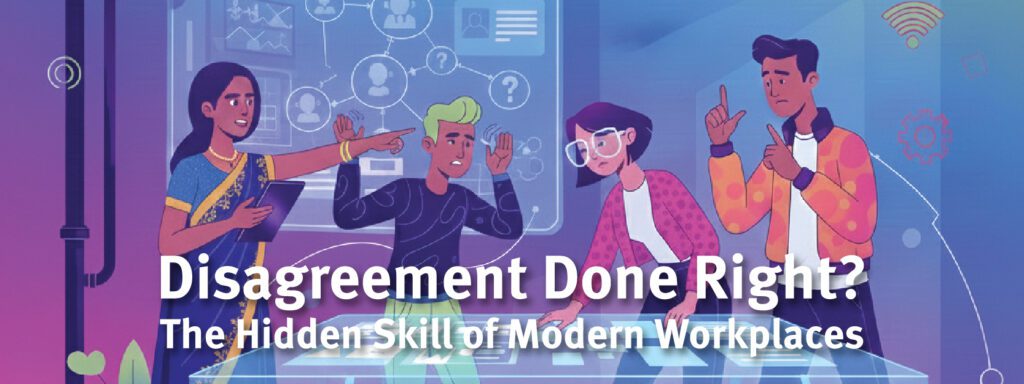
In today’s world, diverse perspectives are not just common; they are essential. Each individual brings unique beliefs, experiences, and ideas, and together, these differences form the foundation of creativity. Wherever constructive work takes place, disagreement follows closely behind. If we treat disagreement as an opposing force, we limit our ability to grow in modern workplaces and in life.
We live in a fast-paced world where both employers and employees strive to keep up. Employers may take bold decisions, while employees propose new ideas. When these perspectives diverge, disagreement naturally arises. If left unmanaged, such disagreements can block progress and distance teams from success.
However, the truth is simple: creative work is born from differences. History shows that groundbreaking ideas rarely emerge from quick, easy consensus. What everyone agrees on usually becomes routine. What people challenge and debate becomes innovation. Success, ultimately, comes from transforming fresh ideas into meaningful action.
The saying “Where there is a will, there is a way” holds profound relevance today. Disagreement has become a regular part of conversations at work, at home, and in society. Yet we often misinterpret it as hostility. When we instead view disagreement as a natural catalyst for improvement, we unlock better results. Modern problems require modern solutions.
Revolutionary outcomes often arise from tension, disruption, and critical debate. These small “revolutions” in the workplace make companies stronger. According to a 2023 McKinsey analysis, companies that encourage innovation outperform competitors by 67% in revenue growth. Google famously allows employees to spend 20% of their time on passion projects, a policy that has produced Google News and AdSense, and other breakthroughs. When embraced with the right mindset, disagreement becomes an engine, not an obstacle.
Workplaces bring together people with diverse attitudes, backgrounds, and emotional states. Some individuals may bring biases, uncertainty, or insecurity into discussions, which can block the flow of creativity. A truly productive workplace requires respect, active listening, and the willingness to treat every idea as valuable.
Good behavior is not optional; it is the foundation of collaboration. When employees feel respected, they share more freely. When leaders maintain humility, they receive richer contributions from their teams.
As the saying goes, “Any man who must say, ‘I am the king,’ is no true king.” Authentic leadership involves listening. A strong workplace culture mirrors this truth: no person, employer, or employee should cling to superiority or bias. Respect fuels creativity; arrogance destroys it.
The same coffee, the same meetings, the same routine, in plain English, it is easy for monotony to dull creativity. But creativity is not a mysterious gift reserved for artists. Anyone can tap into it with the right environment.
However, emotions can disrupt this process. When strong personal feelings influence decisions, especially biases or preferences toward specific individuals, creativity suffocates. There is no room for emotional favoritism in a healthy workplace. What matters most is clear thinking and openness to others’ perspectives. Opinions matter. Minds generate ideas; employers help execute them. When both sides focus on objectivity and understanding, creativity thrives.
We often think deeply about our ideas but forget to consider how to present them. Sharing ideas effectively is an art. Modern workplaces require modern approaches. One innovative method is to support ideas with evidence. For example, if you anticipate disagreement, you might start by saying: “I have an idea, and my research shows that 70% of users prefer this approach.”
Research adds weight to ideas and reduces resistance. Employees who adopt the mindset of “know the unknown and see the unseen” create opportunities for themselves. Desire—the desire to learn, grow, and express ideas well often wins over mere boldness. Those who desire improvement not only adapt but also shine.
Employers carry heavy responsibilities. When they appear frustrated or distant, we often mistake it for arrogance. But we cannot read minds or feel what others feel. Therefore, when disagreements arise, we must avoid quick judgments.
Workplaces are evolving. It is no longer just employers dictating how things are done; employees now play an active role in shaping their environment. Change is constant, and once we learn to embrace it, work becomes more enjoyable.
Every conversation is an opportunity. Every idea holds potential. Methods, approaches, and attitudes matter. In a competitive world, creativity becomes the most valuable asset. Chaos is everywhere, but those who handle disagreement with innovation and maturity are the real winners.
Author: MD. Nadim Ahmed
M.A. in English Language Teaching
Jahangirnagar University
Email: nadim@bangladeshbrandforum.com