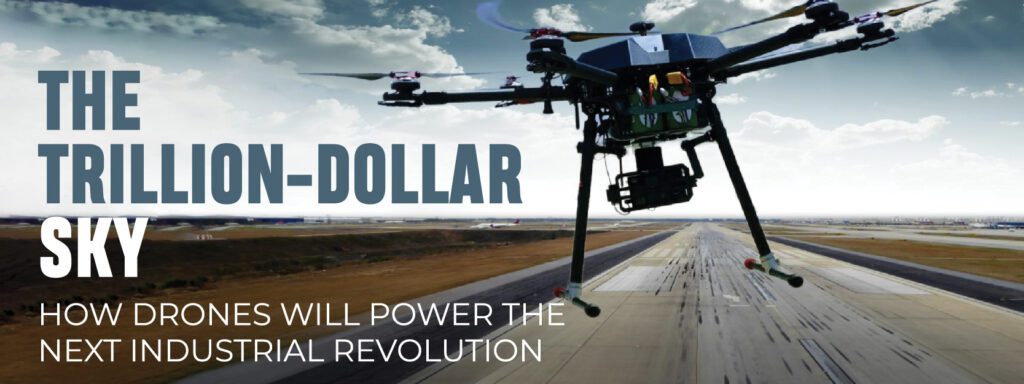
Look toward the sky in 2025, and the picture has already changed. Birds and passenger aircraft share airspace with buzzing quadcopters over farmland, logistics tests in suburban neighborhoods, and military drones on distant frontlines. What was once a niche tool has become a visible global technology.
By 2040, drones are expected to move beyond their current role as support systems. They will shape national economies, alter the way conflicts are fought, and become part of the rhythm of city life. The stakes are serious. Airspace management, privacy, and security are under scrutiny. So are jobs and the broader structure of industries. Drones are not just a trend; they are laying the foundation for an aerial infrastructure that could one day stand alongside highways, shipping lanes, and mobile networks in importance.
How Drones Are Used Around the World Today
Industries across continents are finding practical reasons to adopt drones. Farmers now rely on them to scan crops, identify stress with specialized cameras, and apply pesticides more accurately than traditional machinery. Construction managers use drones to generate detailed 3D maps of work sites in minutes, a task that once required days. Energy firms have integrated them into inspection routines for pipelines and offshore rigs, reducing the risks carried by human workers. Even the entertainment industry has been transformed. Independent filmmakers, who once had no access to sweeping aerial visuals, now capture shots that previously required helicopters or large budgets.
Delivery experiments continue to dominate headlines. Rwanda has proven that drones can reliably deliver life-saving medicines to rural communities. North American pilots are testing grocery and parcel runs, while Japan is exploring postal deliveries as a way to relieve pressure on its shrinking workforce. Regulations still restrict full-scale deployment, but the steady expansion of trials suggests a rising demand for quicker, cheaper logistics.
In disaster zones, drones are proving indispensable. They track wildfires, map earthquake damage in hours, and deliver food or medical kits across flooded terrain. Aid groups now consider them standard parts of their emergency toolkit, helping cut response times dramatically.
The military remains the largest consumer of drone technology. Drones are now integral to reconnaissance, precision strikes, and electronic warfare. Their ability to reduce pilot risk is undeniable, but they raise difficult questions about accountability, escalation, and the ethics of semi-autonomous combat.
Regional adoption reflects local priorities:
- North America has integrated drones into delivery pilots, border surveillance, and inspections. The United States leads in incorporating them into regulated aviation systems.
- Europe ties growth to strict privacy and safety frameworks. Oversight is central, shaping how and where drones operate.
- Asia is the manufacturing hub. China dominates global hardware supply, while Japan and South Korea experiment with passenger and cargo drones to ease logistics pressures.
- Africa has embraced drones for humanitarian needs, with Rwanda and Ghana running national programs for blood and vaccine delivery.
- South Asia shows varied progress. India invests heavily in defense and agriculture, while Bangladesh has begun applying drones to farming, disaster mapping, and creative work, aiming to participate in this wider regional trend.
The picture is not uniform. Instead, drones adapt to the needs of each region—whether that means boosting productivity, extending healthcare, or reshaping military strategy.
Artificial Intelligence and the Push Toward Autonomy
The shift from manual piloting to autonomous systems is happening quickly, and artificial intelligence is the driver. In the past, drones needed direct operator control. Today, algorithms allow them to navigate, recognize obstacles, and complete tasks with limited human involvement.
Navigation is one of the clearest areas of progress. AI-enabled drones can chart safe paths through crowded skies, reroute around storms, and identify suitable landing zones. In agriculture, software interprets aerial imagery to spot pests or nutrient deficiencies. Security operations employ drones fitted with thermal sensors and recognition technology to monitor movement and assess behavior.
Researchers are now testing swarm intelligence. Dozens of drones can coordinate in real time to cover wide areas or pursue complex missions. During natural disasters, swarms could map destruction more quickly than human crews. On battlefields, the same concept could overwhelm defenses through sheer numbers.
But autonomy introduces risks. AI decision-making is often opaque, making it difficult to assign accountability when something goes wrong. Civilian accidents could occur if systems misinterpret data. Cybersecurity remains a major concern, as fleets of connected drones could be hijacked and weaponized.
Even with these challenges, the trend is clear. As AI becomes cheaper and more advanced, drones are evolving from remote-controlled machines into semi-independent systems that can make real-time choices.
Market Snapshot Today
From 2023 to 2025, the global drone market has been valued between 40 and 50 billion dollars. Defense remains the dominant segment, but commercial applications are expanding quickly.
Agriculture, construction, and logistics are among the most active sectors. Drones map fields, monitor infrastructure, and take over inspection work once handled by helicopters. In entertainment, aerial technology has widened access to shots once reserved for high-budget productions.
The global landscape shows clear divides. China dominates hardware manufacturing and exports worldwide. The United States leads in AI integration and regulated airspace systems. Europe emphasizes strict regulation, trying to balance innovation with public concern. Africa, while smaller in financial terms, is experimenting with some of the most innovative humanitarian uses.
The biggest obstacle is regulation. Licensing rules, airspace restrictions, and privacy protections vary sharply across countries. This slows down scaling but does not dampen investment. Governments and private companies continue to fund drones as a piece of future infrastructure.
Market Potential by 2040
By 2040, global drone markets could approach or surpass one trillion dollars. This growth depends not only on scaling today’s uses but also on new applications that are still early in development.
Passenger drones and air taxis capture the imagination the most. If safety and technical hurdles can be overcome, they could relieve congestion in megacities by moving commuters through the air. Companies in China, the United States, and the Gulf are pushing the concept aggressively.
Cross-border logistics may also shift. High-value goods could bypass clogged ports or airports, instead moving directly over short international routes by drone.
Climate monitoring and disaster prevention could rely heavily on fleets. They might measure greenhouse emissions, track glacier retreat, and provide early warnings for severe storms. For countries vulnerable to climate shocks, drone networks may become standard public infrastructure.
Defense is set to grow as well. Carrier-launched drones, swarms, and AI-guided reconnaissance could redefine military power balances. For states with limited budgets, drones may become cheaper substitutes for fighter jets or bombers.
The outlook suggests far busier skies than today, with commercial, civilian, and military flights all competing for the same space.
Key Themes and Impacts
Economic Shifts
Drone technology is likely to cut costs in agriculture, logistics, and energy inspection while creating new types of work in programming, maintenance, and traffic management. At the same time, courier and inspection jobs may decline. In regions with weak infrastructure, drones could help communities bypass poor roads by connecting markets and healthcare services directly.
Technology Challenges
Energy storage remains the biggest limitation. Extending flight times from minutes to hours would unlock new opportunities. Research into hydrogen fuel cells and solar-powered drones is advancing, though still experimental. Advances in swarm intelligence and AI expand applications but raise risks of system failure and cyber misuse.
Business Models
Both startups and large firms see drones as growth opportunities. Drone-as-a-service platforms may let small businesses use aerial technology without owning fleets. Partnerships between logistics providers, telecom networks, and governments could shape nationwide drone systems. The unanswered questions are regulation, liability, and public acceptance, which remain uneven across regions.
These forces explain why South Asia’s choices matter. While attention often falls on China’s production capacity or Europe’s regulatory frameworks, countries such as Bangladesh are testing how drones might deliver both economic gains and climate resilience.
Bangladesh: A Case Study in South Asia
Bangladesh has begun applying drones in agriculture and disaster response. Farmers use aerial imaging to monitor rice fields. NGOs employ them to map cyclone damage or deliver small medical packages. Media professionals are experimenting too, with independent filmmakers in Dhaka capturing aerial shots without relying on external contractors.
The country’s challenges are significant. Investment is modest, regulations are not yet comprehensive, and most hardware is imported. Still, the potential is strong. By 2040, drones could be central to flood monitoring, coastal surveillance, and even garment exports, where fast movement of samples and documents could speed up supply chains.
Compared with its neighbors, Bangladesh is at an earlier stage. India has made larger commitments to agriculture and defense. Sri Lanka has focused more tightly on disaster management pilots. But Bangladesh’s frequent exposure to natural disasters and its dependence on export industries make drones more than optional. If policymakers create clear regulations and support local innovation, Bangladesh could become an example of how drones can strengthen both resilience and economic growth in South Asia.
Security Challenges and Global Responses
Drones are also changing how the world thinks about security.
In Eastern Europe, their use in the Ukraine conflict has raised the possibility of accidents spilling into neighboring NATO countries. Russian strikes on civilian infrastructure highlight how drones can destabilize far beyond the battlefield.
In Latin America, Colombian armed groups have adapted drones for attacks on police and aircraft. These incidents reveal how accessible technology can be repurposed for organized violence.
Africa has seen drones intensify conflict in Sudan, where strikes on airports and hospitals have given irregular forces disproportionate reach.
The Indo-Pacific has introduced new worries with miniature surveillance drones, some reportedly insect-sized, capable of entering secure facilities unnoticed. Traditional radar is ineffective, forcing militaries to design new detection systems.
At sea, humanitarian missions in the Mediterranean have reported drone threats, extending disputes into maritime zones.
Businesses are not immune. Heavy reliance on Chinese-made drones has prompted debates in Washington about supply chain risks and data access. Counter-drone legislation lags, leaving police with limited authority against unauthorized flights.
Defense companies are moving quickly. NATO members and Indo-Pacific allies are investing heavily in electronic jammers, directed-energy weapons, and integrated detection systems.
These security dynamics affect the economy and society, too. Stricter regulations raise compliance costs. Insurance firms adjust coverage as drones share airspace with passenger planes. Urban residents question whether delivery drones could also be used for surveillance.
What This Means in the Near Term
Several challenges are already pressing:
- Cross-border incidents could drag uninvolved states into disputes, underscoring the need for international safety agreements.
- Non-state actors have shown how drones can be weaponized, pushing governments to expand detection and revise legal frameworks.
- Miniaturized drones demand new sensors and consistent legislation to counter surveillance abuse.
- Supply chain risks could drive protectionist policies unless manufacturers commit to transparency.
- Fragmented airspace governance increases the chance of collisions or unauthorized monitoring.
- Autonomy is advancing rapidly in offensive systems, raising the risk of escalation if defenses fail to keep pace.
Future Outlook
By 2040, the drone age will be shaped not just by technology but by choices. Governments will decide how to balance surveillance and privacy. Businesses will weigh responsibility against profit. Citizens will determine how much convenience they are prepared to exchange for security.
One version of the future sees drones embedded in daily life, delivering medicine, transporting passengers, and monitoring the climate. Another sees skies fragmented and militarized, where risks outweigh benefits. In reality, both scenarios are likely to unfold side by side, depending on local decisions.
What is clear is that drones are no longer experimental. By 2040, they will be part of the global landscape. Whether they lift societies upward or burden them with new threats will depend not only on engineers and investors but on political choices made in the years ahead.