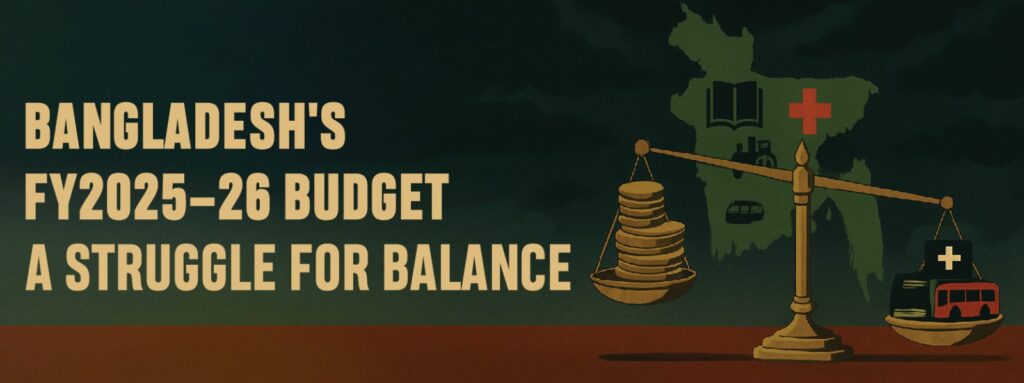
Bangladesh’s budget for the 2025-26 financial year comes at a challenging time. The country is grappling with slower economic growth, rising prices, and the upcoming loss of its “Least Developed Country” (LDC) status. These factors have heavily influenced the budget, shaping what the government can spend on and where it focuses its money.
Overall, the government plans to spend less than last year, aiming for about 12.7% of the total economic output (GDP) versus 13.4%. At the same time, it hopes to collect about 9.0% of GDP in revenue. Even with these tighter controls, the budget deficit—the difference between what the government spends and what it takes in—is expected to shrink to 3.6% of GDP.
However, a big challenge remains: revenue collection is still too low. It’s currently around 7-8% of GDP, far below what other similar countries manage. The International Monetary Fund (IMF) has pushed Bangladesh to increase its tax collection to 9% of GDP in the upcoming fiscal year. This ongoing struggle to raise enough money is a key reason for funds being distributed across different sectors.
Sectoral Allocations
The budget’s sectoral breakdown shows wide variation. Major spending and changes include:
| Sector | FY2024–25 (Revised) | FY2025–26 (Budget) | Change |
| Public Services | 25.3 % | 23.6 % | –1.7 pp (–Tk 2,362 cr) |
| Education & Technology | 13.3 % | 14.0 % | +0.7 pp (+Tk 11,543 cr) |
| Transport & Comm. | 8.1 % | 9.0 % | +0.9 pp (+Tk 10,844 cr) |
| Agriculture & Allied | 6.0 % | 5.9 % | –0.1 pp (+Tk 1,700 cr) |
| Social Security & Welfare | 5.7 % | 5.7 % | 0 pp (+Tk 2,771 cr) |
| Health | 3.8 % | 5.3 % | +1.5 pp (+Tk 13,985 cr) |
| Defense Services | 5.3 % | 5.2 % | –0.1 pp (+Tk 1,459 cr) |
| Energy & Power | 3.1 % | 2.9 % | –0.2 pp (–Tk 185 cr) |
| Others (incl. LG, Culture, Housing, etc.) | Remainder | Remainder | +Tk 5,493 cr (net) |
Sources: CPD Budget Analysis.
Education: Persistent Underinvestment
Education funding sees only a marginal rise. The FY26 allocation is Tk 95,644 crore, a mere 1% increase, representing 12.1% of the total budget. More critically, education’s share of GDP is just 1.53% for FY26 (down from 1.69% in FY25). This is significantly below Bangladesh’s own Eighth Five-Year Plan target (3.5% of GDP) and international recommendations (UNESCO suggests 4-6% of GDP). Bangladesh remains among the lowest education spenders globally, especially among LDCs.
Most budget growth goes to salaries, not development. Capital spending for new facilities or textbooks is very low. This underinvestment leads to crowded classrooms and inadequate facilities, despite some improvements in literacy. Experts contend that doubling current spending is needed to meet global education goals. Education’s GDP share has declined for two decades, far from planned targets.
Health: Severely Underfunded
Healthcare remains critically underfunded. The FY26 health budget is 5.3% of total spending, a slight reduction from FY25. As a percentage of GDP, it’s a meager 0.67% (down from 0.75%), continuing a 20-year trend below 1% of GDP, one of the lowest worldwide.
Per capita public health spending is tiny: about Tk 2,435in FY25. Consequently, 73% of healthcare costs are out-of-pocket, one of the highest globally. Some vital programs even saw cuts. International benchmarks suggest 3-5% of GDP for health in low-income countries; Bangladesh’s share is the second lowest among 44 LDCs. This budget reinforces health as a low priority, showing no bold new funding.
Agriculture: Small Gains, Big Subsidies
The Agriculture & Allied Sectors (AAS) budget rose to Tk 46,268 crore, a 3.8% nominal increase. But in relative terms, the sector’s share slipped to 5.9% of total spending and just 1.1% of GDP. Agriculture subsidies take up a significant portion, Tk 17,241 crore, or 37% of the sector’s allocation. Yet even this falls short of actual needs: subsidy claims totalled Tk 24,935 crore in FY24.
Other departments like Fisheries, Livestock, and Water Resources faced cuts in development spending, suggesting a narrowing policy focus. While Environment & Forests saw a 123% boost, reflecting growing climate concerns, core investments in agricultural R&D, irrigation, and food security remain modest. Compared to the African Union’s CAADP target of 10% or Asia’s 2–4% of GDP norm, Bangladesh continues to underinvest in its rural backbone.
Infrastructure and Transport: Roads Prioritized
Infrastructure, especially transport, received a substantial boost. The Road Transport and Highways sector saw a significant jump. FY26 allocation for Transport and Communication is 9.0% of the total budget (up from 8.1%). The Road Transport and Highways Division alone received Tk 31,772 crore, a massive 71% increase from FY25, driven by delayed highway projects.
Planned works include thousands of kilometers of new roads and bridges, particularly in rural areas. Despite this surge, the overall infrastructure budget remains under 10% of total outlays. Historically, low execution rates have raised concerns about actual project completion. While road transport is prioritized, analysts suggest broader connectivity (digital, urban transit) is needed, as Bangladesh lags peers in urban infrastructure.
Energy and Power: Gas Over Renewables
Energy policy aims to balance affordability and supply. FY26 figures show stability in total energy outlays. The Power & Energy division gets Tk 22,520 crore (2.9% of the budget), a slight decrease. Power sector subsidies remain a heavy burden (Tk 37,000 crore), though less than FY25.
Conversely, the Energy sector (gas exploration/production) sees a dramatic 107% jump to Tk 2,178 crore for FY26, indicating new investments to boost gas and fertilizer output. However, renewable energy spending is minimal, with only about 2.9% of the energy development budget for renewables, far below targets. This indicates a “business-as-usual” approach, prioritizing traditional fuels over modern renewables, falling short of international benchmarks.
Industry and Commerce: Largely Symbolic
The industrial and trade sectors remain a very small budget component (around 0.5%). This is tiny compared to countries actively pursuing industrialization, which invest multiple per cent of GDP in technology and R&D.
While FY26 introduced some business-friendly tax cuts (e.g., 2.5% corporate tax reduction), it lacked major manufacturing subsidies or infrastructure expansion. Trade-related sectors saw no significant special allocations. Critics also note insufficient tariff rationalization for LDC graduation. Overall, the industry portion is symbolic. Development relies more on private investment and export programs than on direct government funding.
Social Protection: Modest Growth, Still Strained
Social protection maintains a 5.7% share of the budget, almost unchanged from FY25. The total outlay stands at Tk 27,771 crore, covering old-age pensions of 6.5%, disability allowances, and child stipends. In GDP terms, this translates to less than 1%, falling short of the 2–3% range observed in peer economies.
Although some livelihood and seasonal employment schemes saw incremental funding, there were no transformative initiatives. Promises of support to flood-affected farmers and energy subsidies for the poor were not backed by significant new allocations. Given the slowing of poverty reduction and rising inequality, this flat trajectory could erode social resilience at a critical time.
Taxation and Revenue: Big Targets, Small Levers
Revenue targets: Tk 564,000 crore (8.9% nominal increase from FY25), corresponding to 9.0% of GDP. Without stronger enforcement, actual tax-to-GDP is likely to remain below potential. The IMF’s loan program requires raising the ratio from ~7.4% to 9% by 2026, a monumental task given political constraints and historical underperformance.
The FY26 budget largely maintains existing tax structures with incremental changes. Government projections rely on improved compliance, a broader tax base, and income growth. While VAT and income taxes are expected to rise, a few new rates have been announced. Achieving the 9% tax/GDP goal requires significant administrative reform and plugging revenue leaks.
Local Government and Rural Development: A Step Back
Local governance and rural development saw a slight budget trim. The entire Local Government & Rural Development (LGRD) sector has an FY26 allocation of Tk 44,895 crore, down 6.4% from FY25. This covers urban municipalities, rural development, and the Chittagong Hill Tracts.
The Local Government Division’s funding is almost flat. The Rural Development & Co-op wing sees a slight cut. This means little net expansion for towns and villages. With LGRD already about 6% of the budget, its GDP share remains around 1%. This lack of growth raises concerns about completing rural infrastructure projects, which often rely on foreign aid. In urban areas, static allocation signals no significant boost to municipal services amidst population growth. The budget suggests no significant ramp-up of local spending, despite “people-centric” development goals.
Conclusion
Bangladesh’s FY2025–26 budget is cautious. While some priority areas like education and health see nominal gains, and transport infrastructure gets a surge, most sectors receive incremental growth. Many allocations (education, health, social protection) remain well below international benchmarks or national targets. Education and health consume under 2% of GDP, agriculture and industry are at or below 1%, and even transport is under 10% of the budget.
The macroeconomic context is challenging. Strained revenue (9.0% of GDP) and LDC graduation limit flexibility. This means new ambitions require reordering priorities or strong economic growth. The budget “lacks adequate allocations or actionable steps” for inclusive, sustainable growth. For readers, the message is clear: while nominal figures show some growth, underlying spending patterns largely persist. Bangladesh is spending more, but perhaps not enough to fundamentally alter its development trajectory. Policymakers must assess if these small shifts are enough to navigate low growth and the post-LDC transition, or if bolder reforms are needed.