GYMSHARK, SEPHORA, AND NOTION BUILT THEMSELVES ON BELONGING RATHER THAN AD BUDGETS. AS THE COST OF BUYING ATTENTION CLIMBS AND TRUST IN ADVERTISING FALLS, MORE BRANDS ARE TREATING COMMUNITY AS CORE MARKETING INFRASTRUCTURE — A CHANNEL THEY OWN RATHER THAN RENT.
For two decades, paid media has been the reflex. Need growth, and fast? Open the ad account, bid for attention, convert a slice of it, and pay again tomorrow for more. It was never the only way to build a brand, but it became the default one, the lever marketers reached for first because it was measurable and it scaled. That lever is getting harder to pull.
The cost of renting attention has climbed to the point where the arithmetic barely closes. According to a 2025 analysis from ProfitWell, the average software company spends 1.32 dollars on paid channels to generate a single dollar of new revenue. That is not growth. It is a subsidy with a logo on it.
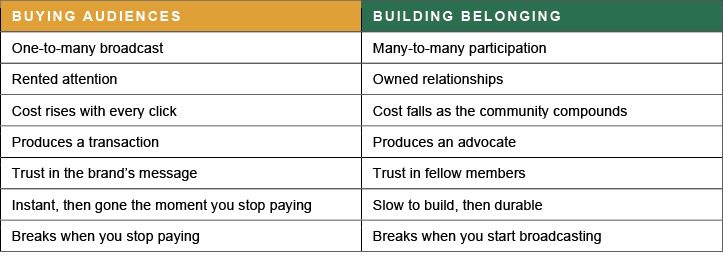
So, a growing number of brands have stopped trying to buy bigger audiences and started building something they can keep. They are investing in community: spaces where customers belong, talk to one another, and stay. The pitch is simple. Rented attention disappears the moment you stop paying. Belonging compounds.
WHY THE MATH STOPPED WORKING — AND WHY NOW
Several forces have converged to make paid acquisition a worse bet than it was five years ago. The first is raw cost. Customer acquisition costs have risen across most industries, and the platforms keep pushing prices higher; the cost of a thousand impressions on Meta has climbed by more than 30 percent year on year in many categories.
The second is precision lost. Apple’s tracking limits, the long erosion of third-party cookies, and tightening privacy rules worldwide have stripped digital advertising of the precise targeting that once justified its price. Advertisers now pay more to aim with less accuracy.
The third is fatigue. Estimates of how many ads the average person meets in a day run from several thousand upward, and the mind has learned to slide straight past them. Banner blindness stopped being a theory years ago.
Underneath all of it sits a deeper problem: trust. People believe advertising less than they used to, and they believe each other more. Nielsen’s long-running research finds that the large majority of consumers trust recommendations from people they know above any form of advertising. Younger consumers are starker still, with surveys showing only a small minority trust large technology companies while a clear majority trust peers and neighbours. A word from a fellow customer now travels further than a message from a brand.
BELONGING AS INFRASTRUCTURE
None of this means simply opening a Facebook group and calling it a community. The distinction that matters is intent. A real community is treated as a product in its own right, one that gives members real value whether or not they ever buy again. Sometimes that value is knowledge. Sometimes it is status, or simply the pull of belonging. The selling, when it happens, is a by-product.
That reframes the whole relationship. Traditional marketing is one-to-many: the brand broadcasts and the audience receives. Community is many-to-many: members talk to each other, and the brand becomes the thing they have in common. Growth stops being something you purchase and becomes something the members generate.
The economics follow from that shift. People who join a community build habits and relationships around a brand, so they buy again not because an algorithm served them an ad but because they belong. Industry analyses consistently find that community-acquired customers carry a noticeably higher lifetime value than ad-acquired ones, and that a meaningful share of members say they joined to belong rather than to buy. The belonging is the point. The buying tends to follow.
THE PROOF IS IN THE BRANDS
The clearest evidence is in the companies built this way. Gymshark, founded in a garage in 2012, grew into a brand valued near 1.4 billion dollars with customers in more than two hundred countries, and it did so with almost none of the heavyweight ad spending of rivals like Nike and Adidas. It built a “family” instead. Challenges such as #Gymshark66 invited customers to share their fitness journeys, a forum called Gymshark Insiders let loyal members shape products, and pop-up events turned the online community into something physical. At one such pop-up, roughly 40 percent of attendees made a purchase within a month. The community was the marketing.
Sephora turned the same instinct into retail infrastructure. Its Beauty Insider Community, a peer-to-peer space where shoppers swap routines, reviews, and questions, sits alongside a loyalty programme of more than 25 million members who account for a large share of the retailer’s sales. The forum became, in effect, a content factory the brand never had to staff, ranking high in organic search precisely because real people were answering each other’s questions.
Notion offers the cleanest contrast with the old model. Rather than build a community from a boardroom, it amplified the superfans already gathering on Reddit, Discord, and Slack and formalised them into an ambassador programme. The pattern in its numbers is the one every marketer eventually notices: the cost of community-driven growth fell over time as the content compounded, while the cost of a paid click stayed stubbornly flat or climbed.
Nor is this only a game for digital-native upstarts. Some of the most durable communities belong to old brands that learned the lesson early. Harley-Davidson founded its Harley Owners Group in 1983, not to win new riders but to keep the ones it had; the group welcomed its millionth member by 2006 and is widely credited with helping the company ride out a near-fatal decade and reclaim its market. Lego went further still. After flirting with bankruptcy in the early 2000s, it built Lego Ideas, an open platform where fans submit set designs, vote on one another’s, and watch the winners become real products, with any idea that clears 10,000 votes eligible to enter the official range. A toymaker had turned its most obsessive customers into its research-and-development department, and rode more than a decade of double-digit growth out of the turnaround.
The same logic now drives business-to-business marketing, where the buying decision rests on peer trust. Salesforce built an entire identity, the Trailblazer, around its user community; Figma, GitHub, and HubSpot grew on the back of users teaching other users. In a market flooded with AI-generated vendor copy that all reads the same, a real conversation between two practitioners is worth more than any campaign.
One principle runs through every example. None of these brands manufactured an identity and asked customers to adopt it; they found an identity people already held and gave it a home. Harley riders already saw themselves as free spirits, Lego adults as builders, Sephora shoppers as beauty obsessives. The brand’s job was to recognise the tribe, not invent it, and then to keep value flowing between members rather than only from company to customer. That circulating, peer-to-peer value is the thing a competitor cannot copy with a lower price.
WHAT BELONGING ACTUALLY COSTS
The approach is neither free nor fast. A community cannot be switched on like a campaign. It takes months, often a year or more, before it produces anything a finance team would recognise as return, and it asks for a patience that quarterly marketing rarely allows.
It also demands that control be given up. The brand that tries to script its community kills it; belonging only forms where members are free to speak their minds and take the lead. And it resists the dashboards marketers love. As recently as 2025, only about a quarter of organisations said they could confidently put a financial figure on their community work, up from a sixth the year before. The value is real but slow to surface, which makes community a hard sell in a room that wants this quarter’s number.
The most common failure is the most predictable. A brand opens a “community,” then treats it as another channel to broadcast offers into. Members feel the sales pitch, sense the space was never really for them, and leave. Community punishes the very push-marketing reflex that built the old machine.
WHERE COMMERCE ALREADY RUNS ON COMMUNITY
Few markets show the raw version of this more clearly than Bangladesh, where commerce already runs on belonging. Tens of thousands of Facebook-group sellers have built the country’s F-commerce economy on trust rather than advertising, with buyers believing a group admin and fellow members long before they believe a banner. The behaviour is already there. What is often missing is the discipline to treat it as a strategy rather than an accident. The brands that learn to nurture those groups deliberately, instead of spamming them, inherit a channel their competitors cannot buy.
THE CHANNEL COMPETITORS CANNOT BUY
That is the quiet advantage underneath the whole shift. An audience can always be outbid; a rival with a bigger budget can simply buy the attention you were renting. A community cannot be bought away, because it is built on relationships and shared identity rather than spend. It is the rare marketing asset that grows more valuable the less it is treated like marketing.
The brands pulling ahead have understood the trade. Buying an audience gets you this quarter’s customers. Building belonging gets you the next decade’s.
Author
Fariha Jahin