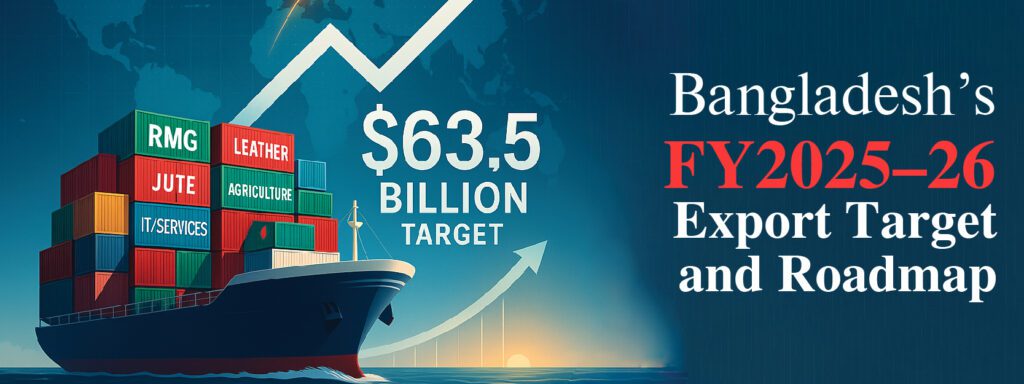
The Bangladeshi government has set an ambitious export target of US$63.5 billion for the fiscal year (FY) 2025–26, aiming for a 16.5% jump over FY2024–25. Commerce Adviser Sk Bashir Uddin unveiled the goal, with a breakdown of $55.0 billion from goods exports and $8.5 billion from services. This follows a year in which merchandise exports reached $48.28 billion (up 8.6% from $44.47 billion in FY24) but fell just short of the $50 billion target set for FY24–25.
In practical terms, the new goods-export target ($55.0 b) implies about a 13.8% growth over last year’s $48.28 b (so a needed rise of ~$6.7 b). That means Bangladesh must sustain or accelerate growth across its leading industries. A large table below compares last year’s actual exports by sector with the FY25–26 targets:
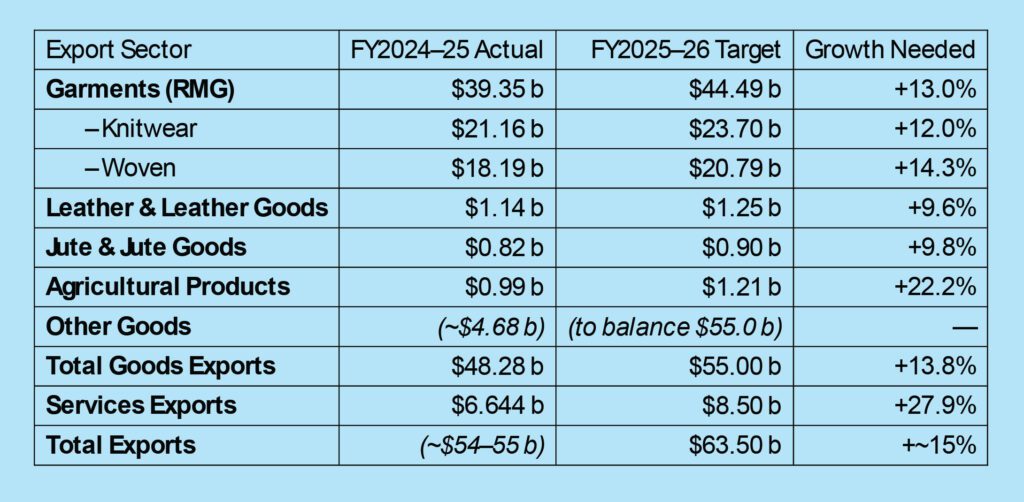
“Other Goods” includes products like frozen fish, plastics, home textiles, engineering products, and others. The FY24–25 mix shows many of these (like engineering and home textiles) grew ~2–10%, while overall their share remains relatively small.
From the table, ready-made garments (RMG) dominate – 81.5% of exports last year. For FY25–26, officials aim for $44.49 b from RMG alone (split ~$23.7b knit, $20.8b woven), meaning roughly 13% growth. Other top goods sectors have much smaller shares: leather and leather goods exports hit $1.14 b in FY25 (over 10% growth) and are targeted to reach $1.25 b (∼9.6% rise). Jute exports were $0.82 b (down 4.1% last year), with a $0.90 b target (+9.8%). Agricultural exports rose only 2.5% to $0.99 b, yet must grow to $1.21 b (+22%). These non-RMG sectors together contribute under 10% of total exports, so achieving targets will require accelerating growth or diversifying products. (For comparison, FY24–25 “other goods” like frozen fish, plastic and engineering totaled roughly $4.7 b to make up the $48.28b.)
From FY2024–25 to FY2025–26, Bangladesh needs an overall export gain of roughly $9.2 b (from ≈$54–55b to $63.5b). In FY24–25, merchandise exports were nearly $48.28 b; services likely added a few billion more. For FY25–26, achieving $63.5b means all sectors must push ahead. Notably, services exports (like IT/BPO, transportation, tourism) have been smaller but growing, and Bashir’s target implies around 28% growth in services.
Bangladesh’s exports in FY2024–25 (Jul 2024–Jun 2025) rebounded 8.6% to $48.28 b, up from $44.47 b the year before. Ready-made garments led the way (81.5% of exports at $39.35 b), with knitwear $21.16 b and woven $18.19 b. Non-RMG items were much smaller: leather $1.14 b, agricultural products $0.99 b, home textiles $0.87 b, engineering $0.54 b, and jute only $0.82 b (down 4%). In FY25 the actual goods exports of $48.28 b fell just short of the $50 b target. This year, the government set a $63.5 b combined target (16.5% higher than last year’s earnings), betting on continued expansion in key industries and new market opportunities.
Sector-by-Sector Pathways
Commerce Adviser Bashir has outlined a multi-pronged strategy to meet the target, focusing on each major sector’s bottlenecks and opportunities:
- RMG (Garments): This remains the engine. In unveiling the target, the adviser called it “quite conservative” and expects actual garments exports to exceed $44.5 b. Crucially, Bangladesh now enjoys a U.S. tariff advantage: under the new U.S. trade regime, Bangladeshi goods face a 20% reciprocal tariff plus the pre-existing 16.5% duty (36.5% total ETR), whereas competitors like India and China face much higher rates (50–55%). Bashir’s roadmap leverages this by securing better market access and negotiating the U.S. tariff down to 15%. He also urges the industry to focus on high-value, diversified products.
- Leather & Textiles (non-RMG): Leather exports have already grown double-digits (10.2% to $1.14 b), but Bashir emphasizes expanding into new markets and products. Home textiles and similar sectors saw modest growth (~2–3% each). To boost these, the government plans to identify sector-specific bottlenecks (e.g. power supply for tanneries, compliance issues) through upcoming dialogue with industry. For example, the commerce ministry will meet leaders from leather, jute, agriculture and other sectors to pinpoint one or two obstacles (like logistics or raw materials) and “work with concerned agencies to resolve them”.
- Jute & Agro-products: Facing Indian import restrictions, jute exports slipped to $0.82 b last year. Bashir noted India’s ban on certain jute goods via land routes but downplayed its impact, saying it “would not significantly affect exports” and that diplomatic channels are engaged. Still, jute exporters must nearly recover last year’s output to hit the $0.90 b target. Agricultural exports (rice, vegetables, etc.) grew only 2.5% to $0.99 b but must climb to $1.21 b. The roadmap here involves tapping duty-free markets (EU/UK), improving product quality, and scaling up processing.
- Services (e.g. IT, finance, transport): Though smaller, services exports are growing. The target of $8.5 b (vs ~$6.5 b last year) represents an 28% rise (some sources say ~13–14%). Bashir is pushing for service sector diversification as well, such as IT-BPO, software, and digital services. He has highlighted the need to expand “non-traditional products,” which can be interpreted broadly to include new tech and creative exports. Negotiations are also underway for Free Trade Agreements (FTAs) that can help services (and goods) access larger markets.
“Starting next week, the ministry will hold meetings with industry leaders to identify bottlenecks for each sector and work to resolve them,” Commerce Secretary Mahbubur Rahman announced. Adviser Bashir emphasized expanding non-traditional items and new destinations, while securing duty-free access in the UK/EU and negotiating FTAs (Japan, South Korea, Singapore). He is also pressing the U.S. to cut its reciprocal tariff to 15% and allow “Made in USA cotton” labeling to help Bangladesh claim tariff benefits.
Last Year vs New Target: A Close Look
- Performance FY24–25: Despite political unrest and global headwinds, Bangladesh’s goods exports rebounded. FY25 saw $48.28 b in merchandise exports (8.6% growth), nearly meeting the $50 b goal. Export growth was broad-based: RMG grew 8.8% to $39.35 b, leather up 10.2% to $1.14 b, engineering 10.0% to $0.54 b, though jute fell 4.1%. Services exports (IT, etc.) were behind schedule (about $5.8 b by April vs $7.5 b target).
- Required Growth FY25–26: To hit $63.5 b total, Bangladesh needs roughly +13–14% in goods and a double-digit jump in services. In pure goods terms, $55 b vs $48.28 b means ~13.8% rise. RMG must grow ~13%; leather & jute around 10%; agriculture and others even faster. This is a tall order given last year’s ~8.6% gain.
Economists caution that such growth depends on solving domestic hurdles. Industry leaders repeatedly note that ongoing energy shortages (gas/electric), banking-sector liquidity issues, customs delays, and law-and-order instability could hold exports back. For example, the former BGMEA president warned that continued power cuts have shaken buyers’ confidence. The news editorials likewise point out that a looming election cycle (leading into early 2026) could dampen economic activity and export momentum. Still, analysts see some upside: U.S. tariffs easing and partial front-loading of orders could boost shipments in the short run.
Roadmap and Outlook
In sum, Commerce Adviser Bashir’s roadmap is sector-targeted and negotiation-driven:
- He labels the target “conservative,” banking on favorable external factors (tariff advantages, resumed global demand) to push exports even higher.
- He has instructed the commerce ministry to collaborate with industries: holding weekly sessions with RMG, leather, jute, agri, and service exporters to clear up transport, logistics, power, or policy issues.
- He continues trade diplomacy: negotiating lower U.S. tariffs (aiming for 15%), pursuing FTAs in Asia-Pacific, and maximizing duty-free access in the EU/UK.
- On the domestic side, he insists that ongoing law-and-order problems are not severe enough to derail trade, and that India’s border ban on jute will have “no major impact”. His government is also reportedly exploring relief like duty exemptions and export financing to mitigate factory costs.
For the general reader, the bottom line is clear: Bangladesh is betting big on exports as a growth engine in FY2025–26. Achieving $63.5 b will require all sectors firing on all cylinders – from the staple garment industry (with added momentum from U.S. tariff relief) to smaller players (like agro-exports and leather) moving faster. Bashir’s plan hinges on smoothing out domestic constraints and opening markets abroad. How closely reality will match these targets remains to be seen, but the government has laid out a detailed, sector-by-sector strategy to try.
Sources: Official figures and news reports on Bangladesh’s FY2024–25 export performance and FY2025–26 targets; Commerce Ministry announcements.
Author: Tasnim Safwan