Each generation has struggled with its own challenges; however, ours can be described by a single word: overload. We live in an era when the information flows all over the place much faster than we can handle it, via screens, feeds, emails, and notifications. Our brain fails to keep up with these overwhelming stimuli, ultimately forgetting them faster than we learnt. Neuroscientists have a name for this memory loss: lethomanthia. We read, we watch, we listen- and then, almost instantaneously, it is gone.
So, how do we retain the things that really matter? That’s where the Nexus Method comes in handy, the concept presented by the neuroscientist and philosopher Iain McGilchrist. It is not a new productivity trick that needs superhuman application. It is a strategic method that organises the scattered thoughts by clustering them around “Nexus Words”. These words act as a base for ideas, work patterns, and most importantly, decision-making.
WHY OUR BRAINS ARE STRUGGLING MORE THAN EVER
Our parents grew up with libraries, not algorithms. It was a time when information wasn’t dumped but presented. Maybe a few notes were enough to gather useful information, unlike today. We live in a firehose of content. Each time we open our phones, we are bombarded with videos, articles, threads, and podcasts. Only parts of it are useful, while the other parts are just noise and overspill that prevent the brain from performing systematically.
This is what cognitive science refers to as cognitive overload. Essentially, we do not have the capacity to juggle an infinite number of thoughts at the same time. According to researchers, cognitive offloading—transferring ideas out of our heads into another system —thereby freeing the brain to make sense of them —is one way to solve this problem. Using a journal, a mind map, or leaving voice notes can make a huge difference in keeping things in order. The Nexus Method extrapolates on this by providing offloaded concepts with a framework that reflects the way our minds relate ideas.
LET’S MAKE IT PRACTICAL
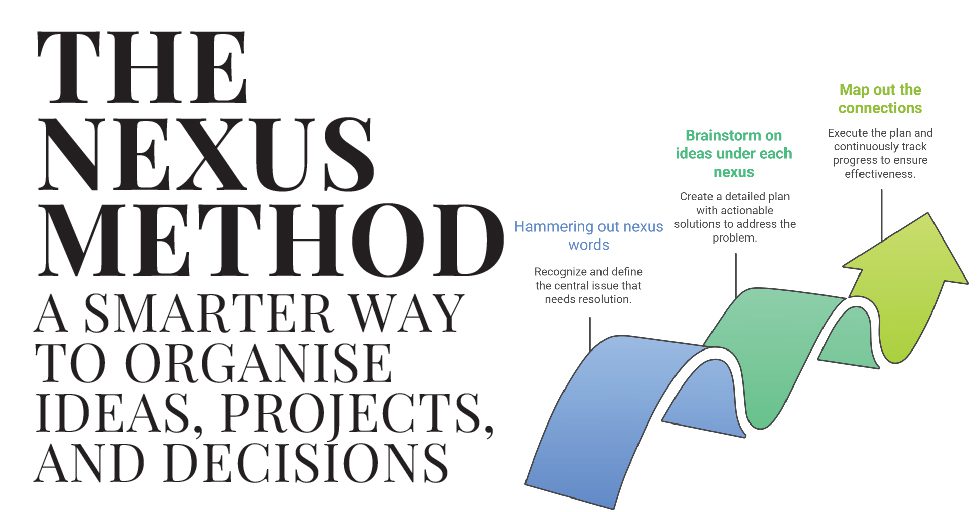
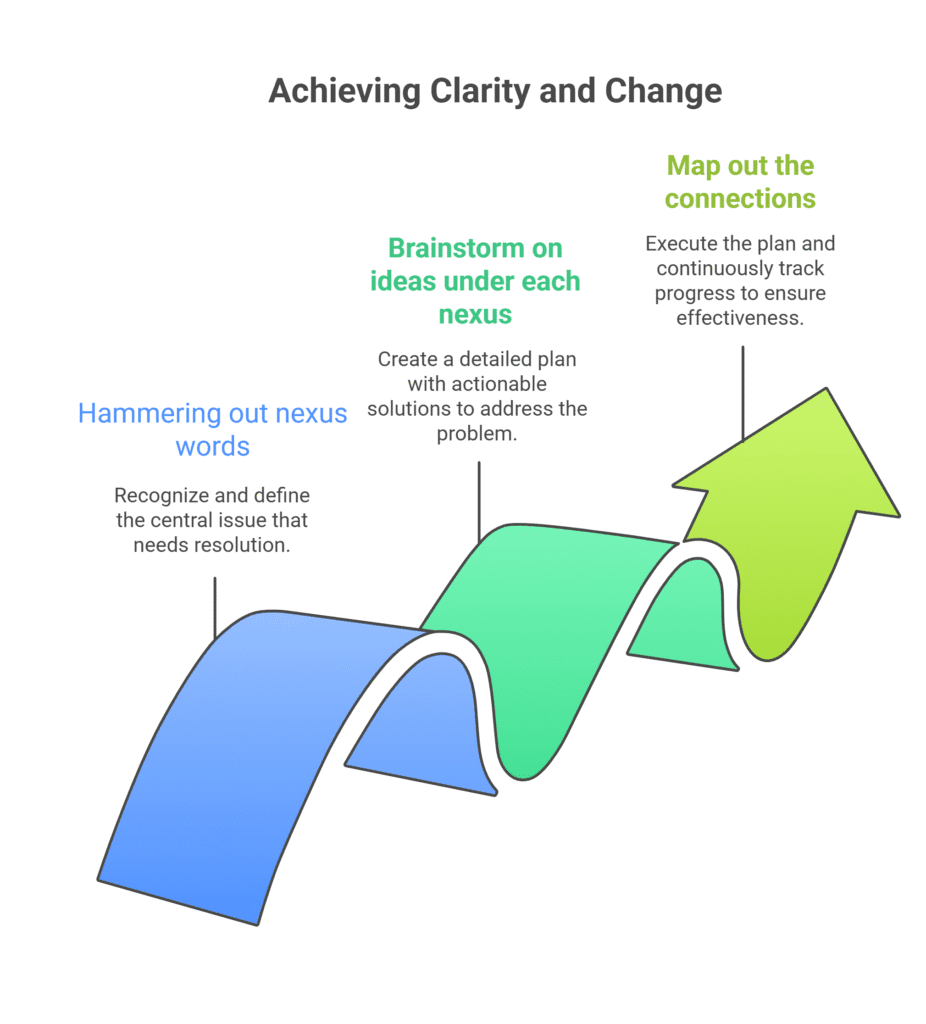
Well, how does it work? There are three key steps in the Nexus Method-
- Hammer out your nexus words: These are anchor terms–the key topics or central ideas you would like to organise around. Take the example of researching climate change; some of your nexus words can be policy, technology, economy, and behavior.
- Brainstorm on ideas under each nexus: When you come across facts, articles, or insights, don’t just put them in any random folder. Rather, you refer them to the nearest nexus word. An article concerning solar panels is classified under technology, and research on meat intake comes under behavior.
- Map out the connections: This is where the magic is. When your clusters begin to fill, you will start to make connections between nexus words. In an instant, you realise how policy influences behavior, or how technology is changing the economy. The larger picture comes out not as mere isolated facts, but as a pulsating network of ideas. In other words, you cease being submerged in pieces and start perceiving systems.
What is nice about the Nexus Method is that it is tool-agnostic. No special application is required (although applications such as Obsidian, Notion, or Miro are well-suited to it). A notebook with several pages of each nexus word will suffice. It can be used by students during study: they will not need to make unlimited highlight notes, but can cluster around nexus words and map connections before an exam. Teams can use it to brainstorm rather than the untidy piles of ideas, clusters emphasising what is strong and what needs work. People can apply it in life decisions.
FROM CHAOS TO CLARITY
The central difficulty of the digital age is that we have lost track of the difference between access and understanding. The greater knowledge we have doesn’t make us wiser people; quite the contrary, it makes us more paralysed. The Nexus Method is to remind that clarity is not about how much you know, but how well you can connect what you know. In a time of broken feeds, open tabs, and short attention spans, that is not just a productivity hack; it is a survival technique. When you feel your brain spinning in 10 different directions at the same time, just keep in mind that you do not have to have all of it in your head. Take a nexus word, bunch together ideas, map out the links, and watch disorder become a pattern. Wisdom is not in the flow of information–it is in the fabric of connections we make out of that flow.
Author: Jarin Subah Turaba