Introduction: A Rising Power in a Strategic Crossroad
Bangladesh, once considered a peripheral player in South Asia, has emerged as a pivotal actor in the region’s geopolitical landscape. With a population of over 170 million and a rapidly growing economy, the country is now a strategic prize for global powers. Its economic policy, once domestically focused, is now shaped by the competing interests of China, India, and the United States. Bangladesh’s geographic location, nestled between India and the Bay of Bengal, and its proximity to key maritime routes, make it a critical node in the Indo-Pacific strategy. As the country seeks to modernize its infrastructure, expand trade, and attract foreign investment, it finds itself walking a tightrope between these powers.
Historical Context: From Non-Alignment to Strategic Balancing
Historical Context: From Non-Alignment to Strategic Balancing
Bangladesh’s foreign policy has been rooted in the principle “Friendship to all, malice to none.” This ethos, enshrined in Article 25 of the Constitution, emphasizes peaceful coexistence, respect for sovereignty, and non-interference.
Early Diplomatic Alignments (1971–1980s)
After gaining independence in 1971 with India’s military and diplomatic support, Bangladesh quickly established strong ties with New Delhi. India was one of the first countries to recognize Bangladesh, followed by the Soviet Union. The United States, however, delayed recognition until April 4, 1972, due to its Cold War alignment with Pakistan.
China, on the other hand, was initially hostile to Bangladesh’s independence due to its alliance with Pakistan and its rivalry with India. Beijing vetoed Bangladesh’s UN membership until 1974. Formal diplomatic relations between Bangladesh and China were only established in January 1976, following a shift in Dhaka’s foreign policy after the 1975 military coup.
Cold War Balancing and Regional Realignments
During the Cold War, Bangladesh leaned toward the Indo-Soviet axis, but gradually diversified its partnerships. President Ziaur Rahman’s administration in the late 1970s and early 1980s restored market-oriented policies and initiated closer ties with China. By the mid-1980s, China had become a supplier of military equipment and development aid to Bangladesh.
India remained a key partner, especially in cultural and linguistic ties, but tensions occasionally flared over border issues and water-sharing disputes. Despite these, bilateral trade and cooperation expanded steadily, with landmark agreements such as the Ganges Water Treaty in 1996 and the Land Boundary Agreement in 2015, which resolved decades-old enclave disputes.
Post-Cold War and Strategic Diversification
With the end of the Cold War and the rise of globalization, Bangladesh adopted a more pragmatic and diversified foreign policy. It joined regional platforms like SAARC, BIMSTEC, and IORA, engaging with both India and China while maintaining strong economic ties with the US.
The most significant shift came in 2016, when Bangladesh formally joined China’s Belt and Road Initiative (BRI). This marked a new phase of strategic balancing, as Dhaka began receiving billions in Chinese infrastructure investments while continuing to rely on Indian connectivity and US trade access.
China’s Expanding Footprint: Infrastructure and Influence
Since Bangladesh joined China’s Belt and Road Initiative (BRI) in 2016, Chinese influence has grown rapidly across infrastructure, trade, and strategic sectors. The BRI framework has brought in a $40 billion commitment, including $26 billion for infrastructure projects and $14 billion for joint ventures.
Infrastructure Projects and Strategic Investments
As of 2024, China has disbursed $4.45 billion for 35 BRI projects, with Chinese firms securing $22.94 billion in construction contracts.
These include:
Energy: 27 power plants (coal, solar, wind).
Transport: 21 bridges, 12 highways, 7 railway lines.
Urban Development: Dhaka Elevated Expressway, Dasherkandi Sewage Plant.
Maritime Infrastructure: Karnaphuli River Tunnel, Single Point Mooring at Maheshkhali.
These projects are expected to boost Bangladesh’s GDP by 2–4% if fully implemented Mongla Port Modernization
In 2025, Bangladesh approved a $335.78 million loan from China to upgrade Mongla Port, the country’s second-largest seaport.
The project includes:
Two container jetties.
120,000+ sq meters of container yards.
Hazardous cargo facilities.
Equipment from China Civil Engineering Construction Corporation (CCECC).
This aims to position Mongla as a regional logistics hub, enhancing maritime connectivity.
Teesta River Management
China’s involvement in the Teesta River Comprehensive Management Project a $1 billion initiative has strategic and environmental implications. After stalled negotiations with India, Bangladesh signed an MoU with POWERCHINA in 2016, renewed in 2025.
Plans include:
Dredging 140 million cubic meters.
Reclaiming 171 sq km of land.
Building 124 km of embankments and 224 km of roads.
India has expressed concern over external involvement in Teesta, highlighting the geopolitical sensitivity.
Trade and Economic Zones
China is Bangladesh’s largest trading partner, with bilateral trade exceeding $25 billion. In 2020, China granted duty-free access to 98% of Bangladeshi exports
A 783-acre Chinese Economic Zone in Anwara, Chattogram, is under development, expected to generate 200,000 jobs and host over 670 Chinese companies.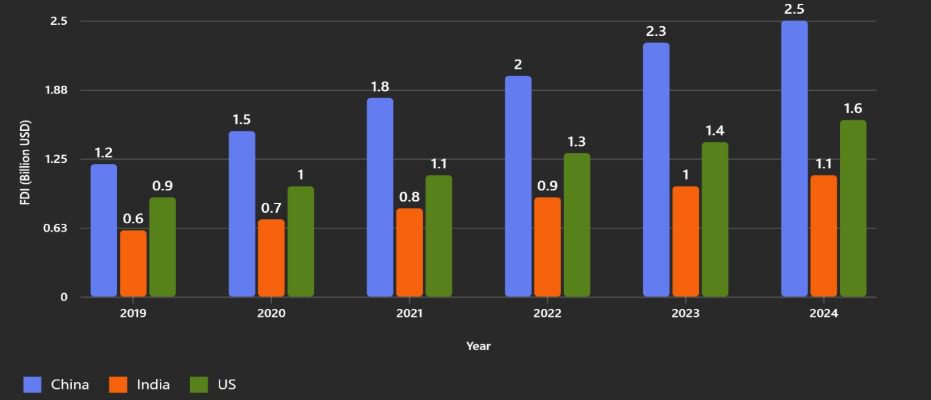
Fig – FDI inflows from China, India and US
Source FDI survey by Bangladesh Bank.
India’s Strategic Concerns and Countermeasures
India’s strategic anxieties regarding Bangladesh have intensified in recent years, driven by Dhaka’s growing alignment with China and the evolving regional power dynamics. These concerns are rooted in geography, infrastructure, and diplomacy.
Geopolitical Vulnerability: The Chicken’s Neck Corridor
India’s northeastern states are connected to the mainland through the Siliguri Corridor, a narrow 22-kilometer-wide strip of land in West Bengal, often referred to as the “Chicken’s Neck.” This corridor is flanked by Nepal, Bhutan, and Bangladesh, making it highly vulnerable to external influence.
Recent remarks by Bangladesh’s interim leader Muhammad Yunus during his visit to China, describing India’s Northeast as “landlocked” and Bangladesh as the “guardian of the ocean,” sparked outrage in India. These comments were interpreted as signaling Dhaka’s strategic pivot toward Beijing.
In response, India has fortified the corridor with advanced military deployments, including S-400 air defense systems, Rafale fighter jets, and BrahMos missiles, underscoring its intent to secure this critical region.
Teesta River Dispute: A Lingering Irritant
The Teesta River, which originates in Sikkim and flows through West Bengal into Bangladesh, remains a major source of bilateral tension. Despite a draft agreement in 2011 proposing a 37.5% share for Bangladesh, opposition from West Bengal’s leadership stalled progress.
Bangladesh’s renewed engagement with China on the Teesta Comprehensive Management Project, including dredging, embankments, and land reclamation, has further alarmed India. New Delhi views external involvement in transboundary water issues as a threat to its regional influence.
Port Politics: Mongla as a Strategic Battleground
India recently secured operational rights to a terminal at Mongla Port, Bangladesh’s second-largest seaport, through Indian Port Global Limited (IPGL). This move is widely seen as a counter to China’s maritime ambitions in the Bay of Bengal.
However, Bangladesh’s decision to grant access to Mongla Port to China and Pakistan for commercial and limited logistical use has raised red flags in New Delhi. Analysts interpret this as part of a broader strategy to “encircle India” through strategic port access.
Diplomatic Recalibration
India’s traditionally close ties with Bangladesh under Sheikh Hasina have cooled under the interim leadership of Muhammad Yunus. The lack of substantive engagement between Prime Minister Modi and Yunus reflects a diplomatic chill. India has responded by terminating cargo transshipment facilities and tightening visa policies, signaling its displeasure.
To counterbalance China’s growing presence, India is expected to scale up joint infrastructure projects, resolve water-sharing disputes, and rebuild grassroots ties through cultural and educational exchanges.
The US Angle: Trade, Democracy, and Strategic Leverage
The United States remains one of Bangladesh’s most influential economic and strategic partners, with its engagement spanning trade, technology, democracy promotion, and regional security. However, this relationship is increasingly shaped by Washington’s efforts to counterbalance China’s growing footprint in South Asia.
Trade and Tariff Diplomacy
The US is Bangladesh’s largest single-country export destination, absorbing over $8 billion annually in ready-made garments (RMG)
In the first half of 2025 alone, RMG exports to the US grew by 25.13%, reaching $4.25 billion, despite tariff concerns
Bangladesh recently secured a tariff reduction from 35% to 20% following high-level negotiations with the United States Trade Representative (USTR). In exchange, Bangladesh pledged to import $3 billion worth of US goods, including wheat, Boeing aircraft, LNG, and cotton
This marks a strategic win for Dhaka’s trade diplomacy and a step toward a potential Free Trade Agreement (FTA)
Democracy and Human Rights: A Tense Undercurrent
American aid agencies like USAID and the National Endowment for Democracy (NED) have played active roles in supporting civil society and democratic institutions. The Biden and Trump administrations have both emphasized the need for free, fair, and inclusive governance, linking aid and trade benefits to democratic reforms. This dual-track approach to economic engagement, coupled with political pressure, defines Washington’s strategic leverage in Dhaka.
Technology and Strategic Signaling: The Starlink Deal
In March 2025, Bangladesh’s interim government announced a pending commercial agreement with Elon Musk’s Starlink, aiming to provide satellite internet across the country
The move is seen as both an economic initiative to support freelancers and digital industries and a geopolitical signal aligning Bangladesh with US tech leadership.
Starlink has already installed four gateway stations in Bangladesh, with plans to export bandwidth to neighboring countries. This positions Bangladesh as a potential regional digital hub, enhancing its strategic value in the Indo-Pacific
Indo-Pacific Strategy and Military Cooperation
Bangladesh plays a key role in the US Indo-Pacific Strategy, which seeks to maintain a free, open, and secure maritime region. The US has supported Bangladesh through:
- $8 billion in development aid since independence
- Joint military exercises like Pacific Angel and Tiger Lightning.
- Strategic dialogues on counterterrorism, climate resilience, and labor rights.
The US sees Bangladesh as a moderate partner capable of contributing to regional stability. However, political volatility and rising Chinese influence have prompted Washington to recalibrate its engagement, focusing on economic incentives, defense cooperation, and civil society support.
Port Infrastructure: The New Battleground
Ports are central to Bangladesh’s economic strategy and geopolitical relevance. The Chittagong, Mongla, and Payra ports are undergoing upgrades with foreign support. China is involved in Mongla and Payra, while India has secured transit rights and connectivity projects. The US, through the Quad initiative, is exploring strategic port partnerships.
The Laldia Container Terminal project, developed with Denmark and Maersk, reflects Bangladesh’s effort to diversify partnerships and avoid overdependence on any single power.
Yunus’s Beijing Visit and Why Bangladesh Must Move with Caution
Muhammad Yunus’s visit to Beijing in March 2025 marked a major shift in Bangladesh’s foreign policy. Traditionally, Bangladeshi leaders visit India first after taking office, but Yunus broke that pattern by choosing China. During the visit, Bangladesh secured $2.1 billion in Chinese investments, including deals to modernize Mongla Port and revive the Teesta River management project, both located near India’s sensitive Chicken’s Neck corridor. These moves gave China strategic access close to India’s northeastern states and raised serious security concerns in New Delhi. Yunus’s remarks, calling Bangladesh the “oceanic gateway” for India’s Seven Sisters, further strained relations. India responded by increasing its military presence near the border and delaying cooperation on joint projects.
While Yunus’s pivot to China may bring short-term economic benefits, it also carries long-term risks. China’s promised $40 billion under the Belt and Road Initiative has only partially materialized, and many projects have faced delays and high interest rates. Overdependence on Chinese loans could lead to debt problems, as seen in other countries. At the same time, Bangladesh must consider its ties with India, which surrounds it geographically and remains a key trade and security partner. Ignoring India’s concerns could lead to diplomatic isolation and regional instability.
The United States, Bangladesh’s largest export market, is also watching closely. Recent tariff hikes and human rights concerns have already strained relations. Yunus’s government is trying to improve ties with Washington through trade deals and technology partnerships like Starlink.
Finally, Yunus’s interim government lacks a democratic mandate. Major foreign policy shifts, especially those that could reshape Bangladesh’s global position, should ideally be backed by an elected parliament and public consensus. Without that legitimacy, these decisions may face domestic backlash or be reversed by future governments.
In this complex geopolitical moment, Bangladesh must act with caution. It has the opportunity to rise as a regional connector, but reckless moves could turn it into a battleground between global powers. Strategic balance, not sudden alignment, is the key to securing Bangladesh’s future.
Author: Abu Yousuf Abdullah