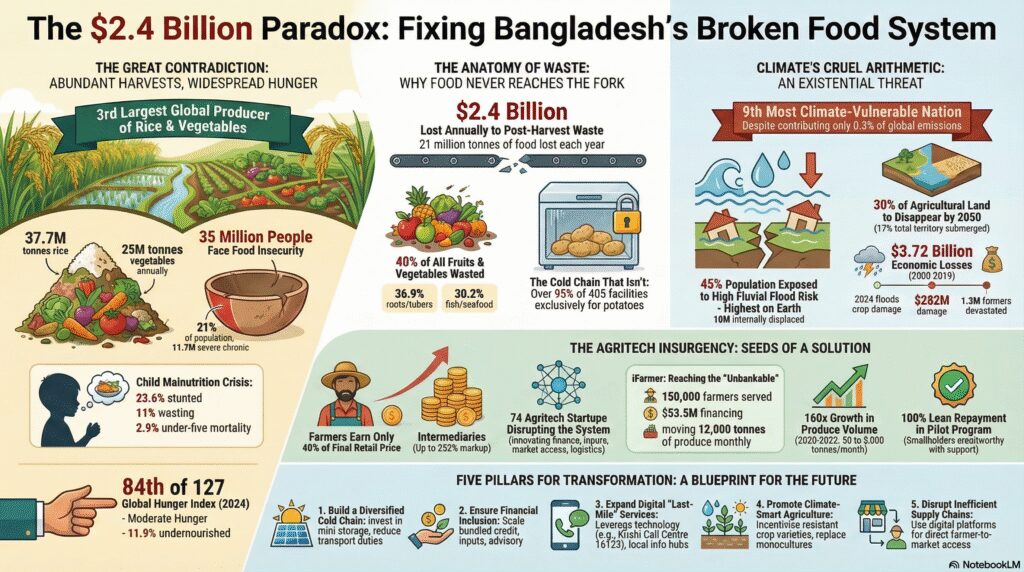
The mathematics of food in Bangladesh reflects both strength and opportunity. The country produces 37.7 million tonnes of rice annually—enough to rank third globally, behind only China and India. Yet 16 million Bangladeshis go to bed food insecure every night. The nation grows 25 million tonnes of vegetables yearly, ranking third in the world. Yet 40 per cent rots before reaching a single mouth. Something is catastrophically broken between field and fork.
That something has a price tag: $2.4 billion in annual losses from post-harvest waste—more than Bangladesh’s entire education budget. Every year, 21 million tonnes of food simply vanish: spoiled in fields without storage, crushed in transport without refrigeration, rotting in markets without buyers. In a nation where 1.6 million children suffer acute malnutrition and nearly one in four children under five are stunted, this waste is not an inefficiency. It is a moral emergency.
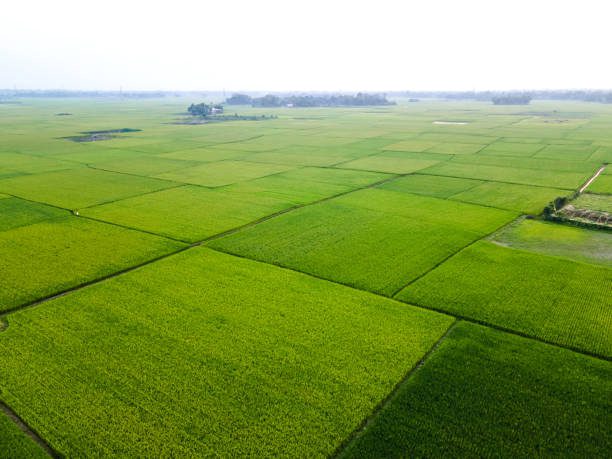
Bangladesh’s agricultural contradictions are staggering. Rice cultivation covers 76 per cent of all cropped land—10.5 million hectares across 13 million farms. Nearly half of all rural workers, some 48 per cent, are involved in rice production. The crop contributes 16 per cent to national GDP and 70 per cent to agricultural GDP. Since independence, rice output has more than doubled from 15 million tonnes in the 1970s. By any production metric, Bangladesh has achieved the impossible.
Yet rice self-sufficiency masks deeper vulnerabilities. Wheat—the second staple after rice—tells a different story. Local production accounts for only 14 per cent of total demand, with annual output stagnating at around 1.1 million tonnes against demand of 7.8 million tonnes. Wheat blast disease reduces yields significantly, while changing weather patterns—shorter winters and higher temperatures—negatively affect production. Bangladesh imported 6.8 million tonnes of wheat in 2024-25, mostly from the Black Sea region, making the country dependent on volatile international markets. Corn cultivation has expanded as farmers chase higher profits, but the 5.8 million tonnes projected for 2025-26 feeds primarily the animal feed industry rather than human consumption.
Yet the 2024 Global Hunger Index tells a different story. Bangladesh ranks 84th of 127 countries, with a score of 19.4 placing it in the “moderate hunger” category. Some 11.9 per cent of the population remains undernourished. Child stunting affects 23.6 per cent of children under five; wasting affects 11 per cent. The under-five mortality rate stands at 2.9 per cent—nearly three children of every hundred do not survive to see their fifth birthday, many due to malnutrition-related illness.
The paradox deepens when examining chronic food insecurity. According to the Integrated Food Security Phase Classification, 35 million Bangladeshis—21 per cent of the total population—face moderate to severe chronic food insecurity. Of these, 11.7 million people (7 per cent) experience severe chronic food insecurity. Six districts—Bandarban, Jamalpur, Kurigram, Gaibandha, Sunamganj, and Cox’s Bazar—have more than 35 per cent of households in crisis. The drivers are familiar: households dependent on low-value income sources like unskilled daily labour, marginal farming, or subsistence fishing, living in areas with high recurrence of floods, cyclones, river erosion, and drought.
Hidden hunger extends even to wealthier households. Even among affluent families, 26 per cent of children are stunted—demonstrating that malnutrition is not simply a poverty problem but a systemic failure of food quality, diversity, and access. About 50 per cent of salt in Bangladesh is not adequately iodized, while rice-heavy diets contribute to widespread zinc deficiency. The consequences ripple across generations.
Women bear the heaviest burden. Research shows that after the cyclone and flooding of 1991, Bangladeshi women aged 20-44 had a death rate of 71 per 1,000—compared to just 15 per 1,000 for men of the same age. Even when cyclone warnings are issued, many women die because they must wait at home for relatives to return before seeking shelter. In 2001, 80 per cent of women lived in rural areas, and Bangladeshi women remain particularly vulnerable to climate change due to limited mobility and power in society. Women and girls suffer disproportionately from the effects of extreme weather and climate-induced disasters, facing unequal food distribution within households even during normal times.
Climate’s Cruel Arithmetic
Bangladesh contributes just 0.3 per cent of global greenhouse gas emissions, yet the country ranks ninth on the 2024 World Risk Index for climate vulnerability. Geography is destiny: approximately 60 per cent of the population faces elevated flood risk, and 45 per cent—the highest proportion of any country on Earth—is exposed to high fluvial flood risk. Over 10 million Bangladeshis are already climate refugees within their own borders.
The 2024 floods—the worst climate disaster in recent memory—devastated 1.3 million farmers and caused $282 million in crop damage plus $156 million in livestock and fisheries losses. In 2022, flooding destroyed crops sufficient to feed 10 million people for a month. The 2017 flash flood in Sunamganj district alone wiped out 90 per cent of agricultural crops and fish production.
The projections are terrifying. By 2050, Bangladesh will lose 17 per cent of its territory to rising sea levels, taking with it 30 per cent of agricultural land. Total rice production is projected to decline 7.4 per cent annually until mid-century. Soil salinity—which has already increased 26 per cent over four decades—threatens over 30 per cent of arable land in coastal areas. By 2100, sea level rise could flood 12 to 18 per cent of coastal zones, displacing millions more.
The economic toll from 2000 to 2019 alone reached $3.72 billion across 185 extreme weather events. Research from the Ministry of Environment and Forests found that a 1°C increase in maximum temperature at the reproductive stage decreases aman rice production by 53 tonnes. Rice crop losses from erratic weather between 2009 and 2014 totalled $228 million. If the sea level rises by just one metre, Bangladesh will lose 12 to 16 per cent of its total land area.
Bangladesh has not been passive in the face of these threats. The country has built a network of 139 coastal polders—5,700 kilometres of protective walls shielding farmland from inundation. Warning systems, storm shelters, and salt-resistant crops represent decades of adaptation investment. Yet the escalating threats of floods, salinization, and waterlogging pose dire risks to over 35 million individuals inhabiting the coastal region. These challenges imperil not just lives but the sustenance and livelihoods of those who live and work within this vulnerable zone. The 2004 and 2007 floods caused major agricultural loss across Dhaka and Rajshahi divisions, with the highest economic losses in Barisal.
The Cold Chain That Isn’t
Bangladesh has 405 cold storage facilities nationwide. That sounds substantial until you learn that over 95 per cent are dedicated exclusively to potatoes. For a country producing 25 million tonnes of vegetables annually, there is effectively nowhere to store perishable produce. The government is building 25 specialized cold storages with just 3,000 tonnes combined capacity—a rounding error against the scale of need.
The waste statistics are damning. Cereals: 12.9 per cent lost. Roots and tubers: 36.9 per cent. Fruits and vegetables: 40.2 per cent. Fish and seafood: 30.2 per cent. Mangoes alone suffer 30 to 35 per cent post-harvest losses; onions lose 20 to 25 per cent. The Bangladesh Institute of Nuclear Agriculture calculates that just ten major crops—rice, pulses, potatoes, onions, mangoes, bananas, papayas, guavas, lychees, and ginger—lose 5.13 million metric tonnes annually from 52.57 million tonnes of production.
Farmers receive just 40 per cent of consumer retail prices due to intermediaries capturing value throughout the supply chain. Price markups from farm to retail range from 44 per cent for mangoes to 252 per cent for red amaranth. Tomatoes, pineapples, and jackfruits see prices more than double. The irony cuts deep: Bangladesh spends over $12 billion annually importing agricultural products like wheat and edible oils while domestically grown produce rots unsold.
Household food waste compounds the problem. The UN Environment Programme’s Food Waste Index 2024 found that Bangladeshi households waste 82 kilograms of food annually—higher than Bhutan (19 kg) and India (55 kg), though lower than Pakistan (130 kg) and the Maldives (207 kg). The paddy storage loss alone reaches 6.8 per cent at farmer level, with additional losses during transportation (1.4 per cent), threshing (1.7 per cent), winnowing (1.5 per cent), and drying (2.6 per cent). Total annual paddy loss, including pre-harvest, ranges from 23 to 28 per cent.
The global rankings make the paradox even more painful. Bangladesh is the third-largest producer of rice, third-largest producer of vegetables, fourth-largest producer of fish, sixth-largest producer of tropical fruits, and seventh-largest producer of potatoes. The country ranks among the top ten globally for onion, ginger, garlic, and eggplant production. In 2020-21, rice production reached 52.6 million tonnes, vegetable production hit 16 million tonnes annually. Yet this agricultural powerhouse cannot prevent one-fifth of its people from going hungry.
The Agritech Insurgency
The government has not been idle. The Krishi Batayon portal and mobile applications now offer crop disease alerts, weather forecasts, market prices, and agronomic advice in Bengali. The Krishi Call Centre (16123) provides free expert guidance on agriculture, fisheries, and livestock. Across the country, 499 Agriculture Information and Communication Centres have been established at the grassroots level, enabling video conferencing with agricultural officers so farmers can show diseased crops and receive real-time diagnosis without travelling to distant offices.
But the private sector has moved faster and further. Bangladesh now hosts 74 agritech startups attacking every link in the broken chain. Among them, iFarmer has become the largest, reaching over 150,000 farmers directly through 700+ physical touchpoints called iFarmer Centres. The company has facilitated $53.5 million in financing for farmers traditionally deemed “unbankable” by formal institutions, and moves 12,000 tonnes of produce monthly from farms to buyers.
The growth trajectory is explosive. When iFarmer began aggregating farm produce in June 2020, monthly volume was 50 tonnes. By 2022, it had reached 8,000 tonnes—160 times the growth in two years. Revenue grew 7.7 times in 2021 alone. The company now operates in 19 districts, works with nearly 3,000 agri-input retailers, and has raised over $3.5 million in funding from investors including IDLC Venture Capital, Millville Opportunities, Startup Bangladesh, and UK-based Razor Capital.
The innovation extends beyond financing. iFarmer bundles credit with high-quality agricultural inputs, weather advisories, soil analysis, and market access—addressing the full spectrum of smallholder challenges. A 2023 pilot with United Commercial Bank achieved 100 per cent loan repayment from 535 maize farmers in the char areas of Bogura, Sirajganj, and Gaibandha—regions previously excluded from formal financial systems entirely. Farmers in the program saved 50 to 67 per cent on their cost of capital compared to informal lenders.
Other startups are attacking different nodes of the value chain. Agroshift aggregates demand from businesses and consumers, building technology-enabled supply chains that merge physical and digital worlds. WeGro collects funds from retail and institutional investors to finance agricultural inputs directly. Adorsho Pranisheba has developed IoT-enabled solutions to monitor cattle health in real time. Together, these 74 startups represent Bangladesh’s best hope for systemic transformation—yet they remain fragile enterprises operating in a challenging environment.
The Scale Problem
For all the startup momentum, the numbers remain daunting. Bangladesh has 16.5 million farmers, and 80 per cent are smallholders cultivating fragmented plots with traditional methods. Even iFarmer’s impressive 150,000-farmer reach represents less than 1 per cent of the total. Connectivity remains a critical bottleneck: internet access in remote chars, haors, and hill tracts is unreliable or nonexistent. Digital literacy, particularly among older farmers and women producers, lags far behind.
The concentration of risk compounds the challenge. Despite hundreds of rice varieties available, 70 per cent of Bangladesh’s boro rice fields are planted with just two varieties—leaving the harvest vulnerable to any disease or pest that targets those strains. Rice cultivation requires 3,000 to 5,000 litres of water to produce a single kilogram; maize needs 30 per cent less, millets 70 per cent less. Yet convincing farmers living from harvest to harvest to experiment with unfamiliar crops is nearly impossible without financial safety nets.
Climate-induced migration adds another layer of complexity. An estimated 50 per cent of urban slum dwellers may be there because they were forced to flee rural homes due to riverine flooding. Up to 400,000 people arrive in Dhaka every year, many driven by environmental displacement. The city holds 47,500 people per square kilometre, straining infrastructure and services beyond capacity. The rural-urban migration that climate change accelerates only intensifies the pressure on agricultural systems that are already breaking.
Economic headwinds compound the challenge. In April 2025, the Trump administration imposed 37 per cent “reciprocal” tariffs on Bangladesh—the second highest in South Asia after Sri Lanka’s 44 per cent. The tariffs represent a major blow to export diversification efforts, with 84 per cent of export earnings still concentrated in garments. The 2024 political upheaval cost the economy over $1.2 billion from nationwide curfews and protests, while inflation reached 10.87 per cent by September 2025. Rising import costs following the Russian invasion of Ukraine pressured foreign exchange reserves and electricity generation, which relies heavily on imported fuel.
Five Pillars of Transformation
The economics of change are compelling. Reducing post-harvest losses by just half would save over $1.2 billion annually—funds sufficient to build cold chain infrastructure, expand digital platforms, and train millions of farmers. The cold chain services market alone is projected to reach $440 million by 2031, growing at 11 per cent compound annual rates. But capturing this opportunity requires coordinated action across five pillars.
First, cold chain infrastructure must move beyond potatoes. Solar-powered mini cold storages—now being piloted at farmer level for the first time—could revolutionize perishable storage in areas without reliable electricity. In August 2025, the government handed over the first mini cold storage units to farmer associations in Singair, Manikganj, a major vegetable-producing hub, funded by the Climate Change Trust Fund. The government’s Climate Change Trust Fund has begun financing these units, but scale requires private sector mobilization and reduced import duties on refrigerated transport. The Bangladesh Institute of Nuclear Agriculture is also progressing with plans for the Bangabandhu Gamma Irradiation Center in Gazipur, which could extend onion shelf life by three to four months using gamma irradiation technology.
Second, financial inclusion must become reality for smallholders. The iFarmer model—bundling credit with inputs, advisory, and market access—demonstrates that farmers deemed “unbankable” can achieve 100 per cent repayment when properly supported. A National Risk Mitigation Facility pooling government, banking, and donor capital could underwrite climate-smart loans and weather-index insurance at scale.
Third, digital extension must reach the last mile. The government’s 499 Agriculture Information and Communication Centres and Krishi Call Centre (16123) provide foundations, but coverage remains inadequate for 16.5 million farmers. Technology can multiply extension officer reach, but only if officers themselves are trained in digital tools and modern agronomic practices.
Fourth, climate-smart varieties must replace monoculture risk. The Bangladesh Rice Research Institute has developed over 100 high-yielding varieties including strains resistant to flooding, salinity, and drought. Alternate wetting and drying irrigation can reduce methane emissions by 37 per cent while saving 25 to 30 per cent of water. Direct seeded rice cuts methane by 47 per cent. These technologies exist; adoption requires incentives and training.
The BRRI’s cutting-edge research offers even greater promise. Scientists have achieved early success in developing some of the country’s first gene-edited rice lines, anticipated to exhibit effective resistance against blast disease, brown planthopper infestations, and abiotic stresses from high soil salinity. The institute’s work has been instrumental since the late 20th century, with extensive trials across various locations gauging both genetic improvements and environmental influences on yields. From aromatic rice exports of just 663 tonnes in 2009-10, Bangladesh expanded to 10,879 tonnes by 2019-20—demonstrating that innovation can transform not just productivity but also market positioning.
Fifth, supply chain intermediaries must be disrupted. When farmers receive 40 per cent of retail prices and price markups exceed 200 per cent for some crops, the system enriches middlemen while impoverishing producers and consumers alike. Digital platforms aggregating directly from farmers—as iFarmer and Agroshift demonstrate—can compress margins and redirect value to those who create it.
The 2050 Countdown
Bangladesh’s population is projected to reach 200 million by mid-century. Climate models show 17 per cent of territory disappearing beneath rising seas, taking 30 per cent of agricultural land with it. The window for building resilient food systems is measured in growing seasons, not decades.
Yet there are reasons for hope. The August 2024 political transition brought fresh perspectives to agricultural policy. The World Food Programme’s anticipatory action in 2024 reached 630,000 people ahead of floods and cyclones—the Jamuna basin activation stands as the largest anticipatory action activation globally to date. The agritech startup ecosystem has demonstrated that innovation flourishes even in challenging environments. Most importantly, Bangladesh’s farmers have proven their resilience across generations of floods, cyclones, and famines. Given the right tools—finance, technology, storage, markets—they will adapt.
International partners are scaling their commitments. The WFP has established 62 aggregation centres in Cox’s Bazar and 4 in Kurigram, where farmers receive training, storage access, and marketing support. The FAO has introduced initiatives in Dhaka to improve food distribution systems and operates 25 aggregation centres in Cox’s Bazar training farmers in washing, grading, and safe transport of fresh produce. The Bangladesh Rice Research Institute continues developing climate-resilient varieties—BR-11, BR-23, BRRI rice-28, BRRI rice-41, BRRI rice-47, BRRI rice-53, and BRRI rice-54 for saline and drought-prone areas. The Bangladesh Delta Plan 2100, launched in 2018, provides a long-term framework for addressing sea level rise and water management across the entire delta system.
Indigenous innovation offers additional pathways. Bangladeshi farmers have been adapting to rising water levels by creating floating gardens—meshing water hyacinth plants with bamboo and fertilizer to provide sturdy floating platforms for agriculture. This traditional technique, documented by climate researchers, demonstrates the ingenuity that exists at the grassroots level. The National Food and Nutrition Security Policy 2021-2030, implemented by the Ministry of Food, aims to advance toward the zero hunger target under SDG2. Bangladesh needs to reduce the prevalence of undernourishment below 10 per cent—a target that requires not just production gains but fundamental transformation of storage, distribution, and access systems.
The $2.4 billion rotting in fields and warehouses each year is not just waste. It is the difference between a child stunted for life and one who thrives. Between a farmer trapped in debt and one building prosperity. Between a nation dependent on imports and one that feeds itself and the world. The World Bank estimates that 15.5 to 16 million people will continue facing food insecurity into 2025 despite production gains—a situation projected to persist without systemic intervention.
The technology exists. The entrepreneurs are ready. The need is desperate. What remains is the collective decision to act—comprehensively, urgently, and at scale. The harvest of 2050 depends on the seeds planted today.