1) Why these matters
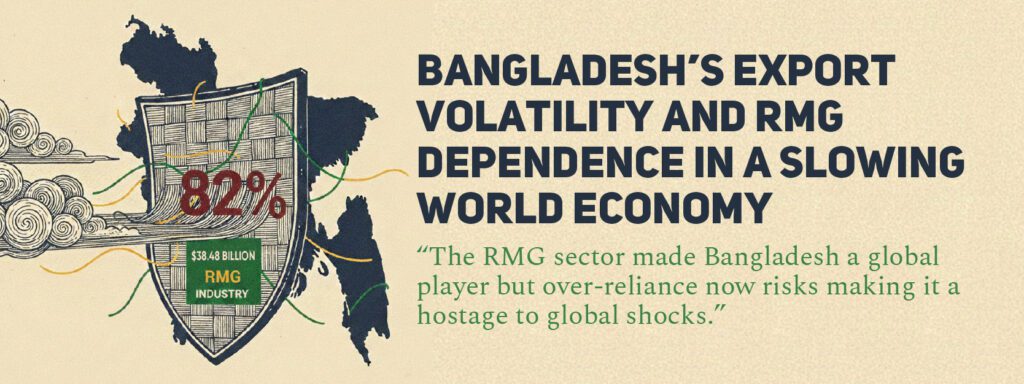
Bangladesh earns more than four-fifths of its export income from one engine, the ready-made garment (RMG) sector, so any global or local shock shows up quickly in jobs, foreign exchange, and growth. In calendar year 2024, RMG exports totaled $38.48 billion, but momentum softened in 2025 as overlapping political, logistical, and trade shocks hit the supply chain.
2) The world economy has slowed and trade has become uncertain
Global demand cooled in 2025 as tariff hikes and policy uncertainty weighed on trade and growth. The World Bank cut its global growth forecast for 2025 to 2.3%, citing tariff-driven uncertainty and front-loading that faded later in the year. World trade itself proved choppy: after a mid-year spurt, the WTO still expected only 2.4% growth in 2025 merchandise trade volumes and warned of a sharp deceleration in 2026 amid persistent uncertainty.
For an export-dependent country like Bangladesh, weaker retail spending abroad and higher trade barriers translate into fewer orders, tighter margins, and more volatile cash flows for factories.
3) Bangladesh’s over-reliance on RMG: strengths and stress points
Strengths. Bangladesh has scale, relationships with global brands, and a growing sustainability edge. The country hosts the world’s largest concentration of LEED-certified green garment factories, adding a record 38 more in 2025 (22 Platinum, 11 Gold, 5 Silver), taking the total to about 270.
Stress points. Concentration risk is high. RMG still makes up roughly 81–82% of total exports, leaving the economy exposed when apparel demand wobbles or when compliance and logistics costs rise. And competitors like Vietnam continue to push into higher value-added segments and faster delivery models, raising the bar for Bangladesh in quality, lead time, and design. (This competitive pressure is reflected in frequent references by trade bodies and buyers to accelerated value-addition and flexible supply chains in Vietnam and others.)
4) 2025 shocks that amplified volatility
a) Transshipment withdrawal by India
In April 2025, India withdrew the transshipment facility that had allowed Bangladeshi exports to move via Indian land customs stations to ports and airports for onward shipment. This change lengthened lead times and raised uncertainty for time-sensitive shipments, especially by air.
b) Customs shutdowns at key gateways
Through late June 2025, protests and a work stoppage by revenue officials led to a near-complete halt of customs operations at Chattogram and Dhaka, stranding tens of thousands of containers and slowing export/import clearance. Even short suspensions can ripple into missed sailings, rolled bookings, and liquidated damages with buyers. Although operations resumed after negotiations, the episode highlighted fragility in trade facilitation.
c) Dhaka airport cargo village fire (October 2025)
A massive fire in the HSIA cargo complex destroyed raw materials, samples, and goods, with exporters estimating losses up to $1 billion and warning of buyer confidence risks during peak season. Even though the blast was in the import cargo area, the indirect impact on production and future orders is large.
d) Labor unrest and political instability
In 2025, episodes of factory stoppages and highway blockades around Gazipur, Savar, and Narayanganj disrupted production and transport. These incidents raise perceived risk for buyers who prioritize reliability alongside price.
5) What the numbers say about export performance
After a strong rebound in 2024 (RMG $38.48 billion, +7.23% y/y), Bangladesh’s FY25 (Jul-Jun) RMG shipments posted $39.35 billion (+8.84%), but monthly data around mid-2025 showed dips tied to holidays and disruptions, underscoring volatility. By structure, RMG still dominates total exports at roughly 81 to 82%, keeping macro-stability tethered to apparel cycles.
6) Channels of macroeconomic risk from export concentration
- Foreign exchange risk. When apparel orders fall or lead times slip, FX inflows slow, pressuring the taka and import finance for raw materials. (This pattern is consistent with how trade slowdowns transmit to EM currencies during tariff and PMI downturns noted by the World Bank.)
- Employment risk. Factory closures or suspensions threaten millions of largely female jobs; in the past year alone, closures have displaced tens of thousands of workers amid price and order pressure.
- Policy trade-offs. During export dips, authorities face hard choices between tight money (to manage inflation/FX) and easy credit (to support working capital), while fiscal space is limited by slower trade-related revenues.
7) Bright spots to build on
- Green competitiveness. The 2025 surge in LEED factories strengthens Bangladesh’s brand with sustainability-focused buyers and can lower operating costs over time through energy and water savings.
- Market mix. Non-traditional markets (e.g., Japan, Australia, India, Türkiye) contributed a $6.3 to 6.4 billion slice and grew modestly in FY25 useful as a hedge against EU/US slowdowns.
- Early 2025 demand signals. Some months showed stronger EU uptake as inventories normalized, though the global backdrop remains uncertain.
8) What Bangladesh should do next?
1) Cut lead time risk.
- Fast-track port and customs automation; adopt a strict “no-shutdown” protocol for border agencies with grievance redress through arbitration instead of work stoppages.
- Diversify gateways (Chattogram, Payra, Mongla; strengthen air-cargo redundancy, and expand bonded logistics capacity near production clusters. (This mitigates shocks like the HSIA cargo fire.)
2) Rebuild trade corridors.
- Negotiate alternative transit and air-freight arrangements with regional partners and carriers to replace the lost India transshipment route, including scheduled charters during peak seasons.
3) Move up the value chain.
- Target product upgrades activewear, performance fabrics, and technical textiles supported by design, R&D, and merchandising skills; align with buyer demand shifts flagged in WTO/World Bank outlooks.
4) Strengthen backward linkages.
- Expand local fabrics, trims, and yarn capacity to reduce import dependence and shorten cash cycles; leverage blended finance to upgrade dyeing/finishing with water- and energy-efficient technologies (synergy with LEED).
5) Stabilize the shop floor.
- Deepen social dialogue and enforce predictable wage/bonus settlements ahead of peak seasons to prevent road blockades and ad hoc closures.
6) Smart incentives tied to diversification.
- Shift from broad cash incentives to performance-linked schemes that reward new products, new markets, shorter lead times, and verified sustainability metrics (e.g., energy intensity cuts or circularity pilots), consistent with global policy guidance favoring transparent, targeted industrial policy.
7) Risk management and insurance.
- Establish a pooled cargo and business-interruption insurance window for exporters following the airport fire, with premium support for firms that adopt certified risk-mitigation standards.
9) Bottom line
Bangladesh remains a top-tier apparel supplier with scale, relationships, and a genuine sustainability edge. But 2025 showed how shocks, tariffs abroad, transit changes next door, protests at home, and even a cargo-hub fire can quickly dent confidence and delivery.
In a slowing, more protectionist global economy, the policy prescription is clear: keep RMG strong, but reduce volatility by improving logistics, ensuring institutional reliability, and diversifying products and markets. If Bangladesh implements these fundamentals while doubling down on green, higher-value manufacturing, it can protect jobs, stabilize the foreign exchange, and rebuild steady export growth.
References
- Bangladesh trade & RMG performance
- BGMEA Export Performance (share of RMG in total exports; FY2024-25 figures). bgmea.com.bd
- The Business Standard: RMG exports reached $38.48 billion in 2024. tbsnews.net
- EPB-based summaries of FY25 RMG exports $39.35 billion (+8.84%). apparelresources.com
- Global outlook
- World Bank, Global Economic Prospects (June 10, 2025 press release): global growth 2.3% in 2025; trade/policy uncertainty. worldbank.org
- WTO, Global Trade Outlook update (Oct 7, 2025): 2025 merchandise trade +2.4%; risks ahead. media.un.org
- World Bank blog on global trade slowdown and policy uncertainty (July 2025). blogs.worldbank.org
- Key shocks
- India’s withdrawal of Bangladesh transshipment facility (April 2025). timesofind…atimes.com , newindianexpress.com
- Customs shutdowns at Chattogram/Dhaka (June 2025) and resumption. dhakatribune.com
- HSIA cargo village fire and loss estimates. aljazeera.com
- Labour protests and highway blockades in garment hubs. dhakatribune.com
- Sustainability edge
- Record 38 new LEED-certified factories in 2025; total around 270. unb.com.bd, rmgbd.net