MBM Group has outlined the next phase of its sustainability journey following the release of its inaugural Environmental, Social, and Governance (ESG). The report was formally introduced on February 3, 2026, at the Group’s Design Studio in Gazipur, marking a structured step in consolidating long-standing sustainability practices within a single, transparent framework.
Operating in Bangladesh’s ready-made garment sector since 1983, MBM Group has developed over four decades alongside the evolution of buyer expectations, regulatory requirements, and global supply chain scrutiny. Throughout this period, the Group has gradually embedded social responsibility, environmental management, and governance discipline into its facilities and workforce policies, often well before such practices were articulated as formal industry standards.
The publication of the ESG Report represents a transition from implicit practice to explicit disclosure. By aligning its operations with globally recognized frameworks, MBM Group has sought to translate years of operational decisions into measurable, comparable, and decision-relevant information for stakeholders across the value chain.
Among the earliest initiatives documented in the report is MBM Group’s introduction of free meals for associates in 1988. The practice, which continues today across its facilities, was established as a basic responsibility rather than a discretionary welfare programme. According to the report, the initiative was rooted in the belief that workforce wellbeing is fundamental to operational stability, productivity, and long-term business continuity.
Environmental investments followed a similar trajectory. In 2005, MBM Group installed its first Effluent Treatment Plant at a time when wastewater treatment in the sector was largely shaped by regulatory minimums. The decision was taken in anticipation of growing environmental risk and accountability, guided by internal conviction rather than external enforcement. This early investment laid the groundwork for subsequent advances in water stewardship and process control.
That approach was further reflected in the development of MBM’s on-site washing unit in 2015. The facility was planned and executed with sustainability as a core operating principle, integrating water efficiency, chemical management, and energy performance at the design stage. Rather than retrofitting environmental controls after commissioning, sustainability considerations were embedded into process flow, technology selection, and monitoring systems from the outset.
The ESG Report situates these milestones within a broader governance and risk management context. Prepared in accordance with the Global Reporting Initiative (GRI) Standards and informed by the European Sustainability Reporting Standards (ESRS), the report applies a double materiality framework to assess both the Group’s environmental and social impacts and the ESG-related risks and opportunities affecting enterprise value.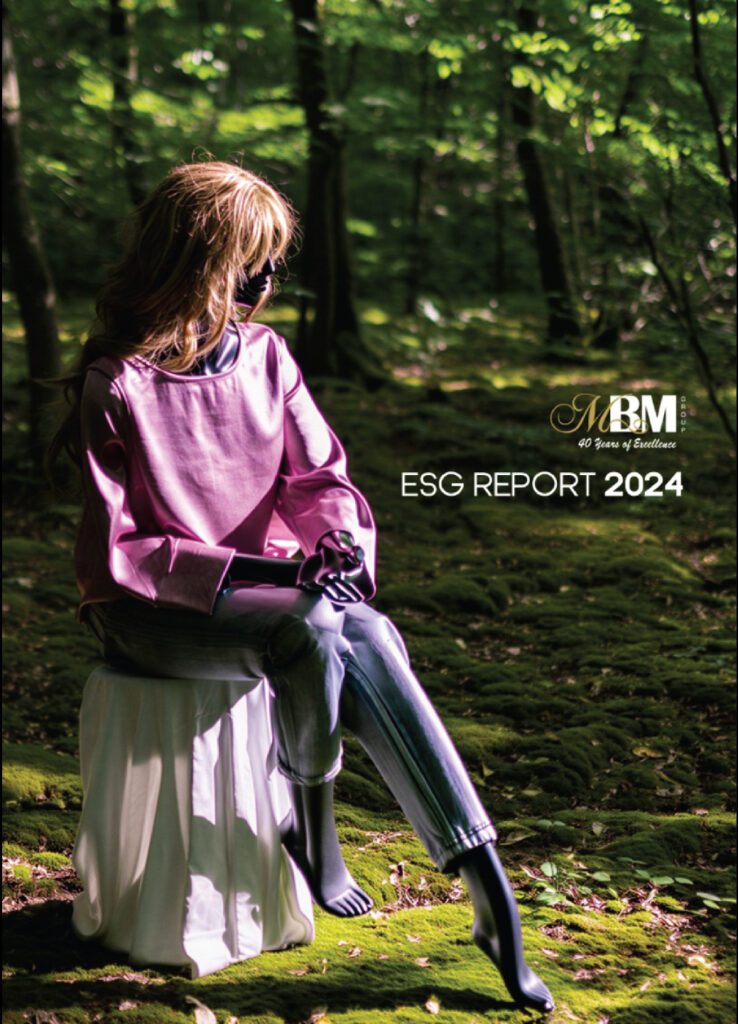
The reporting process was supported through the Better Mill Initiative (BMI), implemented by Solidaridad Network Asia in collaboration with G-Star RAW and funded by the Netherlands Enterprise Agency (RVO). This technical support enabled the translation of operational data into structured disclosures aligned with international expectations.
Industry stakeholders, sustainability partners, and international buyers attended the launch event, reflecting growing interest in consistent ESG disclosure within the apparel manufacturing sector. Representatives from global brands, financial institutions, and development organizations participated in discussions on transparency, comparability, and the role of verified data in strengthening long-term sourcing relationships.

The ESG Report details MBM Group’s approach across four core pillars: environmental performance, social responsibility, governance oversight, and stakeholder integration. Rather than presenting sustainability as a standalone function, the report outlines how ESG considerations are embedded into operational decision-making, capital investments, and risk management processes.
On environmental performance, the report documents measurable outcomes in energy efficiency, water usage, emissions reduction, and chemical management, supported by investments in efficient machinery, monitoring systems, and process optimization. These outcomes are presented alongside clear targets through 2030, providing visibility into both current performance and future direction.
From a social perspective, the report highlights workforce engagement, occupational health and safety systems, training and development programmes, and mechanisms for grievance redressal. These elements are framed not only as compliance requirements, but as contributors to workforce stability, skill development, and operational resilience.

Governance structures are detailed through a tiered oversight model, linking board-level accountability with senior management execution and operational implementation. Specialized committees and defined lines of responsibility are described as mechanisms to ensure that ESG risks and opportunities are reviewed with the same discipline as financial and operational matters.
Stakeholder engagement is presented as an ongoing process rather than a periodic exercise. The report identifies employees, clients, financial institutions, local communities, regulators, industry partners, development partners, and service providers as key stakeholder groups, with structured channels for dialogue and feedback. MBM Group has indicated plans to expand this engagement and conduct periodic materiality reassessments to reflect evolving expectations.
MBM Group noted that the ESG Report is intended to function as a baseline for continuous improvement rather than a one-time disclosure. By establishing consistent metrics, targets, and governance structures, the Group aims to track progress over time and adjust strategy as external conditions change.
Senior management emphasized that structured ESG integration is becoming increasingly relevant for export-oriented manufacturers. Global buyers and financial institutions are placing greater emphasis on verified sustainability data, governance maturity, and the ability to demonstrate not only policies, but operational execution.
As regulatory frameworks in key markets evolve and sustainability-linked financing becomes more prevalent, manufacturers with established data systems and reporting discipline may be better positioned to respond to changing requirements. In this context, ESG reporting is increasingly viewed as part of core business infrastructure rather than an external communications exercise.
MBM Group has stated that its reporting framework will continue to evolve alongside broader digitalization and performance management initiatives. With its in-house developed, SCADA based water and energy resource management system “WEManage” already streamlining tracking, analysis and automation efforts, the Group plans to further deepen data integration across operations, enabling more granular tracking of parameters.

While the ESG Report reflects MBM Group’s specific journey, the company noted that the broader direction of travel within the sector is clear. Structured ESG disclosure, once considered optional or reputational, is increasingly becoming a baseline expectation for manufacturers engaged in global supply chains.
The ESG Report is publicly available on MBM Group’s website and will be updated regularly as part of the Group’s transparency and performance tracking efforts.
Author: MBM Group