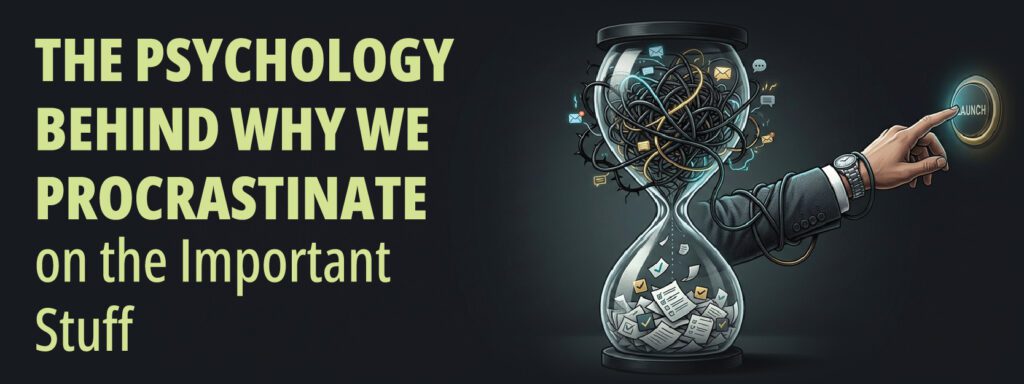
Every Monday morning, millions of professionals arrive at their desks with the best of intentions. They have a list. They know what matters. And yet, by Friday afternoon, the most consequential tasks — the ones that could define a quarter, close a deal, or reshape a strategy — remain stubbornly incomplete. Instead, the week was spent triaging emails, joining calls that could have been memos, and tackling every small, completable task first. Sound familiar?
This pattern has a name, and it isn’t flakiness. Researchers, organizational psychologists, and behavioral economists have spent decades unraveling why high-functioning professionals — including executives, analysts, and team leads — consistently delay the work that matters most. The findings are both humbling and actionable.
The Brain’s Threat Response, at the Office
At the heart of workplace procrastination is a neurological tug-of-war. Dr. Tim Pychyl, associate professor of psychology at Carleton University and one of the foremost researchers on procrastination, describes the behavior not as a time-management failure but as an emotion regulation failure. “We avoid tasks not because we’re bad at managing our schedules,” Pychyl has noted in his research, “but because those tasks generate negative emotions — anxiety, self-doubt, boredom — and we seek immediate mood repair.”
In the corporate context, “important tasks” almost always carry emotional weight. Preparing a performance review for a difficult team member, pitching a risky new initiative to the board, or writing the restructuring proposal no one wants to deliver — these tasks are important precisely because their outcomes are uncertain and their stakes are high. The brain’s limbic system, responsible for threat detection, registers this uncertainty the same way it processes a physical threat. The prefrontal cortex — where rational planning happens — tries to override it. Often, it loses.
“We don’t procrastinate on tasks we hate. We procrastinate on tasks we care about too much to risk doing badly.”
— DR. FUSCHIA SIROIS, PROFESSOR OF PSYCHOLOGY, UNIVERSITY OF SHEFFIELD
Dr. Fuschia Sirois, professor of psychology at the University of Sheffield, has explored this dimension extensively. Her research underscores that procrastination correlates more strongly with self-compassion deficits than with laziness. People who are hardest on themselves about failure are often the ones most likely to delay — and the corporate culture of relentless performance measurement can amplify this loop significantly.
The Completion Trap: Why Small Tasks Win
There is something deeply satisfying about crossing items off a list. Neuroscience explains why: completing a task — even a trivial one — releases a small burst of dopamine. For an employee drowning in ambiguity, a neatly filed expense report is a dopamine hit with zero risk attached. The important project, meanwhile, offers no such certainty. It might fail. The feedback might sting. The effort might be rejected.
Behavioral economists call this present bias — the tendency to favor smaller, immediate rewards over larger, delayed ones. Dr. Piers Steel, professor at the University of Calgary’s Haskayne School of Business and author of The Procrastination Equation, has quantified this dynamic, finding that the perceived value of a task drops sharply as its deadline recedes and its complexity increases. In other words, the more important the task, the easier it is to put it off — until the deadline is close enough that the panic overrides the avoidance.
For organizations, this plays out at scale. Teams default to operational busy-ness — answering messages, optimizing processes already in place, attending status calls — while strategic work accumulates. McKinsey research has shown that senior leaders spend nearly 60 percent of their time on matters they themselves rate as low importance. The important work waits.
Identity, Status, and the Fear of Being Found Out
The corporate environment introduces a layer of procrastination psychology rarely discussed in academic literature: identity threat. In an office, your output is visible. Your peers, your manager, your skip-level all have access to signals about your performance. For many professionals, beginning a high-stakes piece of work is not just a cognitive act — it is an act of exposure.
Dr. Brené Brown’s research on vulnerability in professional settings offers a relevant frame here. When we start significant work, we make ourselves vulnerable to judgment. The unstarted project, paradoxically, feels safer — because an unstarted project cannot be criticized. Professionals experiencing imposter syndrome, which studies suggest affects over 70 percent of people at some point in their careers, are especially susceptible to this logic.
“The perfectionism-procrastination loop is one of the most insidious patterns in corporate culture,” says Dr. Alice Boyes, author of The Healthy Mind Toolkit. “People set an internal standard so high that starting feels futile. So they wait for the ‘right moment’ — which never comes.”
Organizational Design as an Accelerant
Procrastination does not happen in a vacuum. The structures of modern corporate life actively encourage it. Open-plan offices and always-on communication tools have collapsed the boundaries between reactive and reflective work. Slack notifications, email pings, and calendar invites compete for the same cognitive bandwidth as deep, strategic thinking — and they almost always win, because they are immediate and social, two qualities the brain finds irresistible.
Cal Newport, associate professor of computer science at Georgetown University and author of Deep Work, has documented what he calls the “hyperactive hive mind” — a default workflow in most knowledge-work environments where unstructured, real-time communication has replaced protected time for difficult thinking. The result is a workforce that is perpetually busy and chronically underdelivering on the work that would create the most value.
There is also the matter of how organizations measure output. Activity-based metrics — emails sent, meetings attended, tickets closed — are easy to track and rewarding to report on. But important work is often slow, non-linear, and uncomfortable to quantify while in progress. This misalignment sends a quiet but powerful signal to employees: visible busyness is rewarded; invisible thinking is not.
What Actually Works
The evidence base for overcoming high-stakes procrastination is growing — and the most effective interventions tend to work with the brain’s architecture rather than against it. Behavioral researchers point to a cluster of practices that consistently move the needle.
Temptation bundling, a concept developed by Dr. Katherine Milkman of the Wharton School, pairs the important task with something genuinely pleasurable — a specific playlist, a preferred location, a post-work reward — creating a conditioned positive association that lowers the emotional barrier to starting.
Implementation intentions — writing out the specific when, where, and how of beginning a task — reduce avoidance by removing the ambiguity that often masks as a reason to delay. Research by Dr. Peter Gollwitzer at NYU shows that people who form these “if-then” plans are significantly more likely to follow through on difficult goals.
Self-compassion interventions have shown measurable effects on chronic procrastination. Sirois’s research found that people who could forgive themselves after a procrastination episode were less likely to procrastinate again on similar tasks — suggesting that the shame spiral is itself a driver of the behavior.
At the organizational level, leaders are beginning to experiment with protected “deep work” blocks — uninterrupted hours explicitly reserved for high-stakes cognitive tasks — and explicit cultural norms around asynchronous communication. Google, Microsoft, and a growing number of mid-market firms have formalized these practices, with early results suggesting meaningful gains in both output quality and employee wellbeing.
The Strategic Reckoning
There is a broader corporate conversation waiting to happen here — one that moves beyond individual time-management tips and into the structural and cultural conditions that make important work feel impossible. As hybrid work reshapes the office and AI absorbs more of the low-complexity task load, the ability to engage with meaningful, uncertain, high-stakes work becomes the defining professional competency of the decade.
The employees who can resist the pull of the inbox and spend sustained energy on the things that are genuinely hard — that is where competitive differentiation will live. And the organizations that understand procrastination as a systems problem, not a character flaw, will be the ones best positioned to unlock it.
The strategy deck is still on your desktop. The cursor is still blinking. Now you know why.