A few years ago, sustainability occupied a predictable place in most board meetings. It appeared near the end of the agenda. Usually after finance and sales. Sometimes after HR.
It was often discussed in the language of compliance—ESG reporting, carbon footprints, environmental audits, regulatory obligations, or CSR activities.
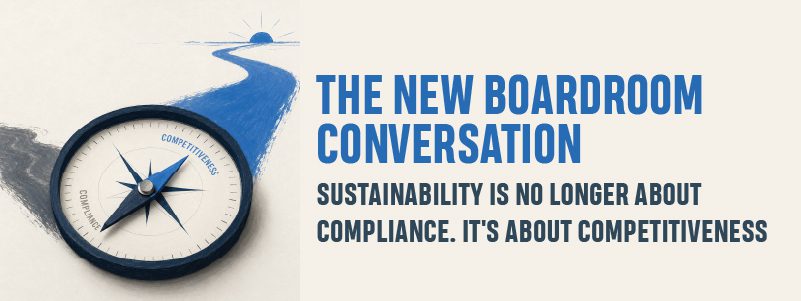
Today, that conversation is changing. Not because regulations are becoming stricter. But because markets are becoming smarter. The question for business leaders is no longer whether sustainability matters. It is whether their business can remain competitive without it.
From ESG to Enterprise Value
Spend time with CEOs across industries—from Dhaka to Singapore, London to New York—and a common pattern begins to emerge.
Very few business leaders deny climate change.
Very few dismiss the importance of responsible business.
Yet many are asking a different question.
“How does sustainability improve business performance?”
It is a fair question. Because shareholders do not invest in good intentions. They invest in resilient businesses. Increasingly, sustainability is no longer being justified through morality. It is being justified through profitability.
Lower energy costs.
More resilient supply chains.
Reduced operational risks.
Improved investor confidence.
Better access to international markets.
Stronger employer branding.
In other words, sustainability is moving from the CSR department to the boardroom.
Bangladesh Is Already Feeling the Shift
For Bangladesh, this conversation is no longer theoretical. The European Union’s evolving sustainability regulations, increasing buyer expectations, and global pressure for supply-chain transparency are already reshaping how exporters operate.
Our Ready-Made Garment industry understood this earlier than many sectors. Today, Bangladesh proudly hosts one of the world’s largest concentrations of LEED-certified green garment factories. That achievement was never just about protecting the environment. It strengthened global buyer confidence.
Improved factory efficiency.
Reduced operating costs.
And enhanced Bangladesh’s competitiveness in international markets.
The lesson extends far beyond apparel. Whether in pharmaceuticals, steel, construction materials, FMCG, logistics, healthcare, or consumer electronics, global customers increasingly evaluate not only what companies produce, but how they produce it.
Sustainability is becoming a market access strategy.
The Cost of Ignoring Tomorrow
Many executives still view sustainability as an expense. Perhaps because the returns rarely appear in the next quarterly report.
But business history consistently rewards organizations that invest before disruption becomes unavoidable.
Consider energy. Organizations that invested in rooftop solar, waste heat recovery, efficient machinery, or water recycling several years ago are now experiencing lower operational costs while others continue to struggle with rising utility expenses and supply uncertainties.
Likewise, businesses that diversified sourcing strategies before recent global disruptions have demonstrated greater resilience than those dependent on a single geography or supplier.
Risk management has quietly become one of sustainability’s strongest business cases.
Technology Will Accelerate the Conversation
Artificial Intelligence is rapidly transforming industries. Yet AI also introduces another leadership challenge.
Its energy consumption.
Its data requirements.
Its cybersecurity implications.
Its governance.
The most successful organizations will not pursue AI and sustainability as separate agendas. They will integrate both into a single strategy focused on operational excellence. Imagine predictive maintenance reducing factory energy consumption. AI optimizing logistics routes to lower transportation costs. Machine learning reducing production waste.
Smart buildings managing electricity consumption automatically.
These are no longer experimental ideas.
They are becoming competitive necessities.
The Trust Economy Has Arrived
Perhaps the biggest shift is not technological. It is societal. Consumers ask different questions today. Employees do too. Young professionals increasingly want employers whose values align with their own. Investors examine governance alongside growth. Global buyers demand transparency throughout the supply chain. Communities expect businesses to contribute beyond economic output. This is particularly relevant for Bangladesh as our companies aspire to become regional and global brands. Reputation is no longer built through advertising alone. It is built through consistent actions.
People can distinguish between genuine commitment and carefully crafted marketing.
Trust has become measurable. And increasingly, it influences purchasing decisions, investment flows, and talent attraction.
A Different Kind of Leadership
The most effective CEOs are quietly reframing sustainability conversations inside their organizations.
Not by asking, “How much will this initiative cost?”
But by asking, “What will it cost us if we don’t act?”
That subtle shift changes everything. It transforms sustainability from a reporting exercise into a strategic investment.
From compliance into competitiveness.
From obligation into opportunity.
The Chronicle Continues
Bangladesh stands at an important inflection point. Our ambition to become a high-income economy, expand exports beyond traditional sectors, attract greater foreign investment, and build globally respected brands will depend on more than production capacity.
It will depend on how resilient our businesses become. How responsibly they grow. And how effectively today’s leaders prepare for tomorrow’s expectations.
In the years ahead, companies will no longer be judged solely by the profits they generate. They will increasingly be measured by the value they create—for shareholders, employees, customers, communities, and future generations alike. Because in the modern boardroom, sustainability is no longer about saving the planet alone. It is about ensuring that businesses themselves remain worth saving.

Towfique Hasan FCIM
Chief Business Development Officer
Akij REsource