On the evening of 11 June, bankers at Goldman Sachs priced the largest initial public offering ever attempted. SpaceX opened on Nasdaq the following morning at $135 a share, raised around $75 billion, and closed its first day of trading up 19 percent at $161. For a few hours that week the rocket company was worth more than Amazon and more than Microsoft, and its market value crossed $2 trillion. Investor demand had run past $250 billion, roughly four times what the company was asking for.
Among the beneficiaries were a set of investors who, a decade ago, were being openly mocked for exactly this kind of bet. Saudi Arabia’s Public Investment Fund and the Abu Dhabi Investment Authority had taken part in SpaceX’s earlier private financing rounds. Qatar’s sovereign fund arrived through the side door, holding a position in xAI, which merged into SpaceX in February.
The mockery was once deserved. PIF and Abu Dhabi’s Mubadala were anchor investors in SoftBank’s first Vision Fund, the $93 billion vehicle launched in 2017 that produced WeWork and a long lecture from Wall Street about what happens when oil money meets Silicon Valley. Analysts said the Gulf should stick to infrastructure, real estate and public equities, where the returns were steady and the embarrassment was minimal.
The Gulf has now done the opposite of what it was told, and the June listing is the least interesting part of the story.
| THE SCALE
$4–5tn combined assets of the six largest Gulf sovereign funds: ADIA, PIF, ICD, Mubadala, QIA and KIA $7.6tn projected combined assets of the region’s 19 sovereign funds by 2030 $2tn+ managed by Abu Dhabi’s investment entities alone, more than the economies of the Netherlands or Switzerland 4 of the world’s ten largest sovereign wealth funds are based in the Gulf |
The quiet exit from public markets
The shift that matters is not which companies these funds are buying. It is which market they are buying them in.
Invesco’s annual study of sovereign investors, covering 90 funds with $17.2 trillion between them, found a net 17 percent of them planning to cut their exposure to listed equities this year. That is a reversal of the pattern of recent years. Between 28 and 35 percent said they intended to add to private equity, private credit and infrastructure instead. Mubadala is already there, with 59 percent of its assets held in private equity, infrastructure and real estate. Singapore’s Temasek, which is not a Gulf fund but moves in the same direction, holds 49 percent of its portfolio in unlisted assets.
There is a straightforward reason for the rotation, and the industry rarely says it out loud. You cannot buy the artificial intelligence boom on a stock exchange, because the assets that make it possible are not listed there. The data centres are private. The power plants are private. The mineral rights are private. A fund that wants exposure to the machinery rather than the marketing has to leave the public market to get it.
“You cannot buy the AI boom on the stock exchange. The assets that make it possible are not listed there.”
What they are actually buying
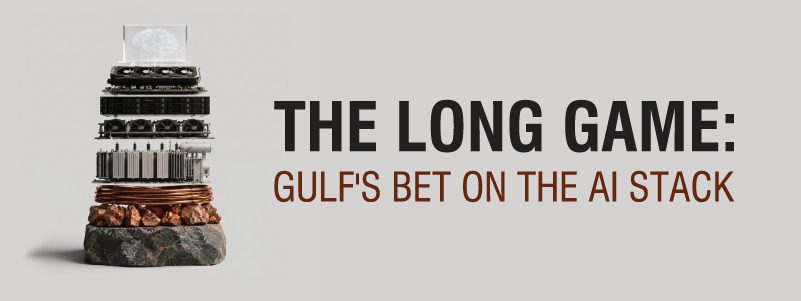
Set the deals side by side and a strategy appears that is more coherent than the headlines suggest. The Gulf is not chasing the models. It is buying the stack underneath them, layer by layer, from the electricity upward.
| LAYER | THE MOVE | THE FUND |
|---|---|---|
| Compute | MGX joined BlackRock’s Global Infrastructure Partners to acquire Aligned Data Centers in a deal reported at around $40 billion, among the largest digital-infrastructure transactions ever done | MGX (Mubadala with G42) |
| Power | A $500 million investment in AlphaGen, a US portfolio of more than 11 gigawatts of generating capacity structured specifically to feed data centres | ADIA |
| Chips and robotics | Alat, a $100 billion vehicle for semiconductors, robotics and automation | PIF |
| Models | Humain, launched to build across the artificial intelligence value chain | PIF |
| Minerals | Sustained buying in the critical minerals the hardware depends on | ADQ |
| Energy systems | XRG, ADNOC’s international investment arm, targeting the energy infrastructure that powers data centres | ADNOC |
Sources: Bloomberg News analysis of Abu Dhabi’s investment entities; company announcements; Middle East Institute.
Mubadala has also backed the data-centre developer Yondr, while ADIA holds positions in Landmark Dividend and Vantage Data Centers and has partnered with Singapore’s SC Capital Partners to buy data centres across Asia-Pacific. MGX itself launched with a war chest of $100 billion earmarked for artificial intelligence infrastructure and semiconductors.
The logic is that of a landlord rather than a speculator. If the artificial intelligence boom delivers everything its promoters claim, the owner of the compute and the power collects rent on all of it. If it disappoints, the electricity is still worth something, the buildings are still worth something, and the copper is still worth something. It is a far more conservative position than a portfolio of model developers, which is precisely why it looks so unlike the Vision Fund.
The payday, and the caveat
SpaceX rose 19 percent on its first day and peaked at $225.64 four days later, before giving back much of the gain. By late June it traded around $153, still comfortably above the $135 issue price.
The SpaceX numbers underneath the share price are worth reading carefully, because they show what the Gulf funds have actually bought into. Starlink generated $11.4 billion in 2025, around 61 percent of company revenue, having grown roughly 50 percent in a year, and its subscriber base more than doubled to 10.3 million customers across 160 countries by the end of March. Group revenue reached $18.7 billion with adjusted EBITDA of $6.6 billion.
The company also posted a GAAP net loss of close to $5 billion for 2025, and its artificial intelligence unit burned $7.72 billion in the first three months of 2026 alone, on which it lost $2.47 billion at the operating line. This is a genuine business with a genuine cash engine attached to a genuine money pit, which is a reasonable description of the entire sector the Gulf has now committed itself to.
The three problems underneath
Three problems sit underneath the strategy, and a business readership deserves to hear them named.
The first is opacity. ADIA, Mubadala, QIA and PIF have all signed the Santiago Principles, the governance framework drawn up in 2008, but the principles are voluntary and the decision-making inside these institutions remains closed. Abu Dhabi has insisted since its 2008 open letter in the Wall Street Journal that it has never used sovereign wealth as an instrument of foreign policy and never will. The German Institute for International and Security Affairs notes the difficulty with taking that on trust: in the Gulf monarchies there is substantial personnel overlap between the people running the funds and the people directing foreign policy, which makes the commercial and the political motive very hard to separate from the outside.
The second is concentration. An enormous quantity of capital, from a small number of related states, is now pointed at a single technology thesis. Diversification was the original argument for building these funds. Buying every layer of one industry is the opposite of diversification, however many separate deals it is spread across.
The third is the irony at the centre of it, and it is not a small one. These are hydrocarbon revenues, being converted into ownership of the infrastructure of an industry whose energy appetite is currently one of the strongest arguments for burning more hydrocarbons. Qatar’s fund announced in 2020 that it would make no new investments in hydrocarbons. Its money still comes from gas.
The wager
Strip away the numbers and the Gulf is making one bet, repeatedly, in public. It is that the oil age ends, that the compute age replaces it, and that the safest place to stand during the transition is underneath the new industry rather than inside it. Owning the data centre is safer than owning the model. Owning the power station is safer than owning the data centre. The funds have worked their way down the stack until they reached the ground.
For twenty years the criticism of Gulf sovereign wealth was that it bought trophies: banks in a crisis, football clubs, skyscrapers, a stake in a story. What it is buying now is unglamorous and extremely difficult to sell in a hurry. Whether that is the most sophisticated hedge in modern finance or simply the most expensive one, the answer will not arrive for a decade. The June listing was not the verdict. It was the first instalment.