Start with the detail that tells you everything. When LinkedIn published a post about its efforts to fight low-quality AI content on the platform, the detection firm Pangram ran the announcement through its model. The post was flagged as AI-generated.
That is funnier than it is surprising, and it sits on top of a study worth taking seriously. Pangram Labs published its findings on 9 July, drawn from just over a million posts that opted-in users actually encountered in their feeds across LinkedIn, X, Reddit, Medium and Substack from late April onward. Because the sample came from a browser extension rather than a scrape, the numbers describe what people are being served rather than what exists somewhere on a server.
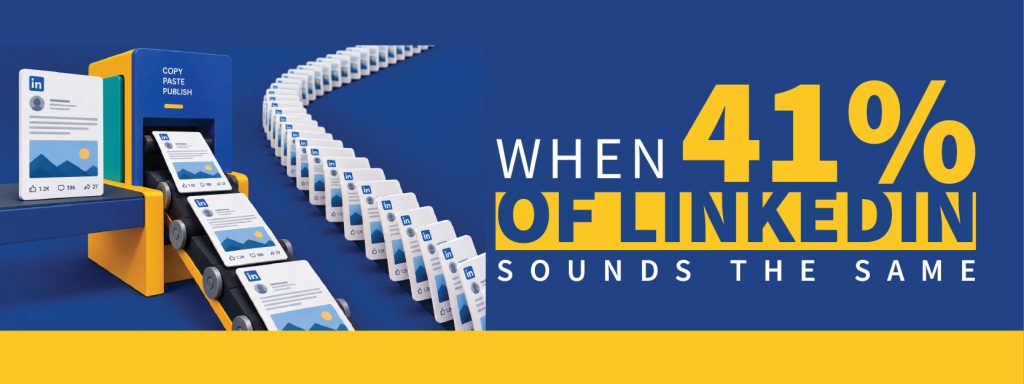
LinkedIn came top by a distance. Forty-one percent of long-form posts, defined as anything over 250 words, were classified as fully machine-generated, alongside 30 percent of shorter posts. The platform accounted for only a third of everything scanned and nearly two-thirds of all the AI content detected.
Why the number holds up
A single detection company producing an alarming statistic about detection-worthy content is not, on its own, evidence. What makes this credible is that a competitor got there first and got the same answer.
Originality.ai, which sells rival detection software, analysed 3,368 posts from 99 influential LinkedIn voices in January and found more than half likely machine-written. An earlier study of 8,795 posts stretching back to 2018 put the figure at 54 percent using a 100-word threshold. Apply Pangram’s stricter 250-word cutoff to that same dataset and the number lands on 41 percent. Two firms, different models, different sampling, direct commercial rivalry, and the figures converge once the definitions match.
Pangram’s chief executive, Max Spero, describes the accumulated result as a tax on readers’ time and calls his own estimate a lower bound.
There is a longer arc behind the number too. Originality.ai traces the surge to the weeks immediately after ChatGPT launched in early 2023, when AI-written posts on the platform jumped by an estimated 189 percent. What began as a novelty among early adopters became, within three years, the default way a professional class writes in public.
The readers noticed first
Here is the part that should concern anyone who posts professionally. AI-generated posts on LinkedIn earn an average of 45 percent less engagement than human-written ones.
Nobody is checking these posts against a detector before deciding whether to read them. They are pattern-matching, and doing it fast. The tidy three-part structure. The rhetorical question in the opening line. The single-sentence paragraph deployed for emphasis. The uniform sentence length. Readers have absorbed the shape of machine prose and learned to scroll past it, which means the discount is applied on sight rather than on evidence.
And a discount applied on sight cannot distinguish. If your writing happens to be tidy, structured and grammatically careful, it collects the same penalty as writing that was generated. Competence has become a suspicious signal, which is a strange thing to have to tell people.
Who pays the penalty
This lands unevenly, and it is worth naming who takes the hit. Detection models infer authorship from stylistic patterns, vocabulary distribution and sentence rhythm rather than from any record of how a document was made. Formal writing and writing by non-native English speakers both trip those signals more often, because both tend toward careful construction and conventional phrasing.
So the professional in Dhaka or Manila who writes correct, slightly formal English is more likely to be mistaken for a machine than the American founder typing in fragments. The penalty falls hardest on people who learned the language properly.
Pangram is candid about the limits of its own method. Its sample came from people who chose to install an AI-spotting extension, often because they already suspected what they were reading, which skews the pool. Authorship is also rarely binary: someone may dictate the substance, let a model organise it, rewrite the result and then run a grammar check, and that hybrid sits on a spectrum no detector resolves cleanly. The 41 percent describes posts where the machine did the heavy lifting, not posts a machine touched.
What LinkedIn is doing, and what you can do
The platform’s own response is narrower than the headlines suggest. LinkedIn does not penalise AI assistance as such. It restricts distribution of content its systems judge to be generic, repetitive or produced by automation with minimal human involvement, and it began rolling out a reader feedback option in July. The target is volume automation rather than editing help.
Which points to the only durable answer available to an individual. What survives the discount is not style but specificity: the number from your own operation, the thing a client said on Tuesday, the detail nobody could have generated because nobody else knows it. A model can produce a competent paragraph about leadership. It cannot tell anyone what your third-quarter renewal rate was, or why the pitch failed.
Everything above that line is thinking, and it is the part worth doing yourself. Everything below it, the tightening and the restructuring, was always mechanics. The mistake most people are making is handing over the first half and defending the second.
For companies paying agencies to run executive profiles, that reframes what is being bought. A retainer that produces polished, structurally identical posts is purchasing the exact commodity readers have learned to skip. The expensive part was never the writing.
Sources: Pangram Labs, “AI Content Is Everywhere on Social Media, Especially LinkedIn”, published 9 July 2026, based on 1,002,627 posts encountered by opted-in users across five platforms from 24 April 2026 · Max Spero, chief executive, Pangram Labs, via 404 Media · Originality.ai LinkedIn AI content studies, January 2026 and July 2026 · Tech Times, on engagement differences between AI and human-authored posts · LinkedIn platform policy on automated and low-quality content, July 2026 · The Register, The Decoder and Gizmodo coverage of the Pangram findings.