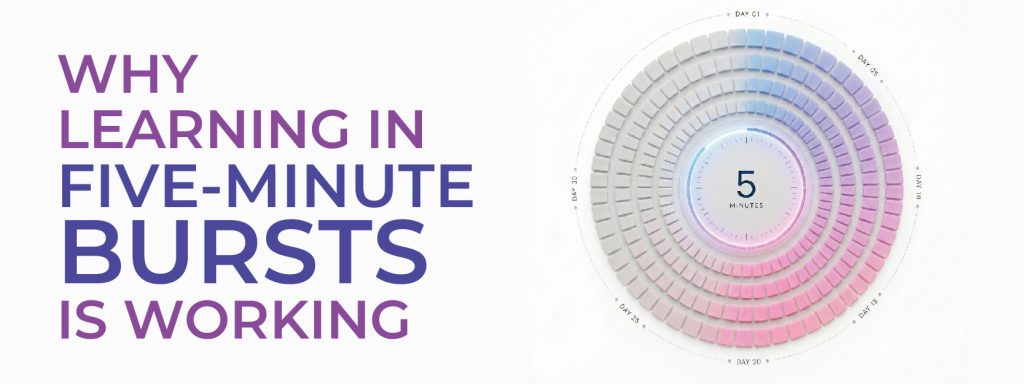
Micro-habits and bite-sized on-demand learning are replacing structured professional development as the dominant mode of skill-building in 2026. The science behind why short, frequent exposures compound more effectively than intensive training events — and what it means for how you design your own learning practice.
Hermann Ebbinghaus was a German psychologist who, in the 1880s, conducted a series of experiments on himself to understand how memory works. Over months of testing, he discovered something that would eventually reshape how education researchers and cognitive scientists think about learning: the rate at which the human brain forgets newly acquired information follows a predictable curve. Without reinforcement, a person retains roughly 70% of new material within 24 hours, around 50% within a week, and only 10 to 20% within a month. The implications of that curve, which Ebbinghaus published in 1885 and which has been replicated consistently ever since, were largely ignored by the organisations responsible for training people — until recently.
The way most professional development has worked, and still works in many organisations, is the opposite of what the forgetting curve prescribes. An employee attends a two-day workshop. Information is delivered in dense sessions. Notes are taken, perhaps a workbook is filled. The employee returns to work, the workbook sits in a drawer, and by the following month most of the content has joined the rest of what the forgetting curve consumes. Josh Bersin, whose advisory firm has tracked the corporate learning market for two decades, describes the pattern candidly: before AI, and before organisations began taking cognitive science seriously, the training department would deliver a solution three to six months after the business requested it — often without diagnosing the underlying performance problem. The output was a course that people attended and promptly forgot.
What is replacing that model is not simply shorter content. It is a fundamentally different philosophy of how learning works, built on principles that cognitive science has supported for over a century but that instructional design has only recently begun to apply systematically.
| 25–60% — the improvement in knowledge retention that microlearning delivers compared to traditional longer training formats. (Continu, 2025)
The global microlearning platforms market is valued at $3 billion in 2025 and projected to reach $7.8 billion by 2035 (Future Market Insights). 85% of organisations now use video-based microlearning as part of their training programmes. The $400 billion corporate training market is being restructured around bite-sized, on-demand formats — not as a convenience but as a science-backed response to how memory actually works. |
What the science actually says — and why it took so long to apply
The cognitive science behind microlearning rests on three principles that, taken together, explain both why intensive training fails and why distributed short-form learning succeeds. The first is cognitive load theory, developed by educational psychologist John Sweller in the 1980s, which proposes that working memory — the cognitive system through which we process new information — has a finite capacity. When learning sessions deliver more information than working memory can handle, the excess is not stored; it is discarded. A two-day workshop that covers twelve modules is not giving learners twelve times the opportunity to learn; it is systematically exceeding the capacity at which learning can occur. Microlearning, by confining each session to a single concept or skill, reduces what researchers call extraneous cognitive load — the mental effort spent processing irrelevant or overwhelming information — and redirects that capacity toward the learning itself.
The second principle is spaced repetition, which addresses the forgetting curve directly. Cepeda and colleagues’ 2006 meta-analysis in Psychological Bulletin, which synthesised 839 effect-size contrasts from 317 experiments across 184 articles, found the same result consistently: distributing practice over time produces better retention than massing it in a single session. The optimal spacing, as Cepeda’s 2008 follow-up with over 1,350 participants established, scales to roughly 10 to 20% of the desired retention interval — meaning that if you want to remember something for a month, your review sessions should be spaced approximately three to six days apart. This is not an abstract research finding. It is the algorithm that powers Duolingo’s learning engine, and it is why a user who practises Spanish for twelve minutes a day for six months retains significantly more than one who attends a forty-hour language course and practises nothing afterward.
The third principle, and the one with perhaps the most counterintuitive implications, is retrieval practice — the finding, established by Roediger and Karpicke at Washington University in St. Louis in 2006 and extended in their 2008 paper in Science, that testing yourself on material produces better long-term retention than restudying it. Students who studied a passage once and then took three recall tests remembered approximately 60% of the content after a week; students who studied the same passage four times without testing remembered only 40%. The implication is that the effort of trying to recall information — even when that effort is partially unsuccessful — does more to consolidate memory than exposure to the material does. A five-minute microlearning session that ends with a quiz is not simply more engaging than a lecture; it is structurally more effective at producing lasting retention.
|
APPROACH |
RETENTION AFTER 1 WEEK |
KEY MECHANISM |
|
Traditional classroom (one-off session) |
8–10% | Single exposure, no retrieval practice |
|
E-learning (long modules, self-paced) |
25–35% |
Some repetition, minimal spacing |
|
Microlearning with spaced intervals |
60–80% |
Distributed practice, retrieval at optimal gaps |
|
Microlearning + spaced repetition + retrieval testing |
Up to 87% |
Full alignment with how memory consolidates |
Knowledge retention by learning approach after one week. Sources: Shift eLearning, Continu, LMSNinjas, Frontiers in Psychology 2025, ERIC meta-analysis. Retention rates are averages across studies and vary by subject matter, learner profile, and implementation quality.
What it means for how you design your own learning
The corporate application of microlearning is growing fast — 85% of organisations now use video-based microlearning as part of their training programmes, and the platforms that deliver it are scaling at 10% annually. But the more important implications may be for individuals designing their own learning practice outside of what their organisation provides, because the science of how memory consolidates does not distinguish between a corporate training module and a YouTube tutorial. The same principles apply, and most people apply none of them.
The typical professional approach to learning is episodic and intensive: reading a book in a burst of motivation, attending a conference, completing an online course in a week. Each of these is a version of massed practice — the approach that the Ebbinghaus forgetting curve and a century of replication have identified as the least effective way to build durable knowledge. The research suggests that the same total time investment, distributed across shorter and more frequent sessions with retrieval practice between them, will produce retention rates that are not marginally better but categorically better. Bersin’s observation — that learning needs to happen in the flow of work rather than as a separate event — reflects this principle applied at the organisational level, but it applies equally at the individual one.
The same total time investment, distributed across shorter and more frequent sessions, produces retention that is not marginally better but categorically better than any intensive approach.
The practical design of a microlearning practice for an individual rests on four specific decisions. The first is session length. Research, including a 2025 review by Alias and Razak cited in the Educational Research Journal, identifies optimal session lengths for microlearning at between five and fifteen minutes: sessions shorter than five minutes may lack sufficient depth for meaningful learning, while sessions exceeding fifteen minutes begin to approach the cognitive load thresholds at which processing efficiency declines. The second decision is frequency — which should prioritise regularity over duration. Daily ten-minute sessions produce better outcomes than weekly ninety-minute ones, even when total time is equal, because of the spacing effect. The third is spacing: reviewing material at increasing intervals — within 24 hours of first exposure, then at three days, then at one week, then at one month — exploits the brain’s sensitivity to the timing of retrieval in a way that a single review session cannot.
The fourth decision is retrieval practice. This is the element most consistently absent from self-directed learning — and the element with the largest effect size in the research literature. Roediger and Karpicke’s finding that testing outperforms restudying applies equally to flashcards, summary recall, teaching the concept to someone else, or the kind of quiz that every well-designed microlearning platform now includes at the end of each module. The mechanism, as Esteban Kramár and colleagues at UC Irvine showed in hippocampal research published in 2012, is biological: retrieval activates the same neural pathways used to store the memory, strengthening the synaptic connections that encode it. Restudying activates them far less. Reading your notes from a workshop is comfortable. Testing yourself on whether you remember what they said is uncomfortable and considerably more effective.
How the best learners are actually using this
The most instructive examples of microlearning done well come not from corporate L&D departments but from individuals who have built self-directed learning systems around the science. Cal Newport, whose research on deep work and deliberate practice has influenced a generation of knowledge workers, describes the essential characteristic of effective skill-building as deliberate practice — focused, effortful engagement with material at the edge of current competence, followed by feedback on performance. That description maps almost exactly onto what the cognitive science of spaced repetition and retrieval practice prescribes: short, effortful sessions, spaced over time, with mechanisms for feedback built in.
Duolingo’s growth — to 500 million users globally, with daily active use rates that no other language learning platform has approached — is the largest-scale demonstration of the model in practice. Its design applies spaced repetition to determine when each vocabulary item should be reviewed, keeps each session short enough to complete in a commute, and uses retrieval practice as the primary interaction mode throughout. The result is a retention rate that its internal research, and external studies, consistently show outperforms intensive classroom instruction for learners who maintain regular daily practice. The platform is not effective because it is fun, though the gamification is deliberate. It is effective because its architecture aligns with what cognitive science says about how memory consolidates — and it makes that architecture frictionless enough that users actually use it daily.
What Duolingo does for language, individuals can design for almost any skill area through a combination of existing platforms and intentional practice structure. LinkedIn Learning, Coursera, and similar platforms now deliver content in five to ten-minute segments by default — a recognition that the research has filtered from academic journals into product design. The missing element in most self-directed use of these platforms is the spacing and retrieval layer: users complete a module once and move on, rather than returning to it at spaced intervals and testing themselves before proceeding. Adding that layer — which requires only a note-taking system and a calendar reminder — converts a passable learning habit into one that the research suggests is genuinely effective.
The argument for microlearning is sometimes presented as a concession to shortened attention spans — an admission that people can no longer sustain focus for long enough to learn anything substantial. The science says something more interesting and more flattering. The human brain does not learn well in long intensive bursts not because it lacks capacity but because memory consolidation is a biological process that requires time, spacing, and effortful retrieval to complete. Ebbinghaus identified the forgetting curve in the 1880s. The cognitive science that explains it has been accumulating for a century. What has changed in 2026 is that the platforms, the research literacy, and the professional context have finally aligned to make acting on that science the path of least resistance. Five minutes a day, consistently, with retrieval practice built in — that is not a shortcut to learning. According to the evidence, it is actually the long way, done correctly.