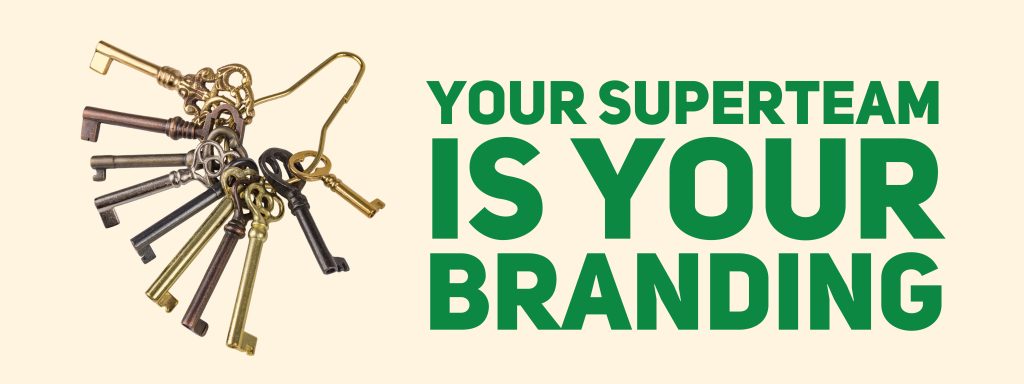
Do you know Superman? Of course you do. He flies, he fights, he saves people, and whenever the world needs him, he shows up. But there is one thing even Superman cannot do: build a brand. Because brands are not built by one superhero. They are built by people.
Every organization needs a team that can do more than simply complete tasks. It needs people who trust one another, challenge one another, learn together, and, most importantly, understand what the brand has promised the world. That is what we call a Superteam. A Superteam is not simply a group of talented people sitting under the same organizational chart. It is a group of people who understand that what they do together matters more than what any one person can do alone. And perhaps that is where the next generation of branding begins—not outside the organization, but inside it.
Not Just a Team; It’s a Superteam
What makes a Superteam different? It is not that every member is extraordinary. It is that ordinary strengths become extraordinary when they work together. A Superteam shares ownership. It does not constantly ask, “Whose job is this?” Instead, it asks, “What needs to be done?” Its members value one another’s decisions and expertise. They disagree without turning disagreement into conflict. When a problem appears, they do not immediately look for someone to blame. They look for a way forward.
Most importantly, they understand focus. In a workplace filled with emails, meetings, notifications, targets, dashboards, and increasingly intelligent technologies, focus has become a competitive advantage. A Superteam knows what matters, what can wait, and what must never be compromised.
That last part matters enormously to branding because a brand promise is easy to write. Keeping it is the difficult part. You can promise simplicity, but someone has to make the customer experience simple. You can promise care, but someone has to demonstrate it when a customer has a problem. You can promise innovation, but someone has to challenge the old way of doing things. The brand may live in advertising, but the promise lives in people.
Trust Is the Bridge
No Superteam can exist without trust. Trust is the bridge between leadership and people. If the bridge is weak, information stops moving. Questions remain unasked. Problems get hidden. People begin protecting themselves instead of protecting the work. And when that happens, the brand eventually feels it.
Gallup’s research has repeatedly highlighted the importance of managers in shaping team engagement, with its research estimating that managers account for about 70% of the variance in team-level engagement. That is a powerful reminder that the employee experience is often shaped by everyday leadership rather than grand corporate statements.
A leader may spend millions building a brand externally, but the everyday experience of employees can be shaped by something much smaller: a conversation with a manager. Did the manager listen? Did they explain why the work mattered? Did they trust the employee to make a decision? Did they create space for disagreement? Did they recognize good work? These small moments accumulate. Culture is built through them, and eventually, culture becomes visible to customers.
This is why trust is not merely an HR issue. Trust is a branding issue.
And trust naturally leads to another important ingredient: feedback. We often treat feedback as something that happens when someone has done something wrong. A manager calls an employee into a room, closes the door, and says, “We need to talk.” But that is not a feedback culture. That is feedback as punishment.
Real feedback is much more ordinary. It happens while the work is happening. It can be a five-minute conversation, a question after a presentation, a suggestion over coffee, or a simple recognition that says, “That part worked. Let’s build on it.” Gallup and Workhuman found that 61% of employees who received both feedback and recognition from their manager at least weekly were engaged. The bigger lesson is simple: people need to know how they are doing, why their work matters, and how they can become better.
A capable team does not become a Superteam because everyone already knows everything. It becomes a Superteam because everyone is willing to keep learning from one another.
Meeting Room vs Coffee Date
There was a time when the meeting room represented collaboration. Now, for many people, it represents something else: another calendar invitation.
The room is the same. The people are the same. Yet the conversation can feel completely different. Perhaps that is why some leaders are increasingly choosing a coffee table over a conference table when the objective is to hear what their people are really thinking.
A coffee date is not a magic solution. Coffee cannot fix bad leadership. But changing the environment can change the psychology of a conversation. A formal meeting often comes with hierarchy. Someone sits at the head of the table. Someone presents. Others listen. People wait for their turn. A more informal conversation can remove some of those signals. The leader is no longer simply “the boss”; they become another person in the conversation.
And that distinction matters.
If you want people to bring you their best ideas, you cannot only ask them to speak. You have to create an environment where speaking honestly feels safe. This is particularly important in multigenerational workplaces. Gen Z may have changed some expectations around workplace communication, but the fundamental human need has not changed across generations: people want to be heard.
A Superteam does not need a leader who has every answer. It needs a leader who is willing to ask better questions.
Improvement Is the New Competitive Advantage
The world of work is changing faster than many organizations are comfortable admitting. Artificial intelligence is no longer a distant possibility. It is already changing how people write, analyze, design, research, communicate, and make decisions.
Microsoft’s 2025 Work Trend Index, based on research involving 31,000 workers across 31 markets, found that 75% of knowledge workers were already using AI at work, while 76% said they needed AI skills to remain competitive in the job market. The numbers point toward a workplace where learning is no longer something employees can postpone until the next training program.
That changes the responsibility of a leader. The question is no longer simply, “Will AI replace my team?” A better question is, “How can I make my team more capable because of AI?”
A Superteam does not fear change simply because it is unfamiliar. It develops the capability to work with change. It experiments, learns, and adapts. That does not mean every employee needs to become an AI expert, nor does every job require the same technological skills. It means organizations need to understand what their people will need next and create opportunities for them to develop those capabilities.
This is where reskilling becomes part of branding. A brand that claims to be innovative cannot have a culture that is afraid to learn. A brand that claims to be future-ready cannot stop investing in the capabilities of its people. And a company that expects its people to adapt to a changing world must be willing to help them adapt.
IBM’s 2024 CEO study found that CEOs expected 35% of their workforce to require retraining or reskilling over the following three years. The message is clear: the Superteam is never finished. It learns, experiments, tries something new, gets something wrong, learns again, and keeps moving. Improvement is not an annual training program. It is a way of working.
Risk Is the Reality
Every organization says it wants innovation. But innovation comes with an uncomfortable companion: risk.
A team that is never allowed to fail will eventually become a team that never tries. But that does not mean Superteams take risks without thinking. Quite the opposite. They take intelligent risks. They ask what happens if they say yes, what happens if they say no, what they might learn, what they could lose, what the customer could gain, and, perhaps most importantly, what happens if they do nothing.
Sometimes the safest decision is not the best decision. Sometimes saying no protects the business. Sometimes saying yes opens a door that nobody had noticed before.
The Superteam is not fearless. It is comfortable enough with uncertainty to discuss it honestly.
That is an important distinction because leadership is not about removing pressure from every situation. It is about helping people navigate pressure without losing their sense of purpose. When people know they can question a decision, challenge an assumption, and raise a concern without being punished for it, the organization becomes more intelligent.
And intelligent organizations build stronger brands because they are better at seeing what is coming next.
Your People Are the Brand
Here is where branding comes full circle. You can advertise a promise. You can design a logo. You can launch a campaign. You can hire an agency. You can buy media. You can create a beautiful brand book. But eventually, someone has to deliver the promise.
A customer calls customer service. Someone answers. A customer walks into a store. Someone welcomes them. A product arrives late. Someone has to respond. A new idea enters the organization. Someone has to decide whether to try it. A problem appears. Someone has to take ownership.
That “someone” is your people.
This is why internal culture cannot be separated from external branding. If the organization says one thing but employees experience another, the contradiction eventually becomes visible. If a company promises care but its people feel ignored, the promise becomes fragile. If it promises innovation but punishes every experiment, the message loses credibility. If it promises empowerment but requires approval for every small decision, the brand begins to contradict itself.
A brand is not only what a company says. A brand is what people repeatedly experience. And employees are among the people creating that experience every single day.
The Next Generation of Branding Starts From Within
Perhaps we have spent too much time thinking of branding as something that happens after the product is ready. First comes the product. Then the campaign. Then the communication. Then the brand.
But what if we reverse the thinking?
What if the brand begins much earlier? What if it begins with how people are hired, trusted, trained, challenged, recognized, and given the freedom to work? What if the real brand-building exercise happens in the everyday decisions that customers never see?
Then branding is no longer simply the responsibility of the marketing department. It becomes the responsibility of everyone.
The salesperson. The customer service executive. The designer. The factory worker. The product team. The finance team. The manager. The receptionist. The person who answers the email. The person who stays late to solve a problem nobody will ever know existed. They may never appear in an advertisement. But they are still building the brand.
This is why your Superteam matters. Not because they are superheroes, but because they are human beings who understand that their work carries the brand promise forward. And perhaps that is the real next generation of branding. Not a louder campaign. Not a bigger logo. Not another tagline. But a team that believes in the promise enough to deliver it when nobody is watching.
In plain English, your Superteam is not simply working for your brand. Your Superteam is making your brand believable.
Author: MD. Nadim Ahmed
M.A. in English Language Teaching
Jahangirnagar University
Email: nadim@bangladeshbrandforum.com