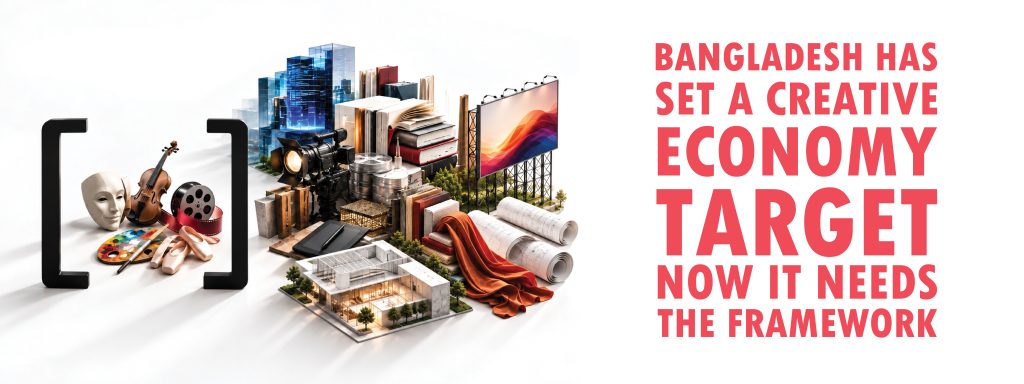
In June the creative economy got something it had never had before: a number, a budget line and a plan to go with them. Presenting the FY2026-27 budget, Finance and Planning Minister Amir Khosru Mahmud Chowdhury set a target of 1.5% of GDP and 500,000 new jobs, supported by Tk 300 crore from the budget and a further Tk 500 crore drawn from Bangladesh Bank’s corporate social responsibility funds. Around it came a ten-year investment strategy, a 160-acre Central Creative Hub at Purbachal to be built as a public-private partnership, regional hubs down to upazila level, a 150-acre theatre district, an international-standard film studio, a National Pool of Designers and a Created in Bangladesh brand.
By September the ambition had grown again. On 7 September the government said it is working to lift the creative economy to 2 to 3% of GDP, which would put Bangladesh level with the share the sector holds in the world economy.
Three months is quick for a sector to travel from the margins of the budget to a headline target, and the confidence behind it is well placed. The sector has been growing faster than the economy around it for years. The one thing that has not caught up yet is the way it gets measured, and that turns out to be the most useful place to begin.
What 0.17% actually counts
Bangladesh does have a figure, and on its own terms it is a good one. The Economic Census 2024 records employment in arts, entertainment and recreation rising from 33,441 people in 2013 to 112,829 in 2024, an increase of 237% across the decade. Output in FY25 came to Tk 9,193 crore. Against an economy of roughly Tk 55 lakh crore, that is 0.17% of GDP.
The sector is also growing faster than almost everything around it, at 15.4% year on year against nominal GDP growth of 10.2%, ahead of agriculture at 12.8%, industry at 10% and services at 11.8%. All of that happened without a dedicated national policy framework, which is worth holding onto for later.
But arts, entertainment and recreation is a narrow statistical category, and it is not the creative economy as the rest of the world defines it. Moving from 0.17% to 3% would be close to an eighteenfold increase in share, which no sector achieves through growth alone inside the life of a ten-year plan. That is the first clue that the number in the target and the number in the statistics are not describing the same thing.
Four countries, four definitions
This is not a problem unique to Bangladesh, and the countries usually held up as success stories all dealt with it before they got their headline figures.
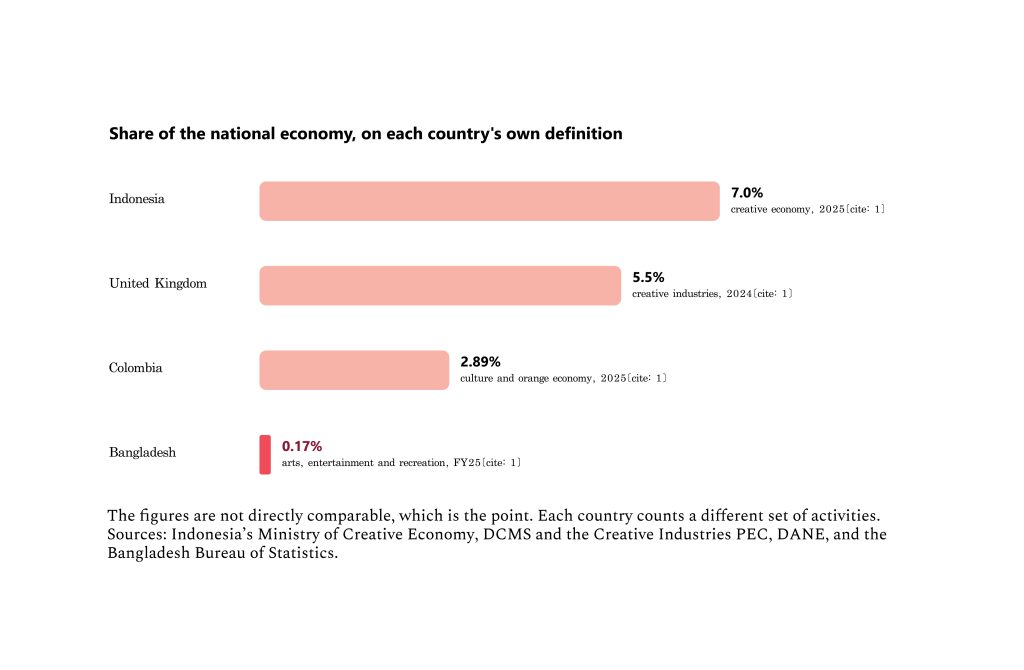 The figures are not directly comparable, which is the point. Each country counts a different set of activities. Sources: Indonesia’s Ministry of Creative Economy, DCMS and the Creative Industries PEC, DANE, and the Bangladesh Bureau of Statistics.
Indonesia is the closest thing to a model. Its Ministry of Creative Economy reported the sector contributing more than IDR 1,500 trillion, around 7% of national GDP, employing over 26 million people, most of them under 40. Exports reached $12.9 billion, the highest in five years, and the composition is the interesting part: fashion accounted for $7.09 billion, crafts for $5.01 billion and culinary products for $767 million. Indonesia built its creative economy around making and selling things, which is a route Bangladesh already knows how to walk.
Britain took the opposite road. Its creative industries reached £145.8bn in 2024, or 5.5% of gross value added, and the official definition runs to nine sub-sectors, one of which is IT, software and computer services. The British figure is that large partly because of what sits inside it.
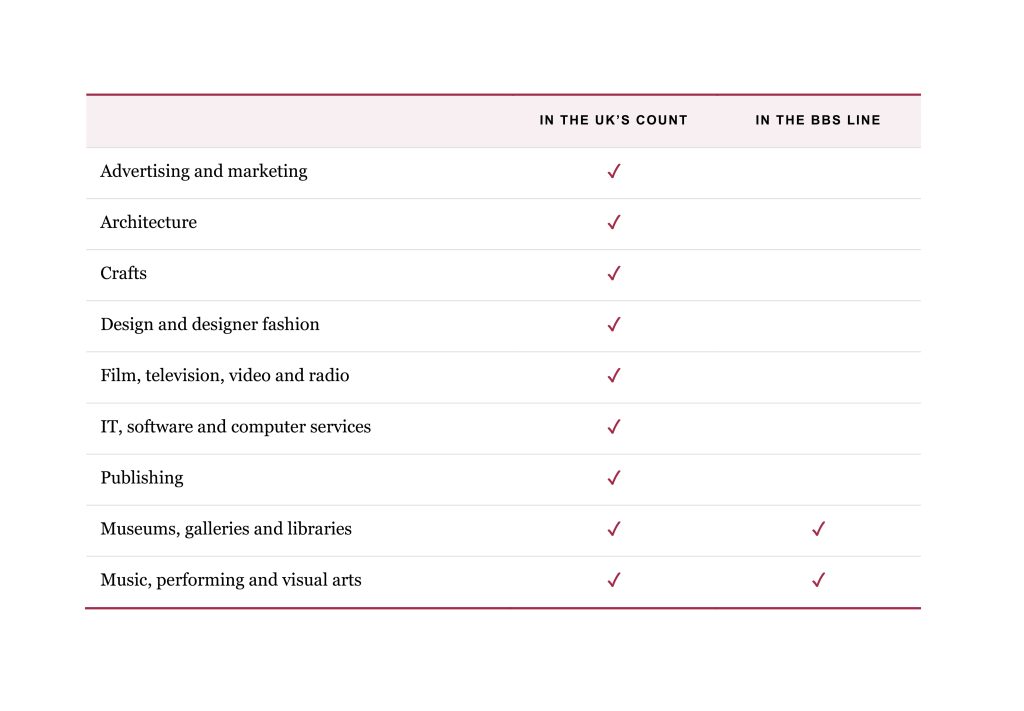 WHAT SITS INSIDE THE TWO DEFINITIONS
The nine sub-sectors are as the UK classifies its creative industries. The right-hand column reflects where these activities sit under the standard industrial classification Bangladesh uses, where advertising, architecture and design fall under professional services, and software, publishing and film production under information and communication.
Colombia did the least glamorous and probably the most useful thing. Its statistics agency built a satellite account for culture and the creative economy, sorting activity into three segments: arts and heritage, cultural industries, and functional creations. The result is a published series rather than a claim. In 2025 the sector came to COP 47.8 trillion, 2.89% of the economy, carrying more than 820,000 jobs, and the agency can say whether that is up or down on last year because it is measuring the same thing each time.
South Korea shows the other lever, used openly. Content exports hit a record of a little under $15 billion in 2025. The culture ministry then widened what counts as K-culture to include inbound tourism, Korean food, beauty and fashion, and the export figure became $71.8 billion, which makes culture the country’s third-largest export category after semiconductors and cars. The 2030 target was raised to $110 billion and a market worth 400 trillion won.
Define it one way and it is worth $15 billion. Define it another and it is worth $71.8 billion.
South Korea’s cultural exports, before and after the culture ministry widened the definition
None of those four definitions is wrong. Each country decided what its creative economy was, said so publicly, and then went and measured that. What none of them did was announce the share first.
The trade winds are favourable either way
The global trade data gives Bangladesh two open doors rather than one. UNCTAD put creative services exports at $1.4 trillion in 2022, which is 19% of all services exported worldwide, up from 12% a decade earlier, and inside that total software accounts for 41.3%, research and development for 30.7% and advertising together with architecture for 15.5%. At the same time, developing countries lifted their share of creative services exports from 10% in 2010 to 20% in 2022.
Indonesia’s fashion and crafts numbers show the goods route still works, and works at scale, for a country with a manufacturing base. Bangladesh has the manufacturing base, a growing software and freelancing sector, and a film and music industry that has already found an audience beyond its borders. Very few countries have all three doors open at once.
The warning already sitting in ICT exports
There is one reason to be careful about folding software into the count, and Bangladesh has already lived through it. On ICT exports, the government has cited around $2 billion. BASIS has put the figure at roughly $1.5 billion. Bangladesh Bank recorded $531.8 million for July to April of FY2023-24, and the Export Promotion Bureau $477 million for July to March. Four official-sounding numbers with a fourfold spread, and no agreed count of how many freelancers are working.
If IT and software come inside a creative-economy account, and by both the British definition and UNCTAD’s they belong there, the flagship target would rest on the least settled series in the national statistics. That is not an argument against counting them. It is an argument for building the account first, which is exactly what Colombia did and what the statistics bureau here could start on without waiting for anyone to break ground.
Money, hubs and 0.81%
Set the Tk 800 crore beside another figure. Culture-related ministries received 0.81% of the FY26 development budget while the sector’s workforce tripled over fifteen years. The new commitment is a real change of posture and the first serious money the sector has seen.
What it buys is mostly buildings. A hub, a studio, a theatre district, a set of regional centres. Which raises a question the plan does not answer: was the constraint ever premises? It is worth being concrete about what the 237% growth actually looked like, because it did not look like a policy. It was production houses working out of flats, editors renting suites by the day, animators taking outsourced work from abroad, musicians releasing straight to platforms, designers invoicing clients they have never met. The sector assembled itself while the state was looking elsewhere, and it is now being offered premises by a state that has decided to look.
The cheaper thing nobody is funding
Bangladesh has a Copyright Act, passed in 2023. What it does not yet have is enforcement that functions. Responsibility is split across the Ministry of Information and Broadcasting, the telecoms regulator and others, and piracy continues through broadcast, streaming and sports content. There is still no collecting society doing what a collecting society does everywhere else, which is find the money a piece of work earns and hand it to whoever made it.
Creative output becomes a creative economy at the point where it can be owned, licensed and paid for. A film studio at Purbachal does not repair a distribution market that leaks. A national pool of designers does not create royalty collection where none exists. Those are the parts that turn output into countable, taxable income, and they cost a fraction of 160 acres.
So can it reach 3%?
Not on what is currently being measured. On a definition built the way Indonesia, Britain or Korea built theirs, the starting point is not 0.17%, and nobody knows what it is, because the account has never existed. That makes 3% a statistical decision before it is an economic one, and the statistical decision is the cheap part.
It has to be made in the open, though. Korea widened its definition and said so, in public, with the old and new numbers side by side. Done quietly, the same move produces a revised series, a press release and not one extra person earning a living from work they made.
Done properly, the ambition looks reasonable rather than heroic. Decide what counts, publish the series, and let the target be argued with. Everything after that is measurable. Nothing before it is.
Sources: The Daily Star and The Business Standard on the FY2026-27 budget and the creative economy target · Bangladesh Bureau of Statistics, Economic Census 2024 · Kemenekraf, Indonesia · Creative Industries Policy and Evidence Centre and DCMS, United Kingdom · DANE, Cuenta Satélite de Cultura y Economía Naranja · The Korea Herald and Korea Times · UNCTAD, Creative Economy Outlook 2024 · Prothom Alo on ICT export estimates · Copyright Act 2023
Author: ROHAN BIN MORTOZA