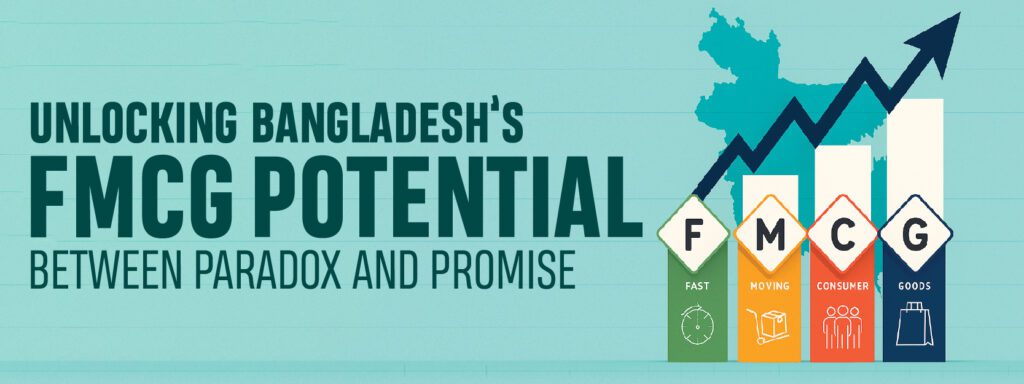
Bangladesh’s growth narrative is among the most compelling in South Asia. With a GDP approaching half a trillion dollars and a steadily expanding middle class, the country has transformed from an aid-dependent economy into one of Asia’s fastest-growing markets. Yet, behind this impressive trajectory lies a quieter paradox: while industry, remittance, and export figures rise, domestic consumption—particularly in fast-moving consumer goods (FMCG)—remains surprisingly stagnant.
Despite rising incomes and urbanisation, Bangladesh’s FMCG sector remains trapped at around USD 4 billion, contributing less than one percent to the national GDP. In India, the sector represents more than three percent of economic output; in the Philippines, it is almost ten times larger despite a smaller population. The question, therefore, is not whether Bangladesh is growing—it is why its people are not spending in ways that reflect that growth.
Understanding this contradiction requires examining the anatomy of Bangladesh’s consumer economy—its structural limitations, behavioural patterns, investment constraints, and slow cultural transitions. The answers, it seems, lie not only in economics but in psychology, policy, and perception.
The Current Landscape: Scale, Segments, and Slow Growth
At its core, Bangladesh’s FMCG market is narrow but evolving. Estimates from Invest Bangladesh and 6WResearch place the total value between USD 3.9 billion and USD 4.2 billion, growing annually at roughly 8–10 %. (InvestBangladesh 2024; 6WResearch 2025) The sector is divided into three primary verticals—food and beverage, household care, and personal care/hygiene.
The food and beverage category remains dominant because of necessity and affordability. Local staples, tea, instant noodles, snacks, and carbonated drinks drive volume sales, though margins are thin and competition is intense. Household cleaning and detergent products hold a stable middle ground, reflecting gradual lifestyle improvements in urban centres. Personal care and hygiene, however, remain underpenetrated. For a nation of nearly 170 million people, daily consumption of soap, shampoo, and toothpaste is remarkably low compared to regional norms.
According to data, per capita annual FMCG spending in Bangladesh stands at USD 22, compared with USD 40 in India and USD 100 in the Philippines. That gap reveals a structural ceiling: even as economic output rises, behavioural consumption patterns have not caught up.
This underperformance is not solely about income disparity. It is also about how people perceive necessity, value, and aspiration. In many Bangladeshi households, a product such as shampoo or body lotion is still considered optional—a luxury to be used sparingly, not daily. That distinction is central to understanding why the sector remains small.
Deep-Rooted Constraints: Why the Sector Struggles to Expand
Cultural Habits and Behavioural Resistance
Consumer behaviour in Bangladesh is deeply shaped by cultural norms and economic caution. Surveys show that households often cut back on hygiene and beauty items whenever inflation rises. Even within Muslim-majority contexts, Bangladesh shows unique consumption behaviour—such as sharp declines in toothpaste sales during Ramadan, rooted in the belief that it breaks fasting.
This behavioural conservatism, paired with a culture of thrift, constrains daily consumption. The difference between potential and actual spending is not only economic—it is cultural. Changing such habits requires time, education, and trust.
Price Sensitivity and the Sachet Economy
The prevalence of micro-packs, typically priced between Tk 5 and Tk 10, underscores the intensity of price sensitivity. These sachets dominate rural and lower-income markets, allowing consumers to access branded products without committing to higher unit prices. However, for manufacturers, such formats offer slim margins and heavy logistical costs. Each product must pass through multiple distribution layers—factory, depot, wholesaler, and micro-retailer—before reaching the consumer, eroding profitability at every step.
Companies that scale within this structure often do so through sheer operational efficiency—filling trucks to capacity, cutting wastage, and minimising transportation cost per unit. The system works, but it also locks the sector into a cycle of low-value, high-volume trading.
Distribution and Infrastructure Barriers
Distribution remains one of the most under-appreciated challenges in Bangladesh’s FMCG landscape. Of the estimated 1.2 million retail shops across the country, only half are directly serviced by large manufacturers. The rest operate through multi-layered intermediaries, informal wholesalers, or grey channels. Rural connectivity is improving but remains patchy; poor roads, inconsistent power supply, and limited cold-chain capacity inflate logistics costs.
As a result, even large multinationals struggle to reach the full consumer base efficiently. Modern trade (supermarkets, organised retail chains) accounts for less than five percent of FMCG sales, meaning traditional shops still dominate—a contrast to regional peers where formal retail is expanding rapidly.
Awareness and Product Literacy
Low awareness amplifies all these problems. In rural areas, consumers often fail to see why a premium detergent or shampoo is worth the extra price. Advertising reach has grown through social media, yet comprehension lags. According to local marketing research (Keeron 2024), purchase decisions are still driven primarily by word-of-mouth, not digital campaigns. This limits the power of mass branding, particularly for emerging product categories such as skincare, deodorants, or processed foods.
Shifts in Motion: Emerging Signs of Transformation
Despite these constraints, Bangladesh’s FMCG landscape is not static. In the past two years, several encouraging developments have begun to reshape the sector.
Urban consumers, particularly in Dhaka, Chattogram, and divisional cities, are spending more on branded personal care. Premium detergents, moisturisers, and body washes are witnessing double-digit growth. Local production of once-imported products has begun to expand—reducing costs, ensuring price stability, and encouraging local employment.
A recent industry report highlighted that Bangladesh is now one of only nine countries producing certain global hygiene brands domestically. (InvestBangladesh 2024) This localisation has immediate benefits: it cuts import dependency, reduces foreign-exchange exposure, and increases accessibility for middle-class consumers.
Digitalisation also plays a role. E-commerce, social commerce, and quick-delivery platforms—though still urban phenomena—have introduced new pathways for brand discovery and repeat purchasing. Small FMCG firms are experimenting with data-driven targeting and influencer-based marketing, bypassing traditional distributors to reach young, aspirational consumers directly.
Such developments may still be incremental, but they signal a slow shift from subsistence consumption to lifestyle consumption.
The Investment Picture: FDI and Domestic Capital Gaps
No consumer market can thrive without capital. In Bangladesh, foreign direct investment (FDI) remains one of the weakest links.
According to the Bangladesh Bank and UNCTAD’s World Investment Report 2025, total net FDI inflows stood at USD 1.27 billion in FY 2023–24, down 13 percent from the previous year. (Financial Express 2024) This marks the fourth consecutive year of decline, reflecting both external headwinds and domestic bottlenecks. FDI as a share of GDP remains around 0.3 percent, far below the South Asian average. (World Bank 2025)
The decline has implications beyond numbers. It reduces competitive pressure, slows technology transfer, and limits the introduction of new global brands. For local manufacturers, low FDI means fewer opportunities for joint ventures and capability building. For consumers, it means less variety, slower innovation, and higher prices.
However, early signs of recovery emerged in FY 2024–25, when FDI rose by nearly 20 percent to USD 1.71 billion. (Daily Star 2025) Analysts attribute this rebound to gradual macro-stabilisation, increased remittance inflows, and a modest improvement in business sentiment. Yet, structural challenges remain—chief among them bureaucratic friction, unpredictable tax policies, and infrastructure bottlenecks.
Multiple agencies—including BIDA, BEZA, and the Hi-Tech Park Authority—still operate without seamless coordination, often duplicating functions and slowing investor processes. Securing industrial land, reliable power, and utility connections can take months. Meanwhile, mid-year tax revisions by the National Board of Revenue create uncertainty for long-term business planning.
Despite these challenges, optimism persists. The global “China + 1” diversification strategy has opened new opportunities for emerging economies to attract manufacturing investment. Bangladesh’s strong apparel supply chain, growing consumer base, and improving logistics infrastructure position it well—if policy alignment and investor facilitation catch up.
Unlocking the Next Phase: Strategic Levers for Growth
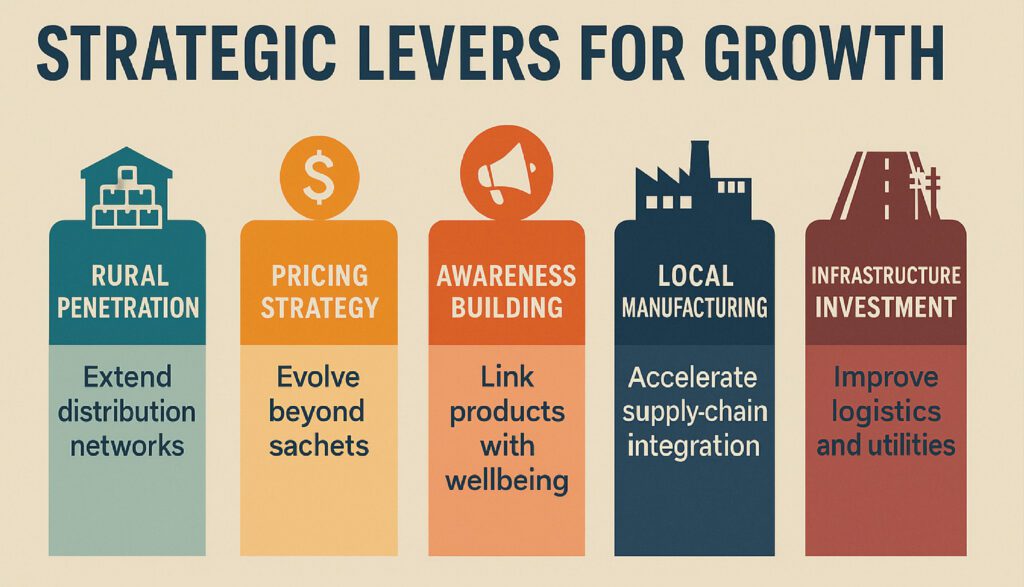
Transforming Bangladesh’s FMCG sector from potential to performance requires multidimensional intervention.
First, rural penetration must be treated as the frontier of growth. Roughly two-thirds of Bangladesh’s population still lives outside major cities, yet the majority of corporate marketing budgets target urban consumers. Extending distribution networks through hub-and-spoke models, micro-dealers, and partnerships with microfinance institutions could create sustainable rural access. The success of mobile banking and mobile recharge networks demonstrates that scale is possible even in low-income segments if infrastructure is localised and trust is built.
Second, the pricing strategy must evolve beyond the traditional sachet model. While sachets are effective entry points, they cannot carry the industry’s long-term profitability. Manufacturers could experiment with family-sized economy packs, refill systems, or cooperative bulk-purchase models for semi-urban consumers. Gradually nudging consumers toward larger, more cost-efficient units can increase both usage frequency and margins.
Third, awareness building must go beyond advertising. The private sector could collaborate with public health and education campaigns to link hygiene products with wellbeing and dignity. School-based hygiene drives, community demonstrations, and local language storytelling can turn behavioural change into social learning rather than commercial persuasion.
Fourth, local manufacturing and supply-chain integration must accelerate. Domestic sourcing of raw materials and packaging will reduce cost volatility and dependency on imports. Incentives for local R&D and quality testing labs can encourage innovation while ensuring standards.
Fifth, policy consistency is crucial. Frequent changes in import duties or VAT structures discourage both local entrepreneurs and foreign investors. A long-term FMCG policy framework—similar to what Bangladesh has developed for ICT or garments—could give the sector direction and confidence.
Finally, infrastructure investment must keep pace. Reliable electricity, roads, and cold-chain logistics are not luxuries; they are prerequisites for perishable goods, dairy, and frozen categories to expand. Public–private partnerships can accelerate these improvements without overburdening the state budget.

Risks and Realities: What Could Go Wrong
Even with strong strategies, several vulnerabilities could derail progress. Inflation and currency volatility continue to erode household purchasing power. Frequent policy changes, particularly in fiscal measures, unsettle investors. Counterfeit and sub-standard products remain widespread, eroding trust in branded goods.
Moreover, the gap between urban and rural consumers could widen if brands fail to address affordability and access simultaneously. A two-tier consumption structure—one elite, one mass—may yield short-term growth but long-term inequality. To avoid this, inclusivity must underpin strategy: from product design to pricing to distribution.
Outlook: Toward a Consumer-Driven Economy
If Bangladesh’s FMCG industry captures even a fraction of its potential, the implications will ripple across the economy. Increased consumption will boost manufacturing, retail, logistics, advertising, and employment. It will also broaden the tax base and attract more FDI through demonstration effects.
Global examples offer encouragement. Vietnam’s FMCG penetration rose from 1.2% to 3% of GDP within a decade through local manufacturing, rural marketing, and consistent policy support. Indonesia, too, combined infrastructure upgrades with behavioural change campaigns to double household spending on packaged goods. Bangladesh’s demographic profile—young, aspirational, and digitally connected—suggests it could follow a similar path if structural barriers are tackled.
Ultimately, FMCG growth is not just about selling soap or snacks. It reflects how far a society has travelled from subsistence to comfort, from survival to choice. For Bangladesh, nurturing that transition is both an economic and cultural journey.
The Way Forward
Bangladesh’s FMCG paradox—rapid growth alongside restrained consumption—captures the country’s wider development crossroads. The fundamentals are strong: a resilient economy, a vast young population, and improving connectivity. What is missing is coordination between policy, investment, and consumer awareness.
The next phase of Bangladesh’s growth story will not be written only in export figures or remittance totals. It will be written in the aisles of local stores, in the frequency with which families buy shampoo, detergent, or packaged food, and in the confidence of investors willing to bet on Bangladesh’s consumer awakening.
If the momentum toward policy reform, infrastructure improvement, and behavioural change continues, the country’s FMCG sector could multiply several-fold within the decade. If it stalls, the opportunity may pass to more agile neighbours.
Either way, the direction of everyday consumption—the simple act of buying better, more often—will decide whether Bangladesh’s next decade belongs to factories alone, or finally, to its consumers.