
On 17 August the National Board of Revenue issued a clarification that should never have been necessary. Industrial users, it confirmed, could continue importing solar equipment at 1 percent duty under the capital machinery facility. Customs stations had been charging 17 percent, having read a new statutory order as withdrawing a concession that was never withdrawn.
The confusion arrived in the same budget that was meant to make solar cheaper. The FY2026-27 package cut import duty, regulatory duty, supplementary duty and advance tax on solar equipment, a reform the industry had wanted for years. Then the implementing order landed, field officers read it their own way, and importers spent weeks paying rates the policy had abolished. By the time some shipments cleared port, the effective rate had reached 38 percent, because customs continued valuing solar panels by weight rather than by transaction value.
That is the condition of Bangladesh’s rooftop solar sector in a sentence. The economics work. The policy exists. The execution keeps arriving late and sideways.
What the roofs are actually worth
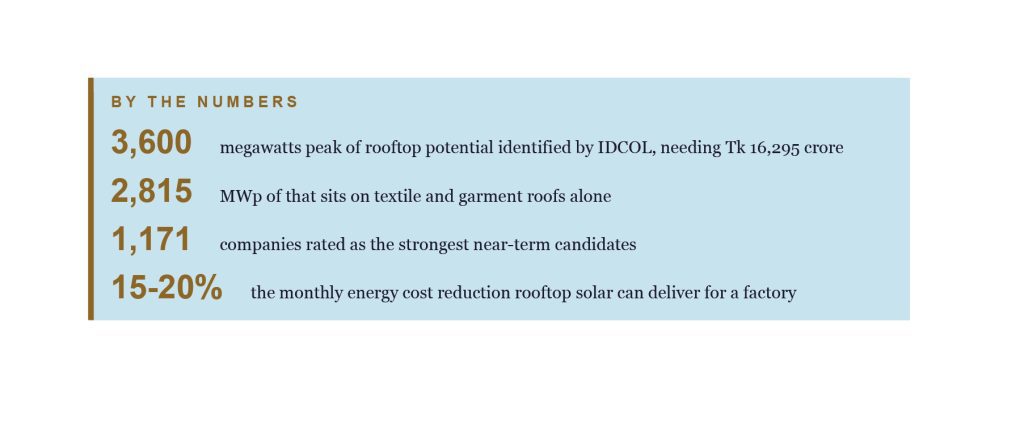
The scale of what is being delayed became clearer in August, when IDCOL published a costed assessment of the national rooftop opportunity. Bangladesh could generate more than 3,600 megawatts peak from industrial and commercial rooftops, the state-owned financier concluded, requiring Tk 16,295 crore of investment. The study drew on interviews with more than 10,000 industrial and commercial companies, which makes it the most granular estimate the sector has.
The opportunity is concentrated rather than diffuse. IDCOL identified 1,171 companies as the strongest near-term candidates, together worth 1,263 MWp, with a further 4,712 companies capable of adding 2,358 MWp. And it sits overwhelmingly in one industry: textiles and garments account for 2,815 MWp of the total, roughly four-fifths, requiring Tk 12,669 crore of the investment.
That concentration is the reason this is a business story rather than an energy story. The country does not need to persuade millions of households. It needs to persuade a few thousand factory owners, most of whom already know each other, share buyers, and belong to the same two trade associations.
 Why a factory owner should care
The case for a mill owner rests on four things, and only one of them is environmental.
The first is cost. Rooftop solar can cut a factory’s monthly energy bill by 15 to 20 percent, which in an industry running on thin margins and rising gas prices is not a rounding error. The second is net metering, which since the 2025 guidelines allows a system sized against 100 percent of sanctioned load rather than the previous 70 percent, so surplus generation is credited against future bills instead of wasted. Larger systems, better returns.
The third removes the objection that used to end these conversations. Under the third-party or OPEX model, an investor finances and installs the system, the factory signs a power purchase agreement at a rate below its retail tariff, and it pays nothing upfront. The arrangement requires a tripartite agreement between consumer, investor and utility, and it converts a capital decision into an operating one. For a company already struggling to borrow, that distinction is everything.
The fourth is the buyer. International apparel brands increasingly require suppliers to demonstrate renewable procurement, and IDCOL has run workshops with H&M’s Bangladeshi supplier base on exactly this. An H&M official told The Daily Star that factories installing rooftop solar would receive benefits including more orders. Around 80 of the brand’s local suppliers have already installed systems totalling roughly 7 megawatts. In that framing, solar is not an energy investment. It is an order-book investment.
It already works at scale
The proof is not theoretical. Youngone Corporation has installed close to 37 megawatts of rooftop solar at the Korean Export Processing Zone in Chattogram, enough to power somewhere between 30,000 and 40,000 households a day. IDCOL has financed rooftop systems at more than 150 factories. Industrial rooftop capacity nationally has crossed 500 megawatts, and it did so while the old duty structure was still in force, which tells you something about how strong the underlying economics are.
The Centre for Policy Dialogue puts the theoretical ceiling higher still, estimating that rooftop solar across the more than 5,000 factories sitting under large concrete roofs could generate 5,500 megawatts, equivalent to four large coal plants. World Bank-supported work in the sector already avoids around 377,000 tonnes of carbon dioxide a year.
Solar on a garment roof is not an energy investment. It is an order-book investment.
Why buyer requirements move faster than tariffs
The plan, and the gap it leaves
IDCOL has set out how much of this it intends to finance, and the numbers are worth looking at closely.
IDCOL’s rooftop solar financing roadmap. Annual financing requirements rise from Tk 450 crore in 2026 to Tk 700 crore by 2030. Source: IDCOL.
Annual financed capacity is projected to rise from 129 MWp in 2026 to 136 MWp in 2027, 200 MWp in 2028 and around 233 MWp in each of 2029 and 2030, with the annual financing requirement climbing from Tk 450 crore to Tk 700 crore. That is a credible institutional plan, and it is also a modest one.
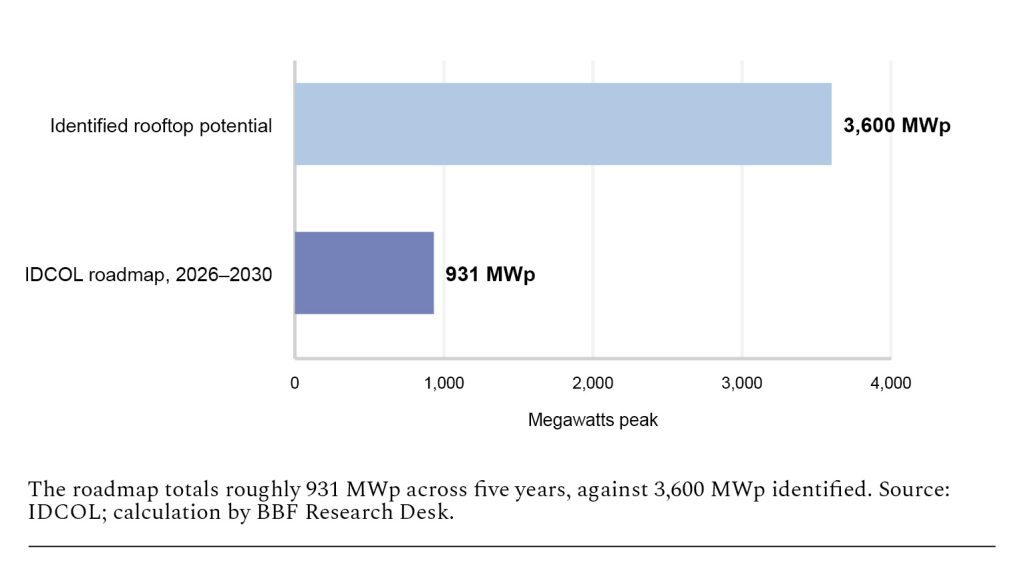
The roadmap totals roughly 931 MWp across five years, against 3,600 MWp identified. Source: IDCOL; calculation by BBF Research Desk.
Added together, the five-year roadmap comes to around 931 MWp, roughly a quarter of the potential IDCOL itself has identified. Closing the rest requires banks and private investors on a scale that has not yet appeared, which is the actual bottleneck. IDCOL is a financier of last resort in this market when it should be a demonstration lender.
What is still in the way
Four obstacles keep recurring in the reporting, and none of them is the technology.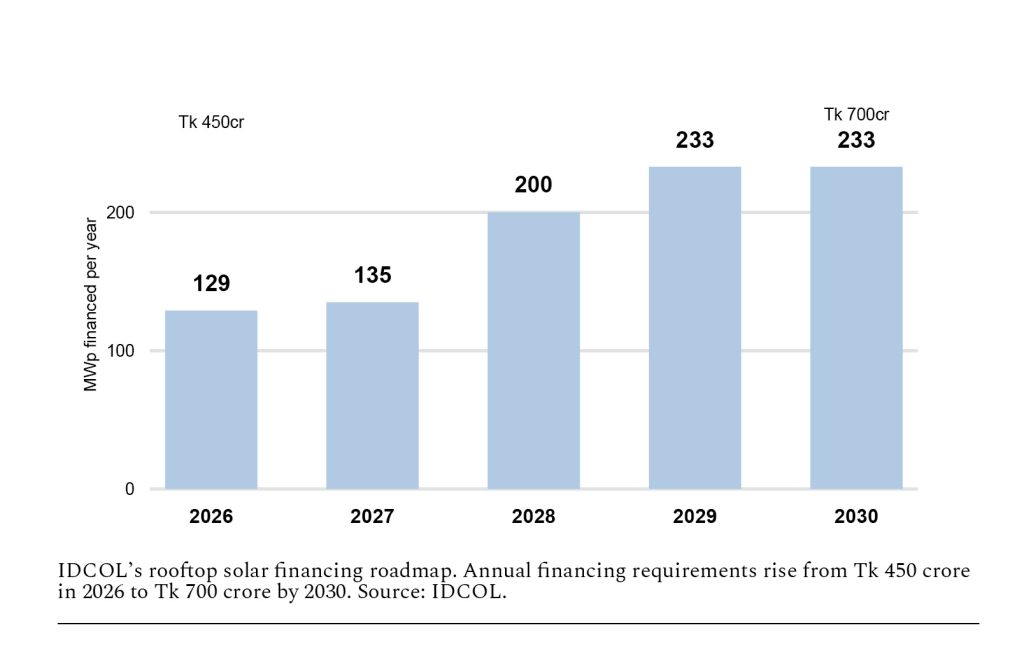
The component problem deserves particular attention, because it undercuts the headline reform. Mostafa Al Mahmud, president of the Bangladesh Sustainable and Renewable Energy Association, has said the August clarification resolved the duty question for industrial users for now, while noting that inverters in some cases still carry 28 percent and batteries more than 50 percent. Solar without storage is a daytime solution in a country whose industrial load runs into the night.
Shafiqul Alam, IEEFA’s lead energy analyst for Bangladesh, has argued that the NBR and the Ministry of Power should simply publish the applicable total tax incidence on rooftop components following the new orders. That is not a request for money. It is a request for a number, and the fact that it has to be made is the story.
 Set against the national target
The energy arithmetic gives the commercial case its urgency. Bangladesh has a renewable generation capacity of about 1,797 megawatts, of which 1,504 megawatts is solar, against a target of 20 percent renewables by 2030 and 10,000 megawatts of solar by the same date.
Rooftop is the fastest route to that target because it requires no land acquisition, no transmission build and no government capital, and the FY2026-27 budget cut energy infrastructure spending by 23 percent, which makes privately financed generation more important rather than less. A factory roof is the only meaningful piece of energy infrastructure in Bangladesh that somebody else has already paid for.
 Which returns to the seventeen percent. The equipment is cheaper than it has ever been, the buyers are asking for it, the financing model removes the capital barrier and the returns are documented. What is missing is an administrative system that can pass its own incentives through to the people they were written for. That is a smaller problem than building four coal plants, and at present it is the more binding one.
Sources: National Board of Revenue clarification on solar equipment import duty, 17 August 2026 · IDCOL rooftop solar assessment and financing roadmap (August 2026), based on interviews with more than 10,000 industrial and commercial companies · Bangladesh Sustainable and Renewable Energy Association (BSREA), analysis of post-budget duty rates · Shafiqul Alam, IEEFA · Net Metering Guidelines 2025 · Centre for Policy Dialogue, on industrial rooftop potential · The Daily Star, on IDCOL, H&M supplier workshops and Youngone Corporation · The Financial Express and The Business Standard, on customs duties and valuation · World Bank, on renewable energy financing in Bangladesh (July 2026) · pv magazine, on renewable capacity and the FY2026-27 tax measures.