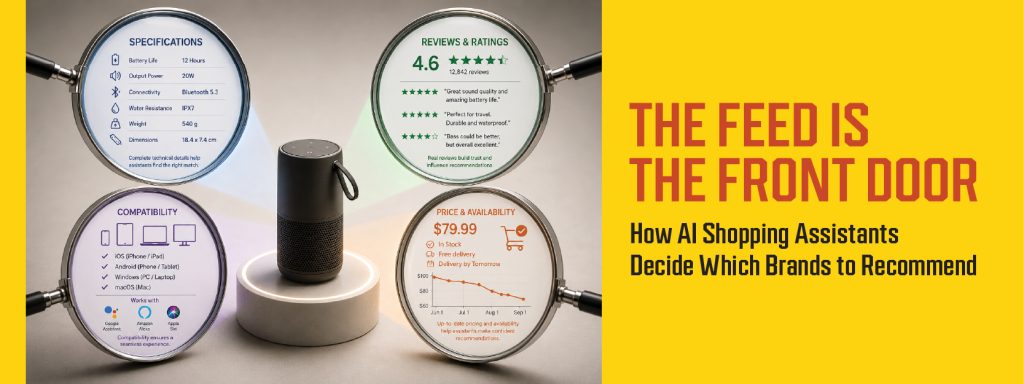
Every craft in advertising assumes a human on the other end. Copy persuades. Photography seduces. A product page is built to hold attention long enough to close. None of that survives contact with an AI shopping assistant, which does not look at the page at all. It reads the feed: titles, specifications, availability, price, compatibility, reviews. If the answer to “will this fade in sunlight” is not in the data, the assistant recommends a competitor whose data contains it.
That is the whole mechanism, and it is now attached to real money.
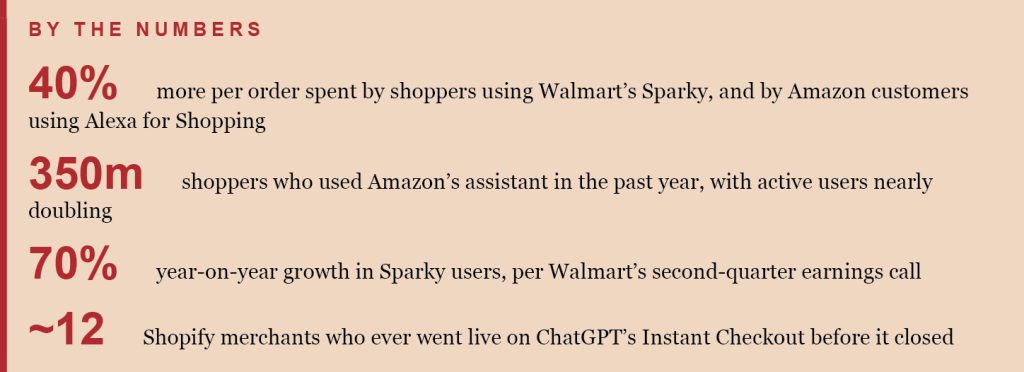
On 20 August, Walmart reported second-quarter revenue of $187.9 billion with global e-commerce up 23 percent. On the earnings call, chief executive John Furner said the number of customers using Sparky, the company’s AI shopping assistant, was up 70 percent from a year earlier, and that those customers spend 40 percent more per order than those who do not use it. Amazon reported the same pattern. After merging Rufus and Alexa+ into a single assistant called Alexa for Shopping in May, chief executive Andy Jassy said more than 350 million shoppers had used it over the past year, that active users had nearly doubled, and that American customers who use it spend 40 percent more per order. Target’s Michael Fiddelke told analysts that digital traffic reaching the retailer from external AI platforms is growing more than three and a half times faster than the industry average.
Three of the largest retailers in the world put a number on the same behaviour within weeks of each other.
The assistant recommends. It does not buy.
The most useful thing that happened to this category in 2026 was a failure.
OpenAI launched Instant Checkout inside ChatGPT on 29 September 2025, built on the Agentic Commerce Protocol it developed with Stripe. Shoppers could buy from Etsy sellers without leaving the conversation, with more than a million Shopify merchants promised as coming soon. Walmart and Target joined within weeks. Shopify’s president Harley Finkelstein called agentic commerce the new frontier for online retail.
Five months later it was over. The Information reported on 6 March that OpenAI was scaling back; the company confirmed within days and by late March had repositioned ChatGPT around product discovery, sending shoppers out to merchants to complete the purchase. Fewer than fifteen Shopify merchants had ever gone live.
The reason was arithmetic. Walmart measured checkout inside ChatGPT converting roughly three times worse than a click through to walmart.com, even while ChatGPT delivered about twice the new-customer rate of search. The assistant was excellent at bringing people to the decision and poor at closing it.
That split now defines the whole opportunity. eMarketer forecasts that checkouts on AI platforms will account for 0.1 percent of US retail e-commerce sales this year. Discovery, meanwhile, runs at the scale of 350 million Amazon shoppers. For a brand, the job is not to be purchasable inside a chat window. It is to be the product the assistant names.
Four assistants, four different readers
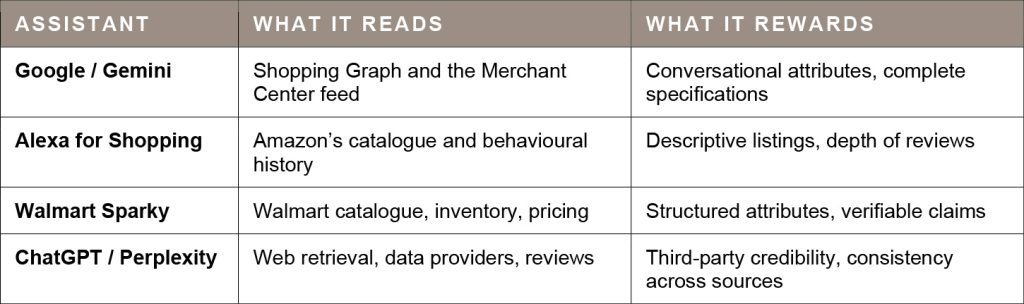
Brands tend to treat “AI shopping” as one channel. It is at least four, and they evaluate differently.
Google and Gemini draw on the Shopping Graph and Merchant Center. From January 2026 Google added conversational attributes to Merchant Center, built specifically for AI Mode: question-and-answer pairs, compatible accessories, substitute products, sitting alongside the standard title, price and availability fields. Google also launched the Universal Commerce Protocol at NRF in January with Walmart, Target and Shopify, extending Merchant Center into cart and checkout.
Amazon’s assistant rewards descriptive, review-driven content, drawing on years of behavioural data across its own catalogue. Walmart’s Sparky rewards structured attribute completeness, every filterable field populated and every claim traceable to a specification. Sparky is also the most agentic of the four by design, built for multi-step tasks rather than single-product questions. Furner gave analysts an example: a shopper asked for a week of high-protein meals and received recipes, meal kits and a one-click basket, with ingredients they had already bought at home filtered out.
ChatGPT, Perplexity and Claude rely more heavily on web retrieval, third-party product data, reviews and editorial sources. Sparky is now embedded in the Walmart app, ChatGPT and Gemini at once, which means the same product data has to satisfy three evaluators simultaneously.
What completeness actually means
Marketers hearing “complete your product data” tend to picture a tidier spreadsheet. The requirement is more specific than that. OpenAI’s protocol asks participating merchants for titles running to 150 characters and descriptions to 5,000, with currency codes, live availability and full image data. Google’s conversational fields want the questions a buyer would ask a shop assistant, answered in the feed: what it fits, what replaces it, what it will not do.
The gap that costs brands placement is rarely a missing price. It is the unanswered question. A washing machine listing with dimensions but no doorway clearance, a paint with a colour name but no light-fastness rating, a charger with a wattage but no device compatibility list. A human shopper works around those gaps by inference or by asking. An assistant treats the absence as a reason to recommend something else, and the brand never learns it happened.
What the evidence actually supports
Here the reporting requires care, because most of the research circulating on this subject is published by firms selling the remedy.
The optimisation industry that has grown up around AI visibility, trading under labels like answer engine optimisation, produces figures that get repeated widely: that merchants with comprehensive product schema see roughly a third higher inclusion in AI shopping features, that near-total attribute completion delivers several times the visibility of sparse data, that only a small fraction of listings are optimised at all. Azoma, one such firm, counts L’Oréal, Unilever, Mars, Beiersdorf and Reckitt among its clients, which tells you the category is real. It does not make the percentages independent.
Treat those numbers as claims from interested parties. The retailer disclosures are the reliable ground, and they say enough on their own.
Two findings are worth taking seriously because they cut against the seller’s interest. Analysis of Sparky’s citations by Azoma suggests retailer listings account for only about a quarter of what the assistant cites, with earned media and the brand’s own site carrying the majority. And research by Envision Horizons in February found that 50.9 percent of shoppers using AI abandoned a purchase after the assistant raised a concern about the product. The assistant is not only recommending. It is reading your worst reviews aloud, in summary form, at the moment of decision.
One more detail deserves attention from anyone who writes for a living: these systems discount language that reads as promotional. Repetitive superlatives and unsupported claims are treated as low-value signal. The copywriting instinct works against you here.
Who this helps, and who it quietly damages
Feed quality is cheap. Attribute completion requires discipline and a spreadsheet, not a media budget. A small seller who could never compete on web design or paid placement can compete on data, and the assistant will not know or care how large the company behind the listing is.
The same logic runs in reverse for anyone coasting on recognition. A brand with forty years of affection and a neglected back end becomes invisible in a channel it is not measuring. There is no impression count to alert anyone. The product simply stops being mentioned.
Walmart has begun testing sponsored prompts inside Sparky, letting brands pay to surface products in AI conversations. The organic window is closing in the way these windows always close.
What this means from Dhaka
Two audiences here, and they face different versions of the problem.
Bangladeshi manufacturers selling through Amazon and Walmart marketplaces are already inside these systems. Attribute completeness on those listings is now a revenue variable, and most local exporters treat product data as a compliance task handled once at onboarding and never revisited. A supplier whose listing was written by a marketplace agency in 2022 is being evaluated in 2026 against competitors who update monthly.
Domestic brands face the slower version. Most Bangladeshi consumer brands have no Merchant Center feed, no product schema and product pages written entirely for people. That costs nothing while shoppers here browse Facebook and Daraz. It starts costing the moment they ask an assistant what to buy, and the levelling effect works both ways in a market built on small sellers: the barrier is low, and almost nobody has crossed it. The first local category to take feed quality seriously will find the competition absent.
There is a second-order point for anyone selling into export markets. Buyers in Europe and North America increasingly research suppliers the same way consumers research products, and the same absence of structured, verifiable information reads the same way to a machine. A factory with no legible digital record is not only hard to find. It is hard to substantiate.
The work is unglamorous and it is not a campaign. Complete the attributes. Answer the questions a buyer would ask, in the feed rather than the brochure. Keep pricing and availability accurate across every surface a machine can see. Then check, occasionally, what the assistant says about you, because that is now the pitch.
Sources: Walmart second-quarter results and earnings call, 20 August 2026, remarks by John Furner · Amazon, remarks by Andy Jassy on Alexa for Shopping, reported July 2026 · Target second-quarter earnings call, remarks by Michael Fiddelke · The Information, on OpenAI scaling back Instant Checkout, 6 March 2026, with subsequent CNBC and Forbes coverage · Walmart conversion data on in-chat checkout · eMarketer, forecast for AI-platform checkout share of US retail e-commerce, 2026 · Google Merchant Center conversational attributes and the Universal Commerce Protocol, announced January 2026 · OpenAI, Agentic Commerce Protocol merchant feed specification · Azoma, The 5 C’s of Agentic Commerce (Q2 2026) · Envision Horizons, AI Shopping Shift (February 2026).
Author: Nusrat Tabassum