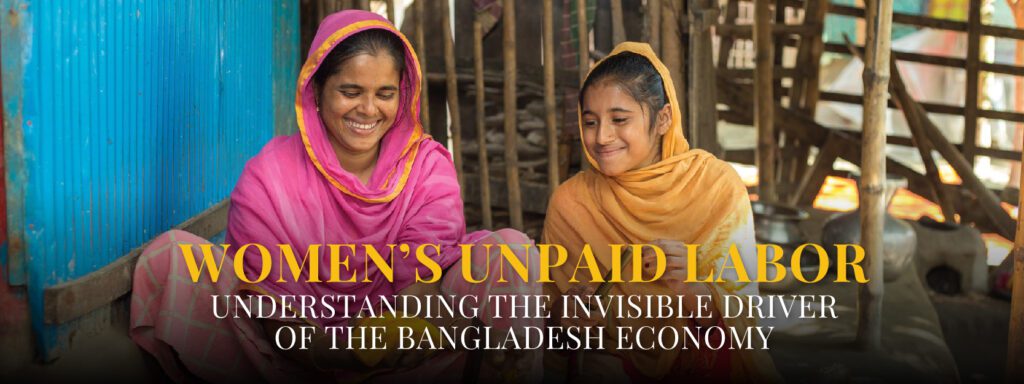
In households across Bangladesh, millions of women begin their days before sunrise. They light cooking fires, fetch water, prepare meals for their families, care for children and elderly relatives, clean homes, and manage countless other essential tasks that keep the society humming along. All this labor that enables the formal economy to operate is essentially larger than the entire manufacturing export industry of our country (18.9%). Yet, they receive no wages, no recognition in economic statistics, and little acknowledgment of their contribution to not only national prosperity, but also within the households that enjoy this unpaid service. Recently, in a historic advancement in the accounts of GDP, the Government of Bangladesh announced that its FY2025-26 budget would include the economic value of women’s unpaid labor in the country’s GDP calculations. This wasn’t merely symbolic politics. The commitment came backed by hard data from the nation’s first Household Production Satellite Account, a comprehensive statistical framework that quantifies what has long been dismissed as simply “women’s work.” The numbers tell a story that demands attention and action.
But why does unpaid care work need to be accounted for?
According to HPSA, unpaid domestic and care work in Bangladesh is worth between 4,954 billion and 7,725 billion taka, depending on the method of calculation. As per the hybrid methodology, this invisible labor contributes approximately 6,673 billion taka to the economy, which is equivalent to nearly one-fifth of the nation’s entire GDP. To put this in perspective, if unpaid care work were a sector of the economy, it would be among the largest, rivaling major industries in scale and importance.
The gender dimensions of this contribution are stark and impossible to ignore. Women’s unpaid labor alone accounts for 16.14 percent of GDP, whereas men’s contribution stands at a mere 2.77 percent of GDP. These figures reflect a fundamental imbalance in how time and labor are distributed within Bangladeshi society, with women shouldering a burden that is both massive and largely unacknowledged.
According to what has been termed as The Great Time Divide, the Time Use Survey from 2021 reveals that women in Bangladesh spend approximately seven times as many hours on unpaid household work as men do. In food preparation alone, women average 1,208 hours annually, while men contribute just 37 hours. The pattern repeats across nearly every category of household labor. Women spend 418 hours per year on childcare compared to men’s 57 hours. They dedicate 237 hours to cleaning, against men’s 15 hours. Even shopping, one of the few activities within the household where men contribute more time, shows women spending only 11 hours annually because they simply don’t have time for this relatively lighter task when weighed against their other responsibilities.
These time allocations aren’t just statistics; they represent real constraints on women’s lives and opportunities. The opportunity costs of these unpaid hours of work for women are paid employment, education, skill-training, rest, personal development, etc. This condition is what researchers call “time poverty”. Unfortunately, due to the stereotypical gender roles established in our society, these sacrifices and unpaid services by women are seldom appreciated, let alone being aware of the economic basis of these works.
The health implications are equally concerning. Much unpaid household work is physically taxing, such as lugging water, collecting fuel, spending hours bent over cooking stoves or washing clothes, and caring for young children or elderly family members. The unremitting nature of this work, done without compensation or proper rest, has a quantifiable impact on women’s physical and emotional health. However, because this labor takes place in the private realm of the household, its expenses are hidden from national consideration.
To put it in a macroeconomic perspective, failing to account for women’s unpaid labor creates what can be understood as a hidden “time-tax” on half the population. Economic policies designed without consideration of this massive invisible subsidy risk can be ineffective or even counterproductive. Development strategies that assume women have unlimited time to take on additional responsibilities, whether in agriculture, small business, or community programs, fundamentally downplay the constraints these women face. The result is that well-intentioned interventions often fail to achieve their objectives because they ignore the reality of women’s time allocation. This oversight also has implications for Bangladesh’s international commitments, particularly SDG 5.4, which explicitly calls for gender equality.
The recognition of unpaid work’s economic value is a crucial first step, but recognition alone won’t address the underlying inequalities. International development frameworks point toward a comprehensive approach called the 5R Framework, which provides a structured way to think about transforming the care economy:
Recognition means bringing unpaid care work to visibility through statistics and national accounts.
Reduction focuses on decreasing the time burden through infrastructure improvements and technology, such as reliable water supplies, electricity access, and time-saving appliances.
Redistribution involves sharing care work more equitably across families, communities, markets, and the state through investments in quality, affordable care services (For example, childcare and daycare centers).
Reward addresses the need for decent work conditions, fair wages, and social protection for those who do care work professionally.
Representation ensures that care workers, including those in informal arrangements, have a voice in policy decisions that affect their lives.
A question may arise as to how unpaid care work is measured, given that there is no financial transaction. A well-accepted method, which the HPSA adopted, is the Replacement Cost Method. This method is used to hypothetically replace unpaid care work with the market wages of paid professionals like nannies, nurses, chefs, domestic helpers, teachers, etc. However, market wages in these sectors are systematically flawed by the gender wage gap. This essentially implies that incorporating unpaid labor into the national accounts requires pushing for legal reforms to tackle wage discrimination.
Bangladesh now has an opportunity to translate its statistical achievement into meaningful policy change. The recommendations emerging from this work so far are concrete and actionable. They include creating an inter-ministerial coordination mechanism to harmonize care economy policies, integrating care considerations into fiscal and social protection planning, engaging the private sector in family-friendly workplace policies, investing in public care infrastructure, strengthening care sector labor protections, promoting social norm change around shared domestic responsibilities, and ensuring sustained data system financing for temporal evaluation. Valuing women’s unpaid work is not about charity or special treatment; it’s about acknowledging an economic reality that has long existed but has been systematically overlooked, despite years of advocacy.
Author: Tasfia Tahiat Umme
Source: HPSA