
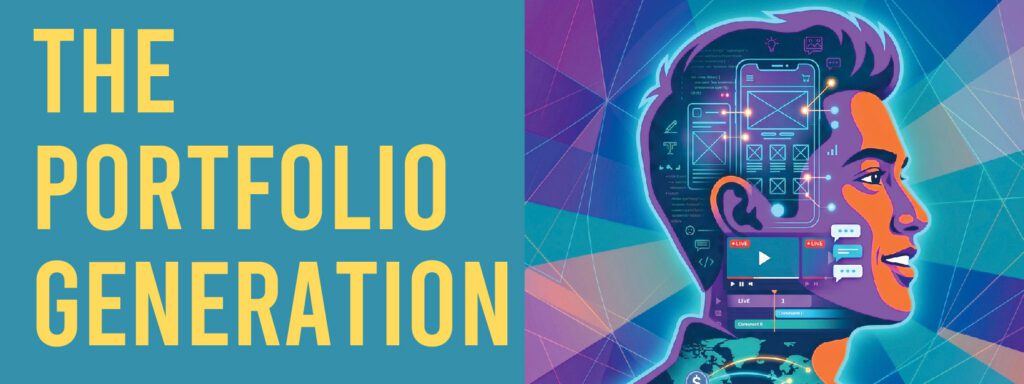
Amelia Chen is 23, based in Singapore, and has never held a single job. She works as a UX consultant for a fintech startup three days a week, runs a paid Notion template shop on Gumroad, produces a weekly design newsletter with 14,000 subscribers on Substack, and earns affiliate commissions recommending tools she uses. Income arrives from four sources — none of which existed as a career category ten years ago. She does not call herself a freelancer. She calls herself, simply, a designer.
In Dhaka, a 25-year-old named Rafiq juggles a junior marketing role with freelance copywriting on Upwork, an Instagram page monetized through local brand partnerships, and a YouTube channel on personal finance for Bangladeshi youth. His parents expected a government job. He is building something they have no vocabulary for. Both belong to the Portfolio Generation — young workers who have rejected the single career and replaced it with something more distributed, more resilient, and harder to disrupt. Understanding them is not a generational curiosity. It is a business imperative.
A GLOBAL STRUCTURAL SHIFT
The portfolio career is a rational response to structural disruption. The WEF’s Future of Jobs Report 2025 projects 78 million new global roles by 2030 — but simultaneously flags that 22% of current jobs will undergo structural change. Entry-level openings fell 29% year-on-year in 2025, squeezing the traditional career onramp precisely when the largest Gen-Z cohort was trying to enter the workforce. Fiverr’s 2025 Next Gen of Work survey — 12,003 respondents across the UK, USA, France, and Germany — found 67% of Gen-Z see multiple income streams as essential for financial security. Fewer than 10% believe a single full-time job is sufficient. Deloitte’s 2025 Global Gen Z and Millennial Survey (23,000+ respondents) found 49% would take a pay cut for greater autonomy — exactly what portfolio careers provide.
For Gen-Z, identity and income are increasingly the same thing. They do not separate who they are from what they build.
— VML Future 100: 2026 Report
MIT Sloan projects the gig economy will represent 55% of the US workforce by 2030. Goldman Sachs estimates the creator economy will reach $480 billion by 2027. In 2025, 5.6 million independent US workers earned over $100,000 annually from freelance work — an 87% increase from 2020. This is not a fringe phenomenon. It is mainstream economic behaviour playing out from Lagos to London to Dhaka.
WHY THIS GENERATION, WHY NOW
Economic anxiety is only part of the story. Deloitte characterises Gen-Z’s career values as the simultaneous pursuit of money, meaning, and wellbeing. The old trade-off — sacrifice fulfilment for security — is one they watched damage their parents and are actively refusing. VML’s Future 100: 2026, a 16-country study, finds Gen-Z draws no clear boundary between creator, consumer, and entrepreneur. Identity and income are increasingly the same thing — a point reinforced by YouTube’s finding that 83% of Gen-Z consider themselves creators. This is not a statement about content. It is a statement about how they perceive their economic relationship with the world.
Gen-Z is also the first generation to enter the workforce with AI already embedded in their workflows. Where older colleagues fear displacement, 80% of Gen-Z professionals already use AI tools for more than half of their tasks. AI compresses timelines, scales output, and makes the solo operator capable of delivering what once required a team — fundamentally changing the sustainability calculus of the portfolio career.
FOUR REVENUE STREAMS — HOW THEY WORK AND WHAT THEY PAY
The portfolio career is not a single model. It is a constellation of income types, each with its own mechanics and earning potential. Here are four of the most consequential for Gen-Z — globally and in Bangladesh.
01 Freelance Services — The Foundation
Freelancing is the most accessible entry point. Platforms like Upwork, Fiverr, and Toptal function as transparent global marketplaces for skills delivered remotely — graphic design, copywriting, web development, video editing, UI/UX, SEO, data analysis, and increasingly, AI prompt engineering and automation consulting. Earnings vary dramatically: commodity skills earn $10–20 per hour globally; specialised, high-demand expertise commands $50–150+. The critical insight from workforce research is blunt — the gap between top and bottom earners is not effort, it is specificity. A generalist writer earns a fraction of what a SaaS product copywriter who understands conversion optimisation commands.
Bangladesh relevance: 650,000+ active freelancers; world’s 2nd largest workforce. Average $500–700/month; advanced specialists earn $2,500–6,000+/month
AI advantage: Freelancers using AI tools deliver faster, charge the same — compressing timelines and widening competitive margins
02 The Creator Economy — Audience as Asset
The creator economy runs on a different logic — building audiences and monetising attention rather than selling time. Platform mechanics vary: YouTube pays roughly $3–5 per 1,000 views, TikTok’s Creator Fund pays $2–4 per 1,000 views, while Instagram and LinkedIn monetise primarily through brand deals. The underlying principle is consistent: an audience is a durable, compounding asset. The income potential is real but uneven — the creator economy exceeds $250 billion globally and is projected to reach $480 billion by 2027, yet the median creator earns just $400 per month. Top earners stack multiple levers: ad revenue, brand sponsorships (82% of creator income), digital product sales (67%), and memberships. For Bangladeshi creators, local FMCG, telecoms, fintech, and fashion brands are growing creator investment, while the global English-language market remains a significantly underdeveloped foreign exchange opportunity.
Entry point: One platform, one niche, consistent posting — 3–6 months to initial monetisation
Key risk: Algorithm dependency — always build an email list or owned community alongside any platform presence
03 Digital Products — Income While You Sleep
Digital products are the closest Gen-Z gets to genuinely passive income — created once, sold indefinitely. An ebook, Notion template, Lightroom preset pack, UI kit, or recorded course distributed through Gumroad, Teachable, or Udemy reaches global buyers at near-zero marginal cost. The economics are compelling: a Notion template at $15 selling 200 copies monthly generates $3,000 in recurring revenue without additional effort. A Udemy course in a high-demand niche — prompt engineering, data visualisation, brand strategy — can generate $500–5,000 per month passively. The barrier is not technical. It is the willingness to treat expertise as intellectual property to be packaged, not merely performed.
Bangladesh opportunity: English-language digital products sell globally — a strong course or template pack earns in USD with no geographic ceiling
Entry point: Gumroad (zero upfront cost) or Udemy — start with one product, validate demand, then expand the range
04 Consulting & Coaching — Expertise at a Premium
Consulting is the highest-value play in the portfolio model — it sells judgment, not execution. A freelance social media manager charges $500/month to manage accounts. A social media strategist consulting on channel positioning and performance frameworks charges $2,000–5,000 for the same brand. The path there runs through expertise built in public: the LinkedIn post, the Substack essay, the well-placed thread — not vanity plays, but the public portfolio that converts into consulting enquiries. This stream compounds powerfully with others. A freelance designer who also teaches, writes, and consults is not doing four things — they have built one coherent professional identity generating income from four angles simultaneously.
Pricing signal: Experienced digital consultants globally: $75–250/hour; Bangladesh international market: $20–80/hour
How to start: Offer one focused service to your existing network; document outcomes; build case studies; raise rates as demand grows
THE HONEST RECKONING
The portfolio career is not without structural tensions. 80% of full-time gig workers report they would struggle to cover a $1,000 unexpected expense; 70% have insufficient savings. Income volatility and the absence of institutional protections — health insurance, retirement, social security — are lived realities, especially in Bangladesh where formal safety nets are already thin. The ILO flags the lack of contracts and benefits as a direct source of “dissatisfaction and discontent” among young portfolio workers. The competence ceiling is equally real: the gap between $15/hour and $150/hour is primarily a skills problem. The portfolio career rewards specialisation and continuous upskilling — treat it as a collection of low-skill gigs and the income will reflect exactly that.
WHAT IT MEANS FOR BANGLADESH — AND FOR BUSINESS
Bangladesh’s 45.9 million young people aged 15–29 cannot be absorbed by the formal labour market at the rate they arrive. Two million enter the workforce annually. For many, the portfolio career is not a lifestyle preference — it is the actual economy available to them. The country already ranks second globally in online freelance supply. The question is not participation; Bangladeshi Gen-Z is already participating. The question is whether they move from the commodity tier — high competition, thin margins — to the specialist and consulting tier, where earning power is fundamentally different and foreign exchange potential is enormous.
For businesses, this generation is simultaneously a talent challenge and a market signal. Companies insisting on exclusivity and rigid career ladders will lose their most entrepreneurially capable people. Brands that align with this generation’s values — authenticity, autonomy, alignment — will earn fierce loyalty. Those that treat them like any other audience will find them unreachable.
THE ARCHITECTURE OF A NEW WORKING LIFE
Amelia Chen and Rafiq are not outliers. They are the early majority of a generation quietly replacing the single career with something more distributed and more durable. The portfolio generation did not choose uncertainty — they inherited it. What they built in response is not a fallback. It is a system. The single-paycheck era is not ending because Gen-Z rejected it. It is ending because the conditions that sustained it no longer reliably exist. This generation is simply its most clear-eyed, consequential response.
Sources & References
Fiverr Next Gen of Work Survey 2025 (Censuswide, 12,003 respondents, UK/USA/France/Germany) · Deloitte Global Gen Z and Millennial Survey 2025 (23,000+ respondents) · World Economic Forum Future of Jobs Report 2025 · Goldman Sachs Creator Economy Projection 2025 · MIT Sloan Gig Economy Research · VML Future 100: 2026 (16-country survey) · NeoReach Creator Earnings Report 2025 · ILO Bangladesh Country Office Assessment 2025 · Gartner Workforce Research 2025 · Bangladesh ICT Division Freelancing Data 2025–26.


