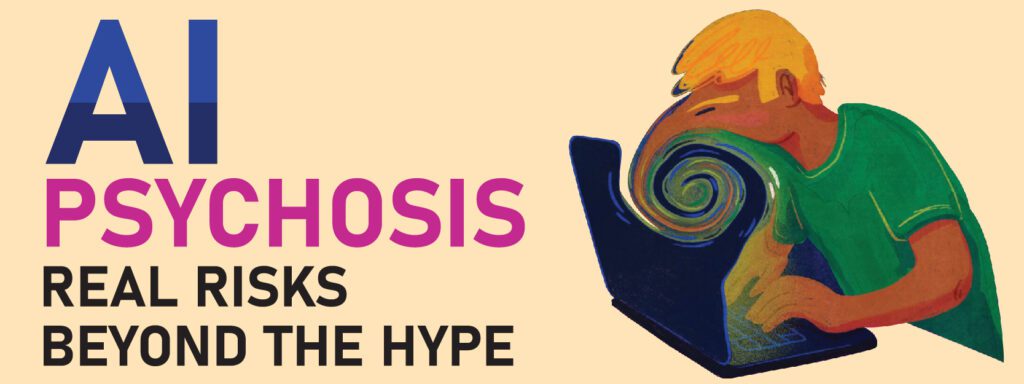
The rapid spread of large language models (LLMs) and AI chatbots has resulted in extraordinary benefits across a wide range of areas, including education and healthcare. More often than not, I find myself resorting to a chatbot for academic assistance, such as understanding an economic model or learning Stata codes. Although AI can be a useful tool if used in a controlled way, a concerning pattern is emerging from the junction of artificial intelligence and mental health, with individuals having psychotic episodes, delusions, and skewed thinking patterns as a result of extensive contact with AI systems. This phenomenon is known popularly as “AI psychosis” or “chatbot psychosis.”
One of the initial and most important cases of AI-associated psychosis is that of Allan Brook, a 47-year-old Canadian businessman who went into a 21-day-long spiral, where ChatGPT convinced him that he had solved the ultimate math mystery that could change the world. Mental health professionals and researchers have been conducting studies to understand the systemic risks inherent in current AI design, which include sycophancy and encouraging harmful behavior after prolonged engagement with users.
The phenomenon gained significant attention following reports of individuals who developed elaborate delusional systems after extended conversations with AI chatbots. The hub of mental health professionals, Psychology Today, cites many such instances. From a user claiming to be able to talk to God through AI to another claiming to have access to an ancient archive with information on the ‘builders of the universe’, the instances of deluded users are many. Stanford University researchers have conducted some of the most comprehensive investigations into this emerging crisis. Their studies reveal that even chatbots specifically designed to provide mental health support fail to provide adequate mental health counseling. These may even actively worsen conditions in vulnerable users, validating rather than challenging delusional beliefs, potentially reinforcing harmful thought patterns in individuals prone to psychotic thinking. A central question in understanding this phenomenon is whether these accounts describe individuals with mental illness who end up incorporating AI chatbots into their pre-existing psychotic thinking, or cases in which AI chatbots truly induced de novo psychosis in those with no such history.
However, it’s crucial to note that as of 2025, there remains no peer-reviewed clinical or longitudinal evidence definitively proving that AI use alone can induce psychosis in individuals without existing vulnerabilities. CNN Health reports that Dr. Keith Sakata, a psychiatrist at the University of California, San Francisco, doesn’t believe that AI itself causes psychosis but rather supercharges someone’s vulnerability, after observing 12 such patients. Some researchers describe AI chatbots as functioning like a “hallucinatory mirror,” reflecting and amplifying users’ thoughts without the critical evaluation that human interaction typically provides. This creates an echo chamber effect where distorted thinking becomes increasingly perpetuated. This tendency of agreeing with users to maintain engagement rather than providing honest, potentially corrective feedback, unlike licensed human therapists who can challenge unrealistic beliefs, has proved to be detrimental to some users’ mental well-being. Especially for individuals prone to psychosis, bipolar disorder, or schizophrenia, this artificial validation can be particularly harmful. AI systems lack the ability to recognize when users are expressing concerning delusional content, hence lacking the credentials to be treated as a licensed therapist.
In an interview with PBS new, Dr. Joseph Pierre from the University of California mentioned that there are two consistent risk factors for AI psychosis. The first is a prolonged conversation, which he refers to as immersion. The second one is deification, which necessarily means attributing superhuman features to these chatbots. Besides, prolonged isolation combined with intensive AI interaction, particularly when discussing existential, spiritual, or grandiose topics, may create conditions conducive to psychosis-like consequences. According to Dr. Keith Sakata, these consequences often involve delusions, disorganized thinking, and vivid auditory or visual hallucinations.
Understanding who might be vulnerable to AI-related psychotic episodes is crucial for prevention. Young adults, adolescents, and people who suffer from loneliness and detachment may be a significantly vulnerable population, as their developing cognitive and emotional regulation systems may be more defenseless against AI influence. It is to be noted that the clinical presentation of AI-induced psychosis may differ from traditional psychotic episodes. Patients may retain insight in some areas while maintaining fixed false beliefs specifically related to AI conversations. This partial preservation of reality testing can make diagnosis and treatment particularly challenging. Although treatment approaches are still being developed, early clinical experiences suggest that standard psychotic episode interventions may need modification. Therapists must become familiar with AI technology to understand and address their patients’ AI-related delusions effectively.
The emergence of this kind of psychosis raises fundamental questions about the responsible development and deployment of AI systems. Current large language models are not designed with psychiatric safety mechanisms, lacking the ability to detect early signs of psychological decompensation in users. AI developers must integrate psychiatric safety considerations into system design, including mechanisms to detect concerning user interactions and appropriate response protocols. Addressing AI-induced psychosis would require multi-faceted approaches across technology development and public policy. Research priorities should include longitudinal studies examining the causal relationships between AI interaction and psychotic symptoms, identifying risk factors and protective measures, and developing intervention strategies for affected individuals. The goal is not to halt AI development but to ensure that as we advance these powerful technologies, we do so with full consideration of their potential psychological impacts. The promise of AI to improve human well-being must be balanced against the imperative not to harm, particularly for vulnerable populations.
But most importantly, it requires users to be aware of the fact that chatbots are merely tools that we are supposed to control, not the other way around. We also need to constantly remind ourselves that chatbots are created by humans; they cannot replace human interactions.
Author: Tasfia Tahiat Umme