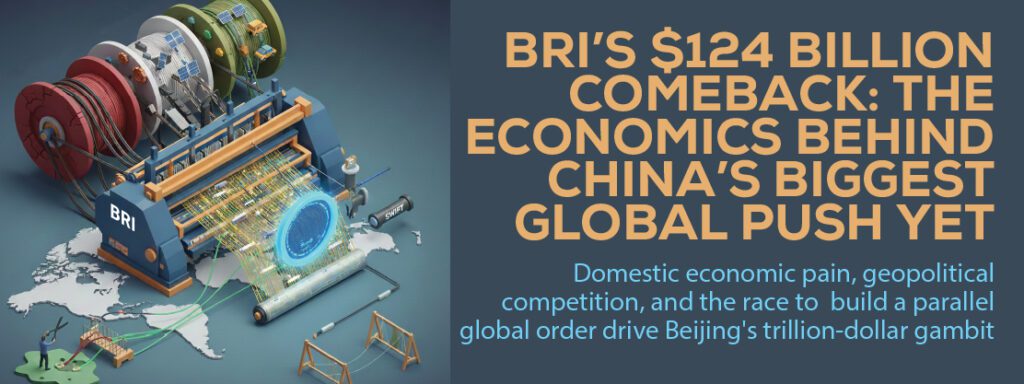
The Belt and Road Initiative hit record investment levels in 2024–2025, not despite China’s economic troubles but because of them. As domestic growth stagnates and Western decoupling accelerates, Beijing is doubling down on its signature foreign policy programme with $124 billion deployed in just the first half of 2025—the highest six-month engagement in BRI history. The initiative now spans 150 countries and has channelled over $1.3 trillion since its 2013 launch.
Why the surge now? Three converging pressures provide the answer. China’s property sector crisis has eliminated a major domestic investment sink, with new housing starts down 68 per cent from peak levels. Manufacturing overcapacity—particularly in steel, solar panels, and electric vehicles—demands external markets. And intensifying US-China strategic competition has made cultivating alternative economic networks an urgent national priority.
The BRI is no longer merely an infrastructure programme; it has become China’s primary tool for building a parallel global economic architecture. Over 80 of 97 central government-owned enterprises have undertaken BRI projects worldwide, winning eight times more World Bank-funded infrastructure contracts than American firms. State-owned enterprises need overseas demand to operate at capacity, and Beijing needs diplomatic relationships beyond Western influence.
Record Numbers, Strategic Intent
The scale of China’s renewed BRI push defies the ‘small and beautiful’ rhetoric Beijing now promotes. According to Fudan University’s Green Finance & Development Center, 2024 saw $122 billion in total engagement—the highest since BRI’s inception. The first half of 2025 shattered that record, with average investment deals reaching $1.24 billion, the largest ever recorded.
The geographic distribution reveals strategic intent. The Middle East emerged as the dominant recipient with $39 billion in 2024 alone—a 102 per cent increase from the previous year. Saudi Arabia absorbed $18.9 billion in gas infrastructure projects, while Iraq secured an $8 billion oil refinery deal. Africa saw a 395 per cent construction engagement increase in early 2025, anchored by Nigeria’s $20 billion oil and gas project—one of the largest single BRI commitments ever announced.
Cumulative BRI financing has now reached approximately $1.3 trillion across 150 countries. To put this in perspective: the G7’s Partnership for Global Infrastructure has mobilised only $60 billion toward its $600 billion by 2027 target, while the EU’s Global Gateway has committed €100 billion of its €300 billion goal. China’s first-mover advantage appears increasingly insurmountable.
The BRI’s resurgence directly reflects China’s domestic distress. Official GDP growth of 5 per cent masks a grimmer reality; Rhodium Group estimates actual 2024 growth at 2.4–2.8 per cent. Chinese steel manufacturers face global overcapacity of 610 million metric tons annually. Solar panel production exceeds 700 GW against only 200 GW of domestic demand. The logic is straightforward: what cannot be absorbed domestically must find markets abroad.
Resources, Finance, and Alternative Architecture
Beyond absorbing overcapacity, BRI serves China’s strategic resource security. Chinese state-backed entities have deployed $57 billion in mining investments across BRI countries, securing processing dominance that Western nations struggle to challenge. China controls 90 per cent of global rare earth refining, 73 per cent of cobalt refining, and 59 per cent of lithium refining—minerals essential for electric vehicles and advanced electronics. The Central Asia-China gas pipeline network delivers 55 billion cubic metres annually, reducing vulnerability to maritime chokepoints.
The BRI increasingly serves China’s ambitions to reduce dependence on Western financial systems. The Cross-Border Interbank Payment System (CIPS), China’s alternative to SWIFT, processed RMB 175.49 trillion ($24.47 trillion) in 2024—a 42.6 per cent year-on-year increase. In April 2025, Beijing launched CIPS 2.0 with digital yuan integration, reducing transaction times to 7.2 seconds versus SWIFT’s three-day average. Yuan-denominated trade now represents 32 per cent of China’s total trade. By 2024, over $300 billion in BRI contracts had been settled using digital yuan.
Green Promises and Debt Realities
Beijing’s messaging has pivoted toward ‘small and beautiful’ projects—the term xiaoermei first appearing in Xi Jinping’s 2021 Belt and Road Symposium address. The China International Development Cooperation Agency’s February 2025 report formalised criteria: loans under $50 million, economically viable returns, and positive environmental impacts. Premier Li Qiang announced 2,000 new ‘small and beautiful’ livelihood projects within five years.
The green transformation appears more substantive. Green energy engagement reached $11.8 billion in 2024—a 60 per cent increase from 2023—and a record $9.7 billion in just the first half of 2025. Solar and wind projects now represent 57 per cent of planned BRI power capacity. The 950-MW Maktoum Solar Park in Dubai became fully operational in February 2024, while Uganda’s 600-MW Karuma Hydropower Station completed the same year. Yet contradictions persist: oil and gas engagement surged to $24.3 billion in 2024, doubling 2023 levels, and average deal sizes have grown rather than shrunk.
The ‘debt trap diplomacy’ narrative has shaped Western discussion of BRI, yet academic research has largely debunked its most extreme claims. Chatham House scholars found that Hambantota Port—the alleged poster child of predatory lending—represented only 10–20 per cent of Sri Lanka’s sovereign debt. The 99-year lease was a commercial arrangement, not a forced seizure. However, real concerns remain: AidData’s tracking reveals that 35 per cent of BRI projects encountered major implementation problems, and 42 low- and middle-income countries have debt exposure to China exceeding 10 per cent of GDP.
Mixed Results Across Regions
The BRI’s record defies simple characterisation. Greece’s Piraeus Port—where COSCO’s $1 billion investment lifted container throughput from 1.5 million to 6.2 million TEUs, making it the Mediterranean’s largest container port—demonstrates genuine transformative potential. Employment tripled; 2024 profits rose 17.4 per cent. No Chinese loans were involved—it was a commercial acquisition. The China-Laos Railway has transported 60 million passengers and 67.6 million tons of cargo since December 2021, reducing freight costs by 40 per cent and Lao exports to China by 21.4 per cent in 2024. The railway transformed Laos from ‘landlocked to land-linked.’
Yet Kenya’s Standard Gauge Railway illustrates how success and struggle coexist. The line carries 2 million passengers annually and 6.53 million tonnes of cargo, reducing Mombasa-Nairobi travel from three days to eight hours. But it operates at only 25 per cent of projected capacity, pushed Kenya’s debt from 38 per cent to nearly 70 per cent of GDP, and triggered default penalties of $1.6 billion in 2024. The planned extension to Uganda stalled; the railway now ‘ends in a field.’ The Jakarta-Bandung High-Speed Rail demonstrates rushed implementation dangers: cost overruns reached $2 billion, and the CEO called the project a ‘time bomb’ after a feasibility study completed in three months failed to anticipate geological challenges.
Europe has largely retreated. Lithuania, Latvia, and Estonia departed the ’17+1′ format, while Italy’s 2023 withdrawal reflected failed expectations—Chinese exports to Italy nearly doubled while Italian exports to China rose marginally. Only Hungary maintains enthusiastic engagement.
Bangladesh Charts a Pragmatic Path
Bangladesh’s BRI engagement offers lessons for developing countries navigating great-power competition. Since joining in 2016, Bangladesh has received $4.45 billion disbursed across 35 projects. Yet Dhaka has maintained significant independence.
The August 2024 political transition—ousting Sheikh Hasina in a student-led uprising—tested Chinese adaptability. Beijing welcomed the interim government led by Nobel laureate Muhammad Yunus, maintaining the ‘Comprehensive Strategic Cooperative Partnership.’ During Yunus’s March 2025 China visit, eight agreements were signed covering digital economy, healthcare, and industrial zones.
Bangladesh has strategically avoided projects that might compromise sovereignty. The Sonadia deep-sea port was dropped when risks became apparent. On the sensitive Teesta River project, Dhaka avoided committing to China despite public pressure, carefully managing India’s concerns. This selective engagement—accepting infrastructure investment while avoiding strategic dependence—offers a model other developing nations may follow.
Strategic Infrastructure in a Fragmenting World
China is strengthening the Belt and Road Initiative now because it must. Domestic economic malaise demands external outlets for capital and production capacity. Geopolitical encirclement requires cultivation of alternative partnerships. Dollar dominance vulnerability necessitates parallel financial infrastructure. The BRI addresses all three imperatives simultaneously.
Three structural tensions will shape BRI’s future. First, debt sustainability: with 55 per cent of Chinese overseas loans now in repayment phase—rising to 75 per cent by 2030—Beijing faces mounting pressure. Second, the 35 per cent implementation failure rate undermines BRI’s development narrative. Third, Western alternatives, while underfunded, signal determination to contest Chinese influence.
The academic consensus is clear: Chinese overseas lending reflects poor risk management and commercial motivations rather than coherent predatory strategy. Projects fail because feasibility studies take three months instead of eighteen, not because China secretly desires to seize assets. For developing nations positioned between competing powers, the lesson is instructive: selective engagement, rigorous project assessment, and willingness to self-finance strategically important projects preserve agency. The choice, ultimately, remains theirs.
Author: Hosen Ankur Andaleeb