
The gap between economic sentiment in emerging and developed economies is widening in 2026 — and for once, the optimism in the developing world may be grounded in something more durable than hope. Lower leverage, stronger domestic demand, and less exposure to the US-China trade war are producing a growth divergence that is beginning to redirect where global capital wants to go.
McKinsey’s March 2026 economic conditions survey captured a finding that deserves more attention than it has received: respondents in emerging economies are much more likely than their peers in developed economies to say global economic conditions have improved, and they are half as likely to predict declining conditions in the months ahead. This is not the normal configuration. For most of the past decade, sentiment surveys have shown developed-economy respondents more confident about the near term — better institutional infrastructure, more stable currencies, more liquid capital markets. The reversal in 2026 is real, and its causes are structural rather than merely cyclical.
The IMF’s April 2026 World Economic Outlook projects emerging markets growing at 3.9% in 2026 against 1.4% for advanced economies — a gap of 2.5 percentage points that has been widening rather than narrowing since 2022. The MSCI Emerging Markets Index delivered a total return of 33.6% in 2025, outpacing the S&P 500’s 17.9% and the MSCI World’s 21.6%. Earnings per share expectations for the MSCI EM index are currently higher for 2026 than for developed market equities. None of these numbers reflect temporary factors. They reflect a structural shift in where the global economy’s growth energy is being generated — and a corresponding shift in where investors who are paying attention are beginning to look.
| 3.9% vs 1.4% — projected 2026 GDP growth, emerging markets versus advanced economies (IMF World Economic Outlook, April 2026).
The growth differential has widened steadily since 2022. Emerging markets are expected to drive 65% of global economic growth by 2035, with their share of global equity market capitalisation rising from 27% in 2023 to 35% by 2030. The MSCI EM Index’s 33.6% total return in 2025 represents the asset class’s strongest performance relative to developed markets in more than fifteen years. |
Why the optimism is grounded in structure, not sentiment
The conventional explanation for emerging market outperformance emphasises external factors — a weaker US dollar, lower global interest rates, and commodity price tailwinds. These are real, but they are cyclical advantages that reverse when conditions change. The more durable argument for emerging market resilience in 2026 rests on structural factors that have been quietly accumulating for a decade and that the US-China trade war has accelerated rather than created.
The first is lower leverage. Emerging markets often carry lower debt burdens, stronger foreign currency reserves, and more conservative fiscal positions than many developed economies, as Lazard Asset Management’s 2026 outlook notes. The OECD’s Global Debt Report 2025 projects global debt surpassing $100 trillion. The countries carrying the heaviest portion of that burden — the United States at 124% of GDP, Japan at 254%, and several EU members above 100% — are precisely the economies facing the most constrained policy space when the next shock arrives. Their emerging market counterparts, many of whom entered the post-COVID period with lower debt loads and have since run more conservative deficits, have more room to manoeuvre.
The second structural advantage is domestic demand. The demographic profiles of major emerging economies — India with a median age of 28, Indonesia at 30, Vietnam at 31 — produce a consumer market that is growing by both number and purchasing power in ways that the aging populations of Europe and Japan cannot replicate. India’s domestic consumption is already the third-largest engine of global demand after the US and China. As per capita incomes in these economies rise and digital infrastructure reduces the friction of commerce, the domestic demand base becomes increasingly self-sustaining — less dependent on export growth, and therefore less exposed to the trade policy shocks that are disrupting developed-economy supply chains.
The third factor is supply chain reorientation. The US-China decoupling that began with the first tranche of tariffs in 2018 and accelerated sharply in 2025 has created a substantial and ongoing flow of manufacturing investment toward markets that are positioned between the two competing systems — able to sell to both, exposed directly to neither. Vietnam, Mexico, and Indonesia are the clearest beneficiaries, absorbing electronics, apparel, and consumer goods production that has moved out of China. Vietnam’s electronics exports alone grew faster than any comparable economy in Southeast Asia in 2025, and the trajectory of FDI inflows suggests the shift is structural rather than transitory.
|
ECONOMY / REGION |
2025 GROWTH | 2026 PROJECTED |
KEY DRIVER |
|
Emerging markets (aggregate) |
4.0% | 3.9% |
Domestic demand, supply chain shift, demographics |
|
Advanced economies (aggregate) |
1.7% | 1.4% |
Slowing momentum, high debt, trade headwinds |
|
India |
6.5% | 6.2% |
Reform momentum, GST, consumer market scale |
|
Poland |
3.2% | 3.5–4% |
EU defence capex, structural funds, domestic demand |
|
Vietnam |
6.8% | 6.5% |
Electronics supply chain absorption, FDI inflows |
|
Indonesia |
5.0% | 4.8% |
Public investment, consumption, commodity exports |
|
United States |
2.8% | 1.8% |
Trade policy drag, slowing labour market |
|
Euro Area |
0.9% | 1.3% |
Recovering gradually; defence investment upside |
|
China |
4.9% | ~5% | Exports remain engine; housing continues as drag |
Sources: IMF World Economic Outlook April 2026 · Lazard Asset Management Emerging Markets Outlook 2026 · East Capital Outlook 2026 · Deloitte Global Economic Outlook 2026. Growth figures are projections and subject to revision.
The countries making the structural case
Within the broad emerging market category — which encompasses economies as different as Argentina and Poland, Vietnam and South Africa — the growth story is not uniformly positive. The optimism aggregates mask significant variation, and understanding which markets are genuinely building structural advantage versus which are simply benefiting from cyclical tailwinds is where the more useful analysis lies.
India is the most frequently cited structural growth story, and for substantive reasons. With inflation structurally lower, interest rates already declining and potentially easing further, and ongoing policy reforms including the GST framework, India is positioned for earnings re-acceleration, as VanEck’s January 2026 emerging markets note argues. The domestic consumer market — 1.4 billion people, a growing middle class, and digital infrastructure expanding faster than physical infrastructure — provides a demand base that does not depend on export markets or external capital flows to sustain momentum. India’s equity valuations remain high relative to EM peers, which limits the short-term return opportunity for new investors, but the structural growth case is as well-supported as anywhere in the emerging world.
Poland is the surprise beneficiary of 2026, and its advantage is specific: it sits at the intersection of rising European defence spending and the EU’s structural funds programme at precisely the moment when both are accelerating simultaneously. Poland’s defence budget will approach 5% of GDP by 2026 — the highest in NATO — following record spending of PLN 200 billion in 2025. The EU’s Security Action for Europe programme, combined with Recovery and Resilience Facility funds and cohesion financing, represents the largest structural fiscal impulse in Central and Eastern Europe since EU accession. GDP growth for Poland is forecast at 3.5 to 4% in 2026, and equity valuations remain at a significant discount to Western and Northern European peers, offering a combination of structural growth and valuation upside that is genuinely unusual in the current global environment.
“Emerging markets often have lower debt, stronger reserves, and more conservative fiscal policies than many developed nations have, making them more resilient and attractive to investors. We believe the current environment is the most supportive of emerging markets in more than 15 years.”
— Lazard Asset Management, Emerging Markets: Back in the Spotlight, January 2026
Vietnam and Indonesia represent the supply chain reorientation argument in its most concrete form. Vietnam’s electronics supply chain integration has accelerated as US companies have diversified their China exposure, and the country’s export profile has shifted from labour-intensive manufacturing toward more technology-intensive production in ways that increase the durability of the growth. Indonesia’s story is primarily domestic — a consumption and public investment cycle driven by a young and urbanising population, supported by commodity export revenues from its substantial nickel reserves, which are critical inputs to electric vehicle battery supply chains. Neither market is without risk: Vietnam’s exposure to global electronics cycles creates vulnerability to demand slowdowns, while Indonesia’s fiscal capacity to sustain public investment is constrained by revenue mobilisation challenges.
What the divergence means for capital allocation
The investment case for emerging markets has been made and unmade many times over the past twenty years, often with cyclical factors doing most of the work in both directions. The question that matters in 2026 is whether the current divergence reflects a genuine and durable shift in where economic momentum is being generated, or whether it represents a temporary gap that will close when developed-economy policy normalises and capital flows home.
The OMFIF analysis from January 2026 offers a counterintuitive framework for thinking about this. Capital is increasingly non-fungible, OMFIF argues — project-linked finance with embedded control rights does not reprice or exit like portfolio flows. It reshapes the opportunity set itself. The implication is that the investment flowing into emerging market infrastructure, manufacturing, and digital connectivity is not the same category of capital as the portfolio inflows that reversed sharply during the 2013 taper tantrum or the 2015 China devaluation scare. It is longer-duration, more structurally committed, and less sensitive to short-term US monetary policy signals than the capital flows that have historically dominated emerging market fortunes.
Private credit, impact investing, and blended finance are growing as channels for emerging market capital deployment, partly because the scale of investment required — the $7.5 trillion annual gap in development and climate projects — exceeds what portfolio equity flows alone can address. The emerging market infrastructure financing opportunity, in energy transition, digital connectivity, and urban development, is large enough that the institutional architecture for accessing it is being rebuilt from the ground up rather than modified at the margins.
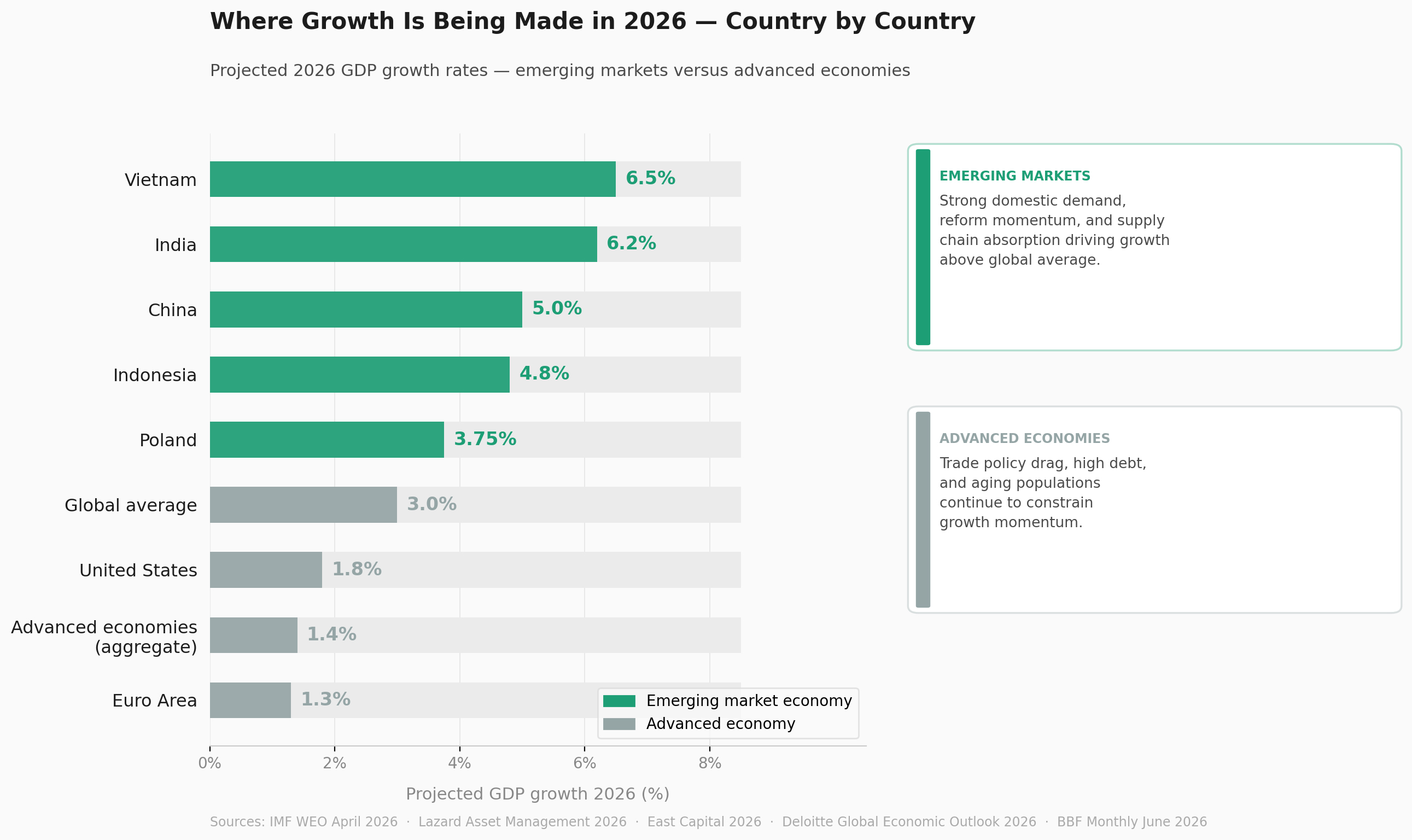
The optimism gap between emerging and developed economies in 2026 is not primarily a sentiment story. It is a leverage story, a demographics story, and a supply chain story — and all three are structural rather than cyclical.
What the optimism does not guarantee
The aggregate emerging market growth premiumDiscover why emerging markets are outperforming developed economies and attracting global capital in 2026. obscures substantial heterogeneity, and the risks embedded in the category are real rather than theoretical. The World Bank’s June 2026 Global Economic Prospects notes that more than one quarter of emerging market and developing economies still have per capita incomes below their 2019 levels — a reminder that the category’s headline growth numbers are heavily influenced by a handful of large economies, particularly India, and that the experience of smaller and more fragile economies within the category can be substantially worse than the aggregate suggests.
Currency risk remains a genuine constraint on the return available to international investors in several emerging markets, particularly those with less liquid foreign exchange markets or where the central bank’s policy credibility has been tested. Geopolitical positioning adds a further layer of complexity, as the US-China competition increasingly forces binary choices on middle-power economies that have benefited from navigating between the two systems. India, Vietnam, and Mexico — the clearest supply chain beneficiaries — are also the markets most exposed to the risk that US-China competition forces explicit alignment and removes the optionality that has been central to their growth strategy.
For business leaders and capital allocators in Bangladesh and across South Asia, the more immediately relevant question is whether the structural advantages that are driving optimism in emerging markets more broadly — lower leverage, domestic demand growth, supply chain reorientation — apply locally. The answer is partially yes, with the same caveats that apply across the category: the structural opportunity is real, the institutional and policy conditions required to fully capture it are not uniformly in place, and the gap between the aggregate headline and the specific country experience can be wide. The global capital that is beginning to look more seriously at emerging markets is doing so with more analytical precision than it has in previous cycles — country-specific fundamentals, currency dynamics, and policy credibility are being evaluated rather than treated as interchangeable parts of a single asset class. The countries that get that evaluation right will capture a disproportionate share of what is beginning to look like a genuine structural shift in where the global economy’s growth is being made.