The complaint arrives in almost identical wording from marketers in Dhaka, Delhi, Manila and Milan. Paid media used to work. Now the same budget buys fewer customers than it did last year, the year before that was better still, and every attempt to fix it by spending more seems to make the arithmetic worse rather than better. Agencies are blamed, then replaced. Platforms are blamed, then paid anyway.
The diagnosis is usually framed as a media problem, which is where most of the discussion stops. It is closer to a briefing problem, and the evidence for that has been sitting in plain sight since 2013.
Two effects, two clocks
When Les Binet and Peter Field published The Long and the Short of It for the Institute of Practitioners in Advertising, they were working from the IPA Effectiveness Awards Databank, which is an unusually good dataset because entry requires proving commercial results rather than asserting them. Their analysis covered 996 case studies, roughly 700 brands and 83 sectors, stretching across three decades of measurement.
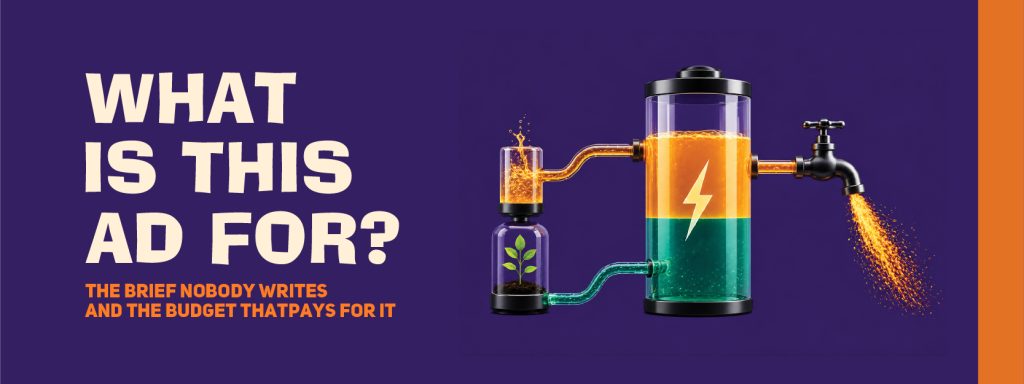
What they found underneath the famous budget ratio matters more than the ratio itself. Advertising produces two distinct effects rather than one. There is a fast effect, largely rational, which converts people who are already close to buying and shows up within weeks. And there is a slow effect, largely emotional, which builds memory and disposition in people who will not buy for months or years, and which shows up in market share, margin and pricing power rather than in this quarter’s conversions.
The two behave nothing alike. Activation produces a spike and returns to baseline. Brand building accumulates, compounds and decays slowly. Because they run on different clocks, they need different creative, different media and different measurement, and a campaign designed for one will not accidentally deliver the other.
Binet and Field’s sharpest observation is organisational rather than creative: most companies are structurally built to see only the fast effect. Everything about a modern marketing department, from its dashboards to its reporting cycle to the questions asked in its monthly review, is calibrated to the thing that happens in thirty days.
Why the budget drifts one way
If both jobs matter, why does spending collapse into one of them? The honest answer has nothing to do with belief and everything to do with measurement.
Activation is countable. A performance campaign produces a number by Friday, attributable to a channel, defensible in a meeting. Brand building produces a flat line in the leads column for months and then, eventually, a change in something no dashboard was watching. Put those two reports in front of a finance director under pressure and the outcome is predictable. The measurable budget survives; the other one is trimmed, then trimmed again, and eventually described as a nice-to-have.
Kantar calls the consequence the seed corn problem, and the analogy is exact. A farmer who diverts the seed budget into better harvesting equipment has an excellent first year. The second year is acceptable, because the ground still holds something. By the third there is nothing left to harvest. James Hurman puts the same point in financial terms: when you stop building a brand you are not saving money, you are borrowing from your future self at a high rate of interest.
The borrowing is invisible for a while, which is what makes it dangerous. Existing brand equity keeps generating returns for six to twelve months after investment stops, so the decision looks vindicated for exactly as long as it takes for the person who made it to be promoted.
What the drift costs
The bill arrives as rising acquisition cost, and the mechanism is worth understanding because it explains why spending more makes it worse.
Performance channels work by finding people who are already in the market. That pool is finite. Once a well-run account has captured the people actively looking, every additional taka reaches someone less interested, so the cost per acquisition climbs while the media team is doing nothing wrong. Rising CAC in a competently managed account is not a sign of poor optimisation. It is a signal that harvestable demand has run out and nobody upstream has been creating more.
WARC’s work on the multiplier effect puts numbers on both directions of the trade. Brands moving from a performance-only model to a combination of brand and performance saw substantial ROI improvement; brands moving the other way saw median revenue ROI fall by around 40 percent. The same body of research finds that audiences exposed to both kinds of work convert at meaningfully higher rates than audiences exposed to either alone, which is the part most budget arguments miss. Brand investment does not compete with performance spending. It raises the yield on it.
The finding that surprises people
Here the research turns genuinely counterintuitive, and it is the part most likely to be argued with in a meeting.
The intuitive division is that emotional work builds image while rational work drives sales, so a brief should ask for feeling at the top of the funnel and information at the bottom. Binet and Field found something close to the opposite. Emotional campaigns outperformed rational ones on long-term effects by a wide margin, as expected, but they also held up on short-term business results. Creativity amplified both.
They also came out against the compromise most clients reach for. Rather than building double-duty advertisements that carry a feeling and a proposition at once, the evidence favoured going for pure emotion in the majority of the work and letting activation do its own job separately. The instinct to hedge, to squeeze a price message into a brand film so that the spend can be justified twice, tends to produce work that does neither job properly.
You can measure the slow effect
The strongest objection to all this is practical: nobody funds what they cannot measure, and brand effects are famously hard to see. That objection is weaker than it was.
At EffWorks Global in 2020, Binet introduced share of search as a proxy, and its appeal is that it costs nothing. Take the volume of organic searches for your brand, divide by total searches across the category, and track the ratio over time using freely available Google Trends data. In some categories, automotive among them, share of search has led share of market by as much as twelve months, which turns it into an early-warning system rather than a rear-view mirror.
Excess share of voice offers the other half of the picture. Work published in the Journal of Advertising by Danenberg, Kennedy, Beal and Sharp found that every ten points of excess share of voice associated with roughly half a percentage point of market share growth per year. Neither metric is perfect. Both are considerably better than the flat line in the leads column that currently loses the argument.
So write the brief
All of which returns to the question in the headline, which almost no brief answers explicitly. Most briefing documents describe an audience, a product, a tone and a deadline, and leave the single most consequential decision unstated: is this piece of work supposed to make someone buy now, or make someone more likely to buy later?
Answer that question at the top of the page and most of the arguments that follow resolve themselves, because the channel choice, the creative route and the metric all follow from it. Leave it unanswered and the work drifts toward whichever job the reporting system happens to reward, which in almost every company is the one that finishes by Friday.
Binet and Field’s ratio is a useful benchmark and a poor substitute for thinking. Their later work found the optimum moves by sector, sitting nearer an even split in online categories and slightly further toward activation in business-to-business. The number that matters for any particular company is the one it can defend. What none of the research supports is the split most companies are actually running, which was never chosen at all.
Sources: Les Binet and Peter Field, The Long and the Short of It (IPA, 2013), Marketing in the Era of Accountability (IPA, 2007) and Effectiveness in Context (IPA, 2018) · IPA Effectiveness Awards Databank · Les Binet on share of search, EffWorks Global 2020 · Danenberg, Kennedy, Beal and Sharp, Journal of Advertising (2016), on excess share of voice · WARC, research on the multiplier effect between brand and performance investment · Kantar, on short-termism and the seed corn effect · James Hurman, on future demand, via Campaign Asia (January 2026) · LinkedIn B2B Institute, on brand and activation ratios in business-to-business.