Type ‘what is content marketing’ into Google. Before you reach any website, you already have the answer — pulled from HubSpot, summarised by AI, displayed in a clean box at the top of the page. HubSpot’s content is right there, being read by millions. But HubSpot is not getting the click. This is the Featured Snippet Trap — and almost every major brand in the world has now fallen into it, panicked about it, or quietly started to turn it to their advantage.
The trap works like this: you invest in content, you rank at position zero, your expertise is surfaced to users at exactly the moment they need it — and then they leave without visiting your site. Traffic drops. The marketing dashboard turns red. Panic ensues. The wrong brands respond by pulling back on content. The right brands ask a different question entirely: if the click is increasingly rare, what does winning actually look like?
THE NUMBERS ARE NOT AMBIGUOUS
The data that has been accumulating over the past three years now tells a clear, consistent story. Research from SparkToro and Datos confirmed that 60% of all Google searches in the US ended without a click to any external website in 2025 — meaning for every 1,000 searches, only 360 resulted in a visit to a site not owned by Google or paid for through ads. In the European Union, the figure is higher still at 59.7%. On mobile devices, where Google’s design prioritises above-the-fold answers, over 75% of searches end without a click.
The introduction of Google’s AI Overviews has dramatically accelerated the trend. Queries that trigger AI Overviews now show a zero-click rate of 83%, according to Similarweb’s 2025 aggregated data. Organic click-through rates for queries featuring AI Overviews dropped 61% between mid-2024 and 2025, falling from 1.76% to just 0.61%, per Seer Interactive’s September 2025 analysis. Ahrefs data shows featured snippets and AI elements can reduce organic CTR by as much as 58% on affected queries. For paid search, the impact is even sharper — a 68% decline in CTR.
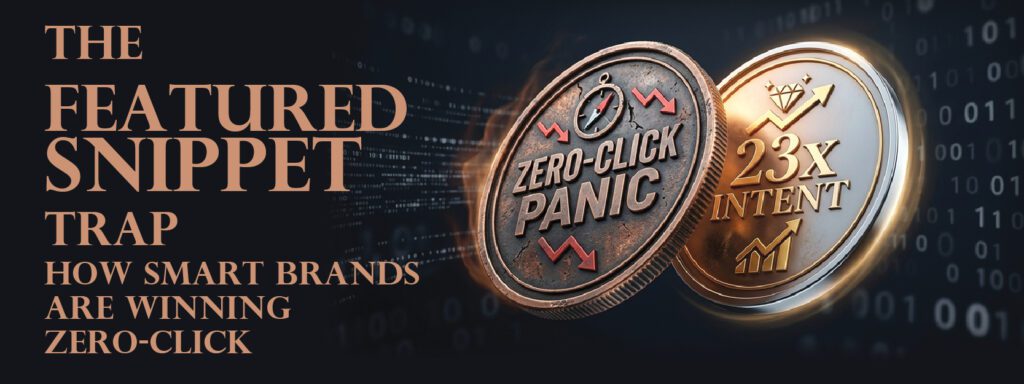
Yet within this data lives one of the most counterintuitive findings in modern digital marketing. BrightEdge’s 2025 cross-industry study of 1,200 websites found that AI search visitors who do click convert at 23 times the rate of traditional organic search visitors. The mechanism is self-selection: when AI answers simple queries on the results page, the users who still click through are those with deep intent — they want to verify, explore further, or act. The volume game of search is over. The quality game has begun.
UNDERSTANDING THE TRAP
The featured snippet — that highlighted box occupying ‘position zero’ above all organic results — was originally celebrated as the holy grail of SEO. Winning position zero meant your content was selected by Google as the definitive answer to a query. For years, it drove significant traffic and signalled authority. Then the rules changed.
As Google evolved from extracting answers from single sources to synthesising them from multiple sources through AI Overviews, the featured snippet became simultaneously more valuable and less commercially useful. More valuable because being cited builds brand authority at scale — your name appears in the answer every time the query is asked, across millions of searches. Less commercially useful because the answer is now complete enough on the SERP that there is no remaining intent to drive a click.
The brands caught most severely in this trap are those whose content strategies were built almost entirely on informational, how-to, and definitional content — precisely the content types that AI Overviews summarise most effectively. They built traffic empires on answering questions. Now Google answers those questions for them, citing them as the source, and the traffic evaporates. The visibility remains. The sessions do not.
HubSpot reported a 70–80% decline in organic search traffic as AI Overviews absorbed their how-to content. Their revenue, however, continued to grow.
— Digital Bloom IQ Analysis, 2025
HOW SMART BRANDS ARE ACTUALLY WINNING
The brands navigating zero-click most effectively share a common insight: they stopped measuring success by sessions and started measuring it by presence, authority, and downstream intent. Here is how three of them are doing it.
CASE STUDY · HubSpot — The Traffic Paradox
HubSpot built its content empire on exactly the kind of how-to, definitional, and process-driven content that AI Overviews now absorb most completely. The company reported a 70–80% decline in organic search traffic as Google’s AI summarised its guides directly on the SERP. By any traditional SEO metric, this should have been catastrophic.
But HubSpot’s revenue continued to grow. The reason: the brand had spent years building multi-channel visibility — email lists, YouTube, LinkedIn, direct communities, certification programmes — that did not depend on organic search clicks to function. When AI Overviews began citing HubSpot as the authoritative source on marketing topics, the brand recognition effect was enormous. Users who encountered the HubSpot name in AI-generated answers searched for HubSpot directly, bypassing Google entirely. Branded search volume — the most commercially valuable kind — rose even as informational organic traffic fell. HubSpot did not set out to win zero-click. They had simply built the brand infrastructure that meant zero-click visibility converted to something else: trust, recall, and direct intent.
CASE STUDY · NerdWallet — The Intent Filter
NerdWallet operates in financial services — a sector where trust is everything and the stakes of a wrong answer are high. When AI Overviews began answering basic personal finance queries (what is an ISA, how does compound interest work, what credit score do I need for a mortgage), NerdWallet’s informational traffic took a significant hit. But the company’s leadership made a strategic distinction that proved decisive: informational queries and transactional queries are fundamentally different audiences.
NerdWallet doubled down on transactional and comparison content — the kind of query where a user needs to act, not just understand. Searches like ‘best credit card for travel rewards in 2026’ or ‘compare personal loan rates’ require a user to visit a site, interact with a comparison tool, and make a decision. AI Overviews cannot complete these tasks. They can explain what a credit card is. They cannot tell you which one to apply for based on your specific profile. NerdWallet identified the content categories where clicks still happen reliably and concentrated its SEO investment there, while accepting that informational content now functions as brand visibility infrastructure rather than traffic generation. The result was declining sessions alongside growing revenue — precisely the pattern that separates brands which understand the new game from those still playing the old one.
CASE STUDY · BlakSheep Creative — The AEO Playbook
BlakSheep Creative — a digital marketing agency — took a more technical and systematic approach to the zero-click challenge. Facing declining website traffic as AI-driven search features captured user attention before any click could occur, the company executed what is now called an Answer Engine Optimisation (AEO) strategy: a comprehensive restructuring of their content and technical infrastructure to maximise presence in zero-click environments rather than fighting against them.
The approach had three components. First, conversational content restructuring — every major piece of content was rewritten to directly answer the most common questions in the first 50–100 words, using natural language that mirrors how users phrase voice and AI-prompted queries. Second, schema markup implementation — FAQPage, HowTo, and LocalBusiness schema were applied comprehensively across the site, signalling to Google’s systems exactly how to extract and display the content. Third, brand mention tracking — instead of measuring sessions, the team began tracking brand mentions in AI-generated responses and zero-click answer boxes as primary KPIs. Within three months, BlakSheep Creative saw a 40% increase in appearances in zero-click answer boxes and a 25% increase in brand mentions in AI-generated responses. Traffic had not recovered. Presence had compounded.
THE ZERO-CLICK PLAYBOOK FOR BRANDS
The common thread across every brand navigating zero-click successfully is a fundamental shift in how they define winning. Traffic is a means, not the end. Visibility, authority, and downstream intent are the end. Here is what that looks like in practice.
The first move is the hardest: accepting that not all content should be optimised for clicks. Informational content — definitions, how-to guides, explainers, process descriptions — is increasingly functioning as brand advertising within Google’s interface. It builds awareness, signals expertise, and earns citations. The commercial return is real but indirect, flowing through branded search, direct navigation, and improved conversion rates from higher-intent visitors. Brands that insist on measuring informational content by sessions will always be disappointed.
The second move is identifying and fortifying the content that still drives clicks reliably. Commercial and transactional queries — comparisons, product reviews, pricing pages, calculators, tool-based content — retain click-through rates because AI cannot complete the transaction. Backlinko’s 2025 research shows that pages earning a featured snippet capture up to 42% of all clicks for their query, outperforming the standard first organic result. For commercial queries, position zero is still enormously valuable. The strategic imperative is distinguishing which queries earn clicks and concentrating resources accordingly.
The third move is technical: structured data implementation is no longer optional. FAQPage, HowTo, LocalBusiness, Product, and Event schema markup increase the probability of appearing in rich results and AI citations measurably. Google’s systems are designed to identify and extract structured content. Brands without schema markup are invisible to the mechanisms that determine SERP feature eligibility. In 2026, this is foundational infrastructure, not a technical nicety.
The fourth move is measurement transformation. Analytics dashboards built around sessions and organic clicks will always make zero-click look like failure. The metrics that matter now are SERP feature appearances, branded search volume, AI citation frequency, share of voice across answer surfaces, and conversion rate from organic visitors who do arrive. The last metric is critical: if the 23x conversion rate uplift from AI search visitors is real — and BrightEdge’s data suggests it is — then fewer, higher-intent visitors are more commercially valuable than the mass informational traffic that AI Overviews have absorbed.
THE ANSWER HAS NOT CHANGED — ONLY WHERE IT LIVES
The featured snippet trap is real. Traffic is falling for content that was once generated reliably. The sessions that justified content investment for a decade are shrinking. None of this means content marketing is broken. It means the location where value is delivered has shifted — from the website to the search results page — and the brands smart enough to recognise that shift are quietly building visibility empires that convert at rates the old click-volume model never achieved.
The question for every marketing leader is not whether to optimise for zero-click. That ship has sailed — 60% of searches have already made the decision for you. The question is whether your brand is present, credible, and structured well enough to be the source that Google cites when it answers your customer’s question. If it is, you are not losing traffic. You are reaching your audience at the exact moment of maximum relevance — for free, at scale, in a format they trust.
SparkToro / Datos Zero-Click Study 2025 · Semrush Zero-Click Searches Study 2025 · Similarweb Aggregated SERP Data 2025 · BrightEdge Cross-Industry Conversion Study 2025 (1,200 websites) · Seer Interactive CTR Analysis, September 2025 · Ahrefs Featured Snippet CTR Research 2025 · Backlinko CTR Research 2025 · Digital Bloom IQ Publisher Traffic Analysis 2025 · SingleGrain / BlakSheep Creative AEO Case Study 2025 · FirstPageSage SERP Position Study, May 2025.