
AI has made our lives easier, but every prompt comes with a hidden environmental cost that often goes unnoticed. While stopping AI use may not be practical, using it thoughtfully can help reduce its impact on nature.
Have you ever wondered what it takes for an AI assistant to answer the simplest of requests?
The answer travels further than it looks. Your prompt leaves your phone and reaches a data centre, where rows of chips break the request into calculations and run them at once. Those calculations produce heat, and heat has to go somewhere. Every answer you receive has been paid for twice: once in the electricity that ran the computation, and again in whatever carried the heat away afterward.
Even courtesy is charged for. Most of us type “please” and “thank you” out of habit, and the model has no idea what either word means. It processes them anyway. Asked in 2025 what that habit costs, OpenAI’s Sam Altman put it at tens of millions of dollars in electricity, and said it was money well spent.
If words that carry no instruction cost that much, it is worth asking what the rest of our prompts cost. OpenAI disclosed in 2025 that ChatGPT receives around 2.5 billion prompts every day, while Google estimates that a median Gemini prompt consumes around five drops of water, or 0.26 millilitres, counting the cooling inside its data centres. That sounds like nothing until you multiply it. A Washington Post analysis with the University of California, Riverside found that generating a 100-word email can use about 519 millilitres, a far larger figure because it also counts the water used to generate the electricity. Long or short, every prompt draws power to run and water to cool.
The question arrives in Bangladesh
Recently, an article by The Climate Watch uncovered that global companies are showing interest in developing AI data centers in Bangladesh. Representatives from the UK, Japan, and South Korea are holding discussions with the government as a UK-based company proposes an investment of about $2 billion. The British Firm, ADIC, wants to build an AI data center at Kaliakair, in Gazipur, the Sirajganj Economic Zone or another economic zone in Bangladesh. After this news was spread online, it spread a massive concern among the people.
But why is it concerning?
The same question, four answers, because each one stops counting in a different place. Sources: Google technical paper (August 2025); Sam Altman, OpenAI (June 2025); Shaolei Ren, UC Riverside, revised estimate; Washington Post with UC Riverside (2024). Log scale.
A data centre is built from thousands of servers, and inside each one sit the chips that carry the real load: graphics processing units, or GPUs. Every prompt you send runs through them and comes back as an answer within seconds. It makes no difference what you asked for. A question, an image, a translation, a rewrite, or just a casual conversation with your bot, the chips process each one the same way.
That last category is larger than you might expect. A European Union study found that 24 percent of respondents use AI at least sometimes for friendly conversation, while around three in ten believe it can be a kind of friend (29 percent) or offer comfort (28 percent).
Where the water goes
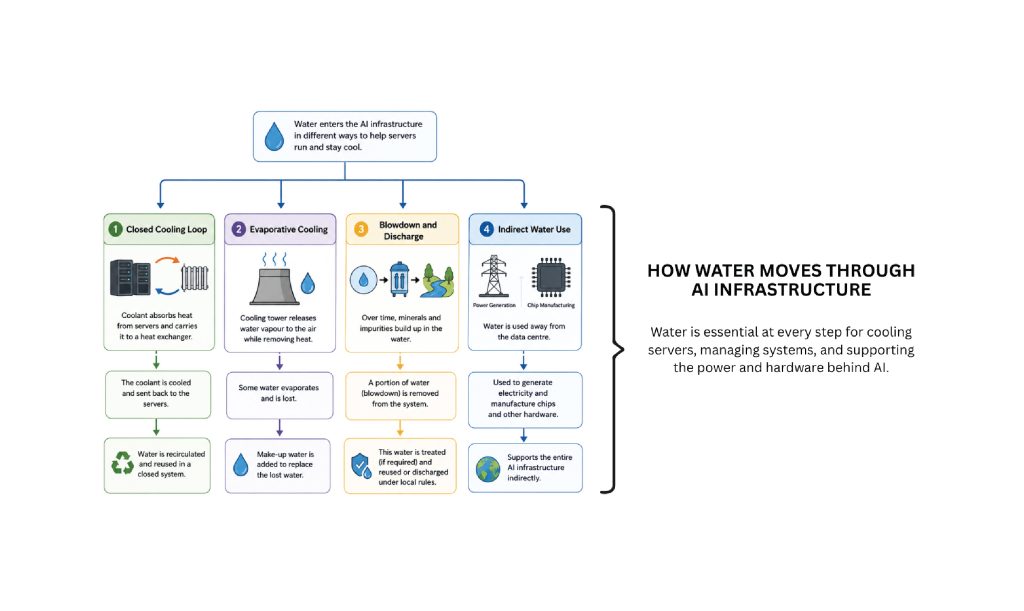
So, whenever we enter a prompt to get an answer, a huge amount of heat is generated by the calculations. Just like our devices when we run software for a long time. If these data centers aren’t cooled properly while they’re computing, it can damage the chip or cause it to malfunction. To keep the servers running safely, data centers use different cooling methods. Some use air cooling, where fans and air conditioners remove heat. Others use evaporative cooling, where water absorbs heat and some of it evaporates to cool the equipment. More advanced facilities use liquid cooling, where a special liquid or water flows close to the computer chips to carry heat away much more efficiently. A data center’s cooling method varies based on factors such as the number of servers, the local climate, water availability, and how energy-efficient it needs to be.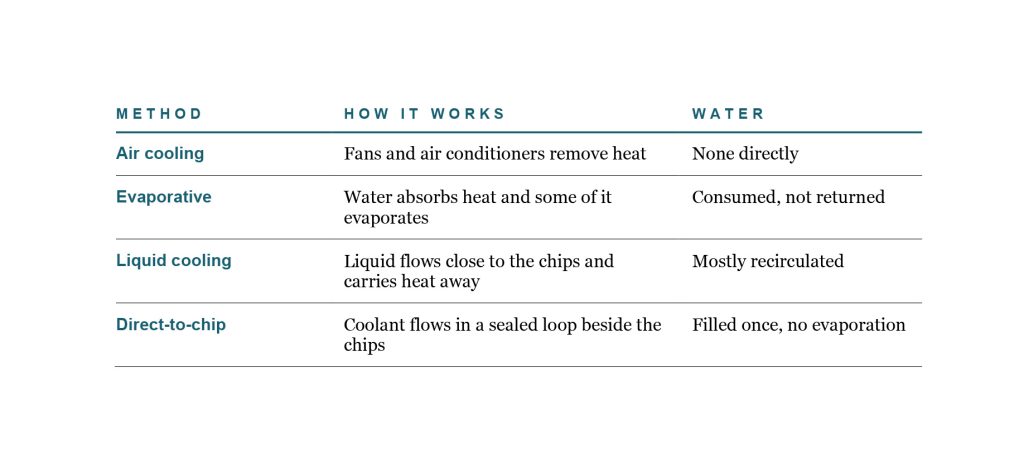 Most of the time, air is not sufficient to cool down these servers. In this case, water is more effective because it absorbs heat much better. Water is used in AI systems in three main ways: to cool data centers, to generate the electricity that powers them, and to manufacture the servers and other hardware they use. Inside data centers, servers produce a lot of heat while processing AI tasks. To keep them from overheating, cold water flows through pipes or cooling plates attached to the servers, absorbing the heat and keeping the systems running safely.
One important part of the cooling process is clean water. Impure water can’t be used because it can clog the server’s cooling pipes and cause corrosion in the equipment. This eventually reduces cooling efficiency and can permanently damage the servers.
Why clean water is the constraint
This heavy reliance of clean water is the biggest environmental concern to everyone. Although about 71% of the Earth’s surface is covered by water, only around 0.5% is readily available as freshwater for drinking and other human needs. In data centers that use evaporative cooling, some of the water is lost through evaporation and must be replaced with fresh water. Even in closed-loop cooling systems, where water is reused, it eventually becomes contaminated with dust, minerals, or chemicals. So how can it be used sustainably?
What the industry is doing about it
Stopping the use of AI is not practical, as many industries and everyday tasks now depend on it. Instead, the focus should be on using AI more sustainably. Data centers can treat and clean the water they use before safely releasing it into rivers and lakes or reusing it for purposes such as watering plants and flushing toilets. At the same time, newer cooling technologies, including liquid immersion cooling and free cooling, are helping data centers reduce their dependence on fresh water.
Many companies are also moving towards closed-loop cooling systems, where the same coolant is reused instead of being thrown away after one use. In a method called direct-to-chip cooling, the coolant flows very close to the AI chips, where most of the heat is generated. This removes heat much more efficiently than traditional air cooling and reduces the amount of water needed for cooling.
Microsoft announced this direct-to-chip design in August 2024, with the first facilities due from late 2027. According to the company, the cooling loop does not lose water through evaporation, meaning no water is used up during the cooling process itself, avoiding more than 125 million litres per data centre each year. Microsoft also says it improved the water intensity of its data centres by 25% between 2022 and 2025, measured as litres per kilowatt-hour rather than total volume.
 Rain is not a refund
Some people argue that water lost through evaporation eventually returns as rain. While that is true, it does not solve the problem. When water evaporates, it enters the atmosphere and eventually returns through the natural water cycle. However, it may fall as rain days, weeks, or even months later, and often in a completely different location. This matters because timing and location are important. If a data center uses a large amount of water during a drought, that water is temporarily unavailable for nearby communities, farmers, or local ecosystems. Even if it eventually returns as rain, it may not return where or when it is needed most.
Some technology companies are also investing in water replenishment projects to help offset their water use. For example, Google says its projects in 2025 helped restore about 7.7 billion gallons of water, about 78% of the freshwater it consumed, although its total consumption rose 34% over the same year. These projects improve rivers, wetlands, and watersheds, but they do not mean the exact water taken by a data centre is immediately returned to the same place where it was used.
The part that belongs to us
While companies have a responsibility to make AI more sustainable, users also have a role to play. Every AI prompt requires computing power, electricity, and cooling. If your prompt is unclear, the AI may not give you the answer you need. You then ask follow-up questions or request multiple revisions. Each extra prompt means the AI has to process more information, using more energy and resources than necessary.
Ultimately, the goal is not to use less AI, but to use it more efficiently. A clear prompt can often produce the right answer on the first attempt, saving time for the user while also reducing the computing power, electricity, and water needed to process repeated requests. At scale, millions of better prompts can make AI systems more efficient and reduce their environmental impact.
Sources: OpenAI, daily prompt volume (2025) · Google, technical paper on the environmental impact of AI inference (August 2025) · Sam Altman, OpenAI (2025) · The Washington Post with the University of California, Riverside (2024), and Shaolei Ren’s revised estimate · Google 2026 Environmental Report · Microsoft Cloud Blog and datacenter water disclosures · The Climate Watch, on proposed AI data centre investment in Bangladesh · European Union survey on public attitudes to AI.
Author: AKASHLEENA SAMADDAR