A shopkeeper in Old Dhaka used to keep five QR stickers on his counter, one for each bank or wallet his customers might use. Since 1 July he has needed one. Bangladesh Bank made the unified Bangla QR mandatory nationwide under a policy it calls One Country, One QR, and in the first 48 hours the system processed 77,165 transactions worth Tk 22.02 crore.
That single sticker is a reasonable summary of what has happened to Bangladeshi payments over the past eighteen months. The plumbing got built. Whether the country uses it is a different question, and the answer so far is more encouraging than most people expect.
Start with what has not changed
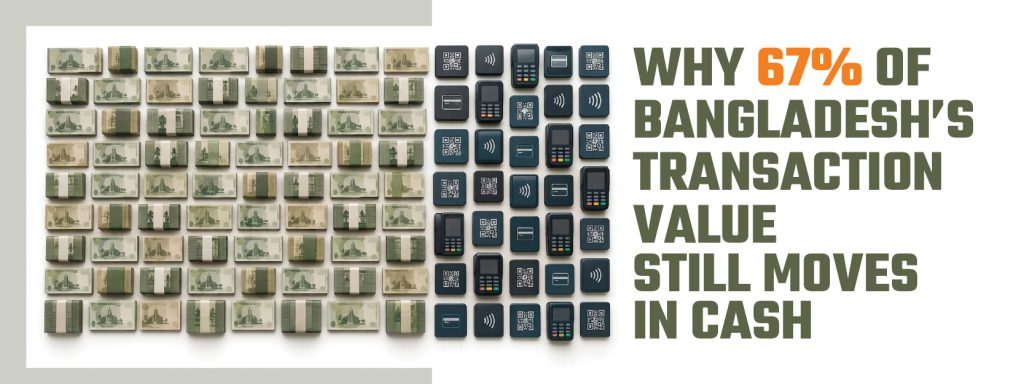
Bangladesh Bank wants every transaction digital by 2031. Its own annual report shows how far that is. Cash accounted for 67.2 percent of total transaction value in 2025, some Tk 209 lakh crore out of Tk 311 lakh crore, with digital taking the remaining 32.8 percent.
The direction is right and the pace is slow. Cash stood at 72 percent a year earlier, so roughly five percentage points moved in twelve months. At that rate the 2031 target arrives somewhere in the 2040s.
The reason sits outside the banking system. Between 80 and 85 percent of the Bangladeshi workforce is informal, contributing somewhere between 30 and 43 percent of GDP, and that portion of the economy runs almost entirely on notes. A payment system can be excellent and still not reach a vegetable seller who has no trade licence, no bank account and no particular reason to want either.
The number that makes the case
The business argument for all this is usually made in terms of convenience and transparency, which are difficult to price. There is a better number available, and Bangladesh Bank has now put it on the record.
Md Parvez Anzam Munir, an additional director in the central bank’s Payment Systems Department, told a workshop in Chattogram in August that managing physical cash costs the country around Tk 20,000 crore a year. That figure covers printing, production, distribution, collecting worn notes and destroying them. He described the expenditure as an extreme luxury and waste for a poor country.
Set that against the Tk 16,295 crore IDCOL says would electrify every industrial rooftop in Bangladesh, or the Tk 13,100 crore the government has already paid out on this year’s LNG subsidy, and the scale becomes clear. The country spends more each year moving its own money around than it does on several things it agonises over funding.
What the mandate actually did
Now the encouraging part, because the adoption curve is genuinely steep.
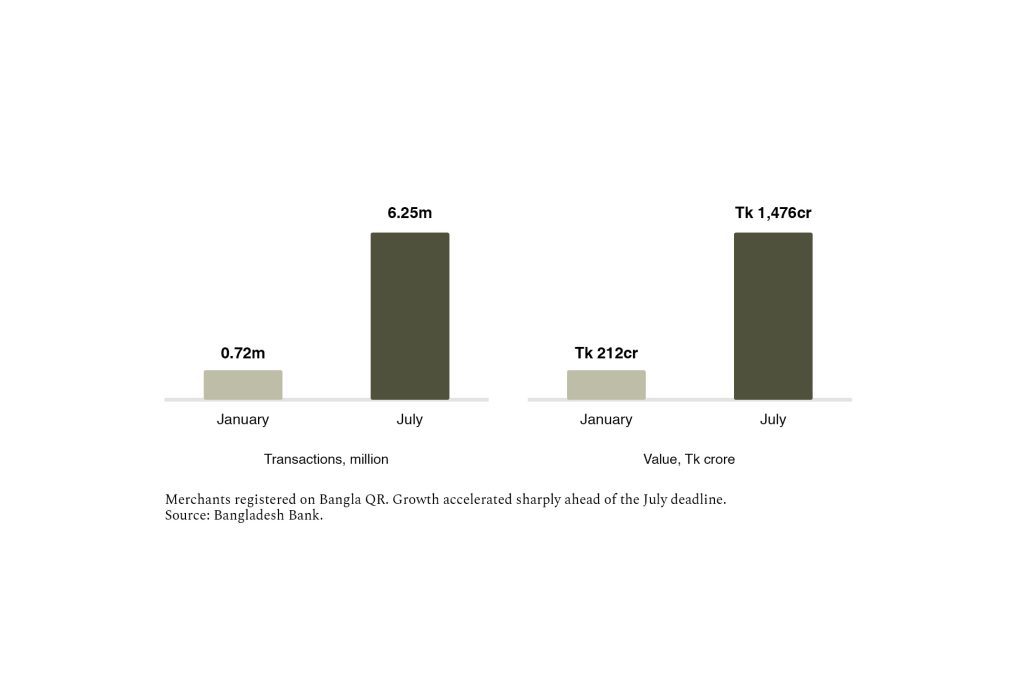
Bangladesh Bank data show Bangla QR transactions rising from 723,378 in January, worth Tk 212.05 crore, to 6,254,938 in July, worth Tk 1,475.95 crore. That is an 8.6-fold increase in volume and close to a sevenfold increase in value inside six months.
Bangla QR monthly transactions and value, January and July 2026. Source: Bangladesh Bank.
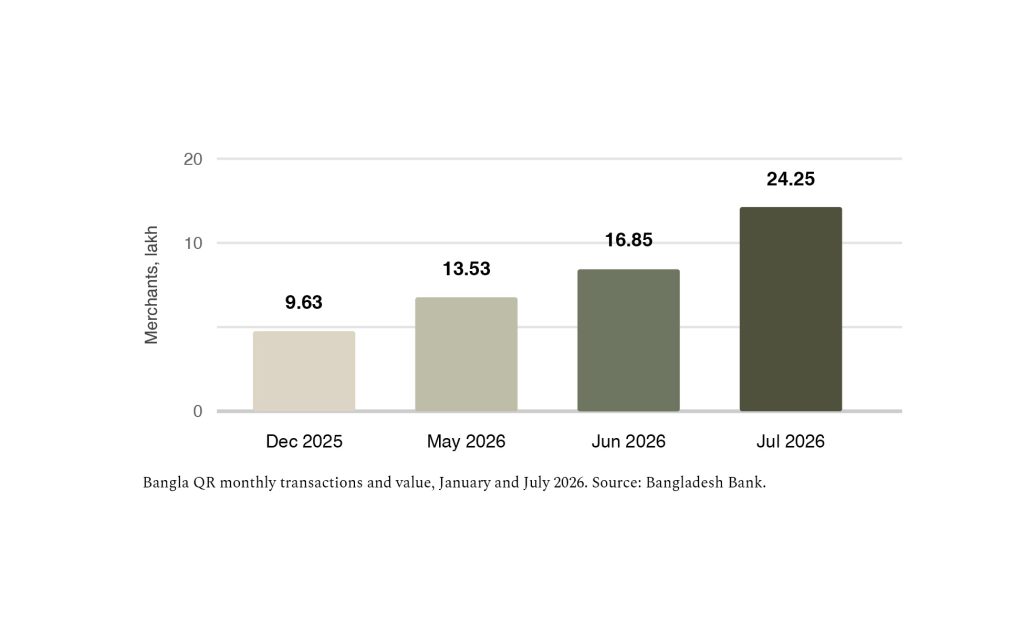
The merchant base moved in step. Registered Bangla QR merchants went from 9.63 lakh at the end of 2025 to 13.53 lakh in May, 16.85 lakh in June and 24.25 lakh in July, which is 79 percent growth in three months and close to 93 percent over ten.
Merchants registered on Bangla QR. Growth accelerated sharply ahead of the July deadline. Source: Bangladesh Bank.
One figure inside that data is worth pausing on. The average Bangla QR transaction runs at around Tk 2,865, which is not a cup of tea. It is a grocery shop, a pharmacy bill, a month of tuition. The system is currently being used for the mid-sized purchases people already planned to make rather than for the small spontaneous ones, and that distinction matters, because the small spontaneous purchase is where cash is genuinely entrenched.
 Notice where the acceleration sits. Most of it arrived in the weeks before the mandate rather than after it, which tells you the deadline worked as a forcing device rather than as a formality. The pattern continued once the rule took effect: daily transactions averaged 1.78 lakh in early July, worth about Tk 37.33 crore, and by the third week of the month had climbed to roughly 3.03 lakh a day worth Tk 110.38 crore. Volume nearly doubled and value roughly tripled inside three weeks.
The reason the state wants this
Convenience is the argument made to consumers. The argument being made inside government is different and rather more interesting.
Deputy Governor Md Kabir Ahmed has said that wider Bangla QR use could help raise the tax-to-GDP ratio, which in Bangladesh is among the lowest in Asia and is the binding constraint on nearly every public spending decision the country makes. A cash transaction leaves no record. A digital one leaves a trail that a revenue authority can eventually follow, and that is the single largest reason a finance ministry anywhere pushes digital payments.
That creates an obvious tension the rollout has to manage. The merchants least willing to be visible to the tax authority are precisely the small informal traders the system most needs to recruit, and no amount of fee waiving resolves that if the underlying worry is assessment rather than cost. Bangladesh Bank has tied Bangla QR to merchant licences issued by city corporations and municipalities, which brings enforcement into the picture alongside encouragement.
Governor Mostaqur has also made a quieter argument aimed at the traders themselves. Digital transactions improve transparency in a business owner’s own accounts and reduce the risk carried by small traders who rely on employees to handle cash. Anyone who has run a shop will recognise the problem being described.
Why the price went to zero
The single most contested feature of the rollout has been the merchant discount rate. Banks and mobile financial service providers were charging 1 percent on Bangla QR transactions, and for a tea stall running on a few taka of margin per cup, 1 percent is not a rounding error. It is a reason to keep taking cash.
Bangladesh Bank has now removed it. From 1 October, merchant charges on Bangla QR go to zero, and rather than asking banks to absorb the loss the central bank is paying them to participate: an incentive to the acquiring institution and a larger one to the issuer, on transactions up to Tk 2,000, settled monthly. The central bank has also established a Tk 100 crore fund to encourage small merchants onto the system, which Governor Md Mostaqur Rahman said would be increased if necessary.
The design is deliberate. Subsidising the small-ticket end is precisely where cash is hardest to displace, because that is where the fee mattered most relative to the sale.
The last piece arrives on 1 November
Merchant payments are the easier half of the problem. Person-to-person transfers are where a payment system either becomes habitual or stays occasional, and Bangladesh has been running that half through a separate mechanism.
That changes shortly. Bangladesh Bank has directed all providers to have their apps ready for person-to-person payments over Bangla QR by 31 October, with rollout from 1 November. The practical gain is mundane and significant: sending money by typing an account number means one wrong digit sends it to a stranger, while scanning a code does not. It also opens the standard to people who cannot be merchants because they have no trade licence, which describes domestic workers, delivery riders and a very large share of the informal economy.
What the rollout cannot fix by itself
Three constraints deserve stating plainly, because the optimistic reading of this story depends on them being addressed rather than ignored.
The first is hardware. Around six crore Bangladeshis are still using feature phones, and a QR standard is of no use to any of them. The government is working on affordable Android handsets, which makes the digital payments target partly a device-affordability question rather than a banking one.
The second is the scale of the ambition. The country currently records roughly one crore digital transactions a month. Bangladesh Bank’s stated target is one crore a day by the end of this fiscal year, which is close to a thirtyfold increase in about ten months. Nothing in the current trajectory, impressive as it is, gets there.
The third is the most fundamental. Ashikur Rahman, principal economist at the Policy Research Institute, has argued that a financial system does three things: it moves payments, it mobilises deposits and it lends. Bangladesh has spent its effort on the first. Making a payment digital does not by itself keep money inside the banking system, which is what turns a payment network into a source of credit for the shopkeeper using it.
There is a fourth constraint that is easy to overlook because it sounds technical. Bangladesh Bank has introduced instant settlement, so a Bangla QR payment credits the merchant’s account immediately rather than after a delay. That sounds like a housekeeping detail and it is closer to the heart of the matter, because a shopkeeper deciding between cash and a code is comparing money in hand now against money in an account later. Removing the delay removes one of the better reasons to prefer notes.
That last point explains a behaviour visible across the market. Around two million mobile money agents exist largely to convert digital balances back into cash. Until a merchant has a reason to leave money in an account, the system is a faster way of handling notes rather than a replacement for them.
What is worth watching
So the honest position sits somewhere between the two arguments usually made about this. The infrastructure is built and works, adoption is rising faster than most observers expected, and the pricing has been fixed in the only way that would have made a difference. Those are real achievements compressed into eighteen months, and comparable systems in India, Brazil, Singapore and Thailand all took considerably longer to reach the same point.
The comparison with other markets is worth making carefully rather than for reassurance. India’s UPI, Brazil’s Pix, Singapore’s SGQR and Thailand’s PromptPay are all held up as evidence that these systems take time, which is true. It is also true that each of them solved person-to-person transfers first and let merchant payments follow, on the reasoning that people learn a payment habit by sending money to each other before they learn it by paying a shop. Bangladesh has done it the other way round, and November is when that sequencing decision gets tested.
The remaining two-thirds is harder than the first third, because it does not live in banks or in shops with trade licences. It lives in an informal economy that has functioned on cash for a very long time and has not yet been given a reason to stop. Whether the next set of numbers shows that changing is the thing to watch when December’s figures arrive.
Sources: Bangladesh Bank annual report, on cash and digital shares of transaction value · Bangladesh Bank payment systems data on Bangla QR transactions, values and merchant registrations, January to July 2026, reported by The Business Standard, The Daily Star, Dhaka Tribune and BSS · Governor Md Mostaqur Rahman and Md Parvez Anzam Munir, Bangladesh Bank, at the Bangla QR workshop with the International Finance Corporation, Chattogram, 8 August 2026 · Deputy Governor Md Kabir Ahmed · Bangladesh Bank circulars on merchant fee waiver and person-to-person payments · Ashikur Rahman, Policy Research Institute · Bangladesh Bureau of Statistics, on informal employment.
Author: Rohan Bin Mostafa