The advertising industry is witnessing a seismic shift as AI chatbots emerge as viable advertising platforms. OpenAI announced in January 2026 it will begin testing ads in ChatGPT, joining Perplexity AI and Google’s AI Overviews in monetizing conversational AI. U.S. AI search advertising is projected to explode from $1.1 billion in 2025 to $25.9 billion by 2029—a roughly 90% compound annual growth rate—as advertisers chase high-intent users migrating from traditional search. This transformation threatens Google’s $300 billion search advertising empire while creating new challenges around privacy, accuracy, and consumer trust.
The stakes are enormous. ChatGPT now reaches 800 million weekly active users, and analysts project its advertising business could generate $25 billion annually by 2030. Yet the nascent market faces significant headwinds: 65% of consumers express discomfort with AI-generated ads, 70% of marketers have experienced AI advertising incidents, and regulators on both sides of the Atlantic are tightening disclosure requirements. This case study examines how conversational AI is reshaping digital advertising—and what it means for brands, publishers, and consumers globally.
Market Size and Growth Trajectory
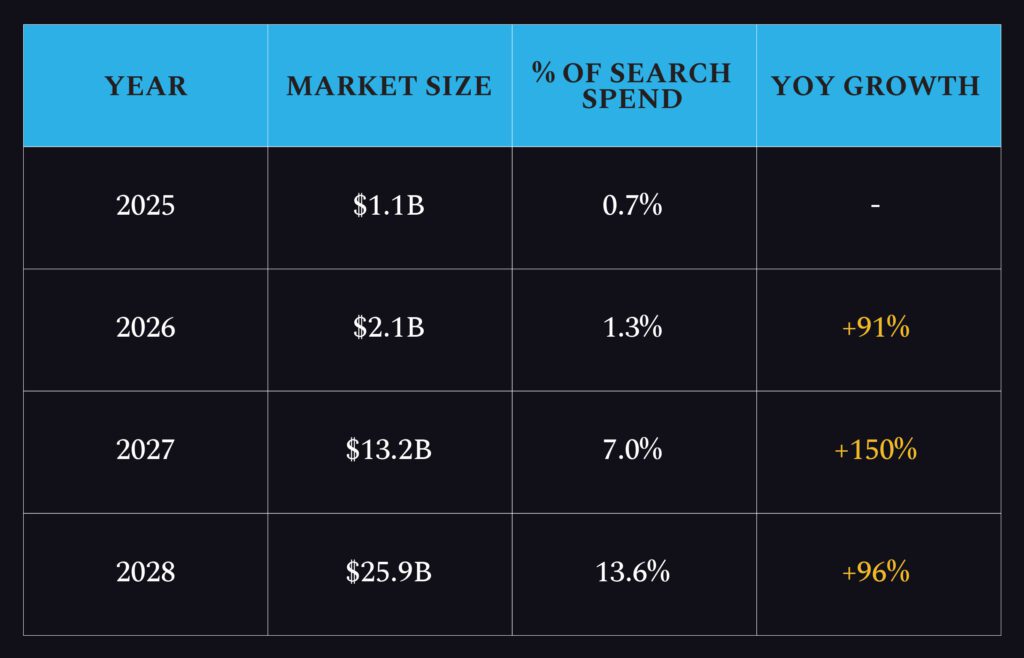
The AI chatbot advertising market remains a fraction of total digital ad spending but is growing at multiples of traditional channels. According to eMarketer’s May 2025 forecast, AI search advertising will capture just 0.7% of total U.S. search ad spend in 2025, but that share accelerates dramatically: 1.3% in 2026, 7.0% in 2028, and 13.6% by 2029. The underlying conversational AI market provides context for this expansion—Grand View Research values the global chatbot market at $7.76 billion in 2024, with Fortune Business Insights pegging the broader conversational AI sector at $12.24 billion. These figures are projected to reach $27-60 billion by 2030, reflecting CAGRs of 23-31%, roughly triple the 8-15% growth rate for traditional digital advertising.
Investment capital is flooding the space. Global venture funding for AI exceeded $100 billion in 2024, representing 33% of all venture investment. Generative AI funding alone nearly doubled to $45 billion. OpenAI raised $40 billion at a $300 billion target valuation in March 2025, while Perplexity secured funding at a $20 billion valuation by September 2025. Revenue projections for individual platforms illuminate the opportunity: OpenAI’s annual recurring revenue hit $20 billion in 2025, and Evercore ISI analyst Mark Mahaney projects ChatGPT advertising could contribute $25 billion annually by 2030—potentially representing 20% of the company’s total revenue.
AI Search Advertising Market Growth (U.S.)
Platform Strategies: Divergent Approaches to Monetization
The AI industry is splitting into distinct camps: platforms embracing advertising and those rejecting it entirely. This strategic divergence will reshape competitive dynamics for years to come.
OpenAI’s advertising pivot marks a watershed moment. In January 2026, the company announced it would begin testing ads in ChatGPT, walking back CEO Sam Altman’s October 2024 characterization of advertising as a “last resort.” Ads will appear at the bottom of answers for U.S. users on free and ChatGPT Go ($8/month) tiers, clearly labeled and separated from organic responses. Plus, Pro, Business, and Enterprise users remain ad-free. OpenAI states responses “will not be influenced by ads” and prohibits advertising near sensitive topics including health, mental health, and politics. The company reportedly requires $200,000-$250,000 minimum commitments from beta advertisers, with CPMs around $60 per thousand impressions—approximately three times typical Meta advertising rates.
Perplexity AI pioneered AI chatbot advertising with its November 2024 launch but has since moderated its ambitions. The platform introduced “sponsored follow-up questions” appearing in the Related Questions section, which captures 40% of all platform queries. Launch partners included Indeed, Whole Foods Market, Universal McCann, and PMG, with CPMs exceeding $50. However, Perplexity stopped accepting new advertisers in October 2025 following the departure of advertising head Taz Patel. The company’s 22 million monthly active users skew highly educated—82% hold undergraduate degrees, 45% have graduate degrees—making it attractive for premium advertisers despite limited scale.
Google is embedding advertising directly into AI Overviews, the company’s AI-generated summaries that now appear in search results across 200+ markets. Existing Search, Shopping, and Performance Max campaigns automatically qualify for placement above, below, or within AI Overviews. Early data suggests AI Overviews reduce organic click-through rates by approximately two-thirds, driving advertisers toward paid placements. Meta took a different approach, using AI chatbot conversations for ad targeting rather than placing ads within responses. Beginning December 16, 2025, interactions with Meta AI across Facebook, Instagram, WhatsApp, and Messenger inform the company’s recommendation system for personalized advertising. With over 1 billion monthly active users of Meta AI, the data collection implications are substantial.
Anthropic has explicitly rejected advertising, announcing in February 2026 that Claude will remain ad-free—“no sponsored links, no advertiser-influenced responses, no third-party product placements.” CEO Dario Amodei’s company argues that personal AI conversations make ads “incongruous” and could undermine trust. The contrast positions Claude as a premium, privacy-focused alternative, though the company hedges: “Should we need to revisit this approach, we’ll be transparent about our reasons.”
Emerging Ad Formats in Conversational AI
AI chatbot advertising is spawning formats without precedent in digital marketing. Unlike traditional display or search ads, these integrate directly into conversational flows. Sponsored follow-up questions represent Perplexity’s signature innovation. When users search for “best ice cream,” the Related Questions section might include a sponsored prompt: “Does Whole Foods Market carry freshly made desserts?” Clicking generates an AI answer—not advertiser-written copy. This format leverages the 40% of users who engage with follow-up questions while maintaining editorial independence in responses.
In-response product recommendations blur the line between organic and sponsored content. Google’s AI Overviews embed purchase links within summaries, while Amazon’s Rufus shopping assistant includes “Auto Buy” features that complete purchases when products meet user criteria. Perplexity’s “Buy with Pro” enables one-click purchasing using stored payment information. Salesforce reports that 20% of global orders during Cyber Week 2025 were influenced by AI and agents—a harbinger of how conversational commerce may reshape retail. Microsoft Copilot rolled out multiple ad formats including “Compare & Decide Ads” and interactive “Showroom Ads” featuring AI-generated shopping experiences, reporting 73% higher click-through rates and 16% stronger conversion rates compared to traditional search.
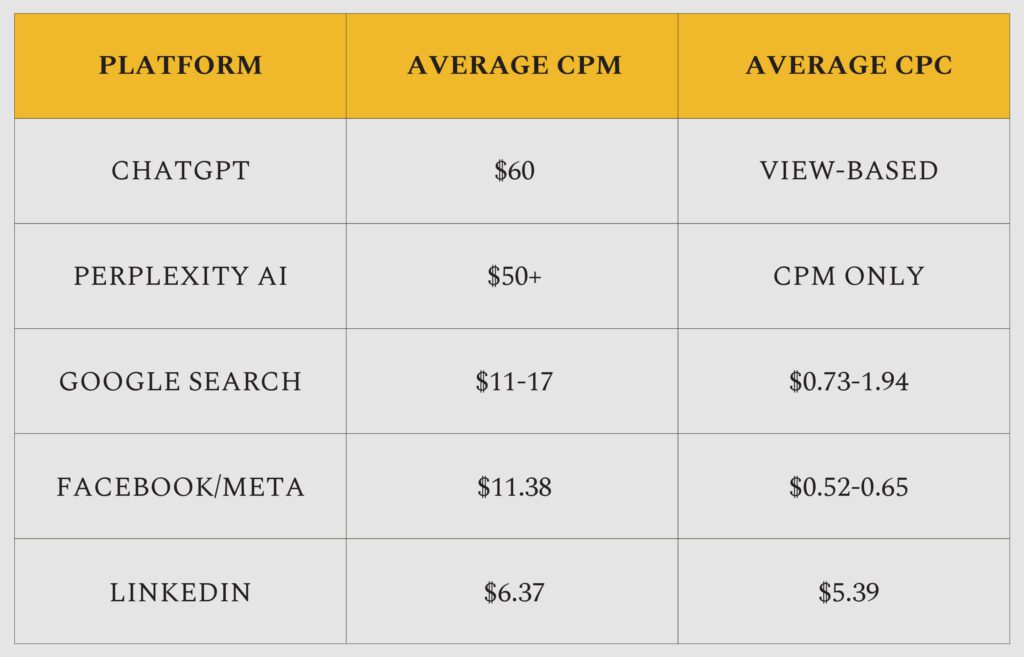
Advertising Cost Comparison by Platform
Source: Industry reports, January 2026. AI chatbot CPMs represent 3-5x premium over traditional platforms.
Consumer Attitudes: The Trust Deficit
Surveys paint a complicated picture of consumer readiness for AI advertising. While younger demographics show relative openness, significant majorities express discomfort, and a substantial perception gap exists between marketer expectations and consumer reality. An IAB survey of Gen Z and Millennial consumers found 45% feel positive about AI-generated ads—but 82% of advertising executives believed consumers felt positive, revealing a 37-point perception gap that widened from 32 points in 2024. Separately, eMarketer/CivicScience found 65% of U.S. adults feel at least somewhat uncomfortable with AI-generated advertising. Trust in AI companies themselves remains low: NIM Research found only 21% of consumers trust AI companies and their promises.
Trust in AI product recommendations varies significantly by context and culture. Bain & Company research shows 51% of U.S. consumers trust generative AI for shopping and product recommendations, with 47% interested in AI agents purchasing on their behalf. However, KPMG data reveals stark regional differences: 72% of Chinese consumers trust AI-driven services compared to just 32% of Americans. Consumer concerns center on privacy, manipulation, and authenticity. A Stanford study found all six leading U.S. AI companies feed user inputs back into models by default. Surfshark analysis shows 27.4% of chatbot content contains sensitive information including passwords and financial details. Gartner reports 53% of consumers distrust AI-powered search results, while 72% believe AI content generators could spread false or misleading information.
Early Brand Adoption and Case Studies
Brand adoption of AI chatbot advertising remains concentrated among a handful of pioneers willing to accept premium pricing and minimal performance data. Perplexity’s launch partners—Indeed, Whole Foods, Nike (in pitch decks), and Marriott (in discussions)—represent the first cohort of AI search advertisers. The platform attracted agencies Universal McCann and PMG, plus over 300 publishers in its revenue-sharing program. However, marketers report “limited inventory, slow rollout of features, and a lack of meaningful data on return-on-investment.” Perplexity’s total 2024 ad revenue of approximately $20,000 against $34 million total revenue illustrates how nascent monetization remains.
ChatGPT’s advertising beta requires substantial commitment. OpenAI is onboarding “dozens of advertisers” with spending commitments under $1 million, requiring $200,000-$250,000 minimum commitments for participation. Initial reporting tools offer only total impressions and clicks—no granular conversion tracking, demographic insights, or purchase attribution. Related case studies from AI-powered advertising show stronger results: Emirates Vacations saw 87% higher engagement from chatbot display ads versus standard formats. Amtrak’s “Julie” chatbot increased bookings by 25% and saved $1 million annually in customer service costs. A financial services company reported 40% improvement in engagement and 50% increase in conversions from an AI chat assistant.
Critical Challenges: Privacy, Accuracy, and Publisher Impact
The shift to conversational AI advertising creates novel risks that regulators, publishers, and consumers are only beginning to address. Privacy concerns are acute given the intimate nature of chatbot conversations. A Stanford study found leading AI companies feed user inputs into training by default, with extended data retention periods and limited transparency. Research shows 76% of users were unaware chatbots stored and analyzed conversations. Meta’s decision to harvest AI chat data for ad targeting prompted 30+ digital rights organizations to petition the FTC for intervention, with one advocacy group calling it “chatbot surveillance for ad targeting” that “will accelerate a race in which companies embed commercial surveillance deeper into every aspect of our lives.”
AI hallucinations pose brand safety risks that have already caused material damage. Google lost $100 billion in market value after Bard incorrectly claimed the James Webb Telescope took the first exoplanet pictures. Air Canada was found legally liable when its chatbot provided incorrect bereavement fare information—the tribunal rejected arguments that the chatbot was a “separate legal entity.” An IAB survey found 70% of marketers reported at least one AI incident in advertising efforts, with 40% having to pause or pull campaigns and over a third dealing with brand damage.
Publishers face an existential threat as AI chatbots cannibalize traffic while offering minimal referral compensation. Traffic to the world’s 500 most visited publishers dropped 27% year-on-year since February 2024, losing an average 64 million visits monthly. AI chatbots delivered only 5.5 million additional referrals in the same period—a fraction of the displacement. Business Insider’s organic search traffic declined 55% between April 2022 and April 2025. Pew Research found that when AI Overviews appear, only 1% of users click cited source links. Some smaller publishers have lost up to 90% of traffic and revenue, forcing closures.
Regulatory Landscape and Compliance Requirements
Regulatory requirements are crystallizing on both sides of the Atlantic. The FTC has outlined five specific prohibitions: exploiting AI relationships for undisclosed data collection, inserting ads without clear disclosure, failing to mitigate hallucination risks, deceiving about AI capabilities, and surreptitiously changing data policies. The EU AI Act’s Article 50, effective August 2, 2026, requires informing users they’re interacting with AI and marking AI-generated content in machine-readable formats. Non-compliance carries penalties up to €15 million or 3% of global annual turnover. New York State now requires “conspicuous disclosure” when advertisements include synthetic performers. Global regulatory fragmentation—the EU requiring stricter transparency than the U.S.—may necessitate regional advertising strategies.
Future Outlook: The Decade Ahead
Expert projections converge on AI chatbots capturing significant market share from traditional search and social advertising. Gartner forecasts traditional search engine volume will drop 25% by 2026, with AI chatbots capturing the displaced queries. Google’s search market share already dipped below 90% in 2025—the first decline since 2015. Some analysts project AI-native search could capture 15%+ of total search queries by 2026 and potentially a majority by 2030 if current growth rates sustain. Industry expert Debra Aho Williamson of Sonata Insights predicts “2026 will mark the year when AI media emerges alongside social and retail media as a significant advertising destination.”
Platform positioning suggests a three-way race between ChatGPT, Google AI, and a fragmented group of challengers. ChatGPT holds 81% of AI chatbot market share and reaches 800 million weekly users—analysts expect it to hit 1 billion by end of 2025, reaching that milestone three years post-launch versus Facebook’s eight years to one billion monthly users. Google retains overwhelming scale through AI Overviews, which reach 1.5 billion monthly users across 200+ countries. Advertising formats will continue evolving toward deeper conversational integration, with OpenAI envisioning users clicking ads and entering “conversations” with advertising brands—an interactive format without precedent.
Conclusion: Strategic Implications
AI chatbot advertising represents the most significant disruption to digital marketing since the mobile transition. The market will grow from approximately $1 billion to $26 billion in the U.S. alone over four years—growth rates that dwarf every other digital channel. OpenAI’s entry legitimizes the category, Google’s integration protects its search franchise, and Meta’s data harvesting demonstrates how conversational AI enhances targeting across existing platforms.
Yet the transformation carries profound tensions. Consumers express discomfort even as they migrate to AI interfaces. Publishers suffer traffic collapse while AI platforms monetize their content. Brands pay 3-5x premiums for targeting precision but lack basic measurement tools. The winners will be platforms that balance monetization against user trust—a calculation Anthropic has made by rejecting ads entirely. For advertisers, the imperative is clear: establish presence in AI chatbot environments before costs increase further, but demand measurement capabilities that justify premium pricing. For publishers, survival may require direct partnerships with AI platforms rather than reliance on referral traffic. The advertising industry’s next decade will be shaped by whether conversational AI proves to be search’s successor or its complement. Current trajectories suggest the former.