The global waste problem is no longer a technical afterthought. Across cities and industries, the traditional approach of collecting everything, dumping or burning most of it, and recycling what remains is proving unsustainable. In my work with data systems in environmental technology, it has become clear that artificial intelligence is one of the few tools capable of transforming waste management from a reactive service into a predictive science. The shift underway is less about fancy robots and more about how cities can think differently about waste itself.
The Scale Of The Waste Challenge
Global research indicates that waste generation has increased sharply in recent years. A review published in Environmental Chemistry Letters found that using AI in waste logistics can reduce transportation distance by nearly thirty-seven percent, lower costs by thirteen percent, and save almost twenty-eight percent in collection time. Those numbers matter because the underlying scale of waste is staggering. The world now generates more than two billion tonnes of solid waste every year, and that figure continues to rise.
These impacts extend way beyond storing or disposing of objects. The landfills in most cities are filled and leaking harmful chemicals into the land and water. The plastic waste that does not fully decompose finds its way into rivers and oceans. Waste degradation emits methane, one of the leading causes of climate change. This situation shows that conventional systems cannot handle modern volumes because they are neither fast nor flexible. The waste management process is still predominantly reactive; it addresses the situation at hand rather than how it will be in the future.
Why Conventional Systems Are Falling Behind
Waste management in the majority of municipalities is constructed using standard schedules, manual labour, and minimal real-time information. Trucks use the same route regardless of whether the bins are half-filled or overflowing. At collection points, sorting is done manually, which is limited in speed and accuracy. The system relies on guesswork, since there is seldom reliable data on exactly what is being gathered, where it is taken, and how much of it can be retrieved.
Three problems reinforce each other. First, the diversity of waste has expanded. Modern packaging, mixed materials, and consumer waste streams create complexity that manual sorting cannot handle efficiently. Second, logistics remain inefficient. Fixed routes lead to unnecessary fuel use and wasted time, especially when bins are not full. Third, data scarcity leaves managers unable to plan ahead. Without clear information about volume, composition, and seasonal variation, it is impossible to optimise collection or recycling.
Cities in developing regions face these difficulties most acutely. Urban growth often outpaces investment in waste infrastructure. As a result, cities respond to waste rather than manage it strategically.
How AI Is Entering The Equation
The principle behind applying AI to waste systems is the same as in other industries. When you instrument the environment, collect data, train models, and feed results back into operations, you can make more accurate decisions. Waste management is finally following that pattern.
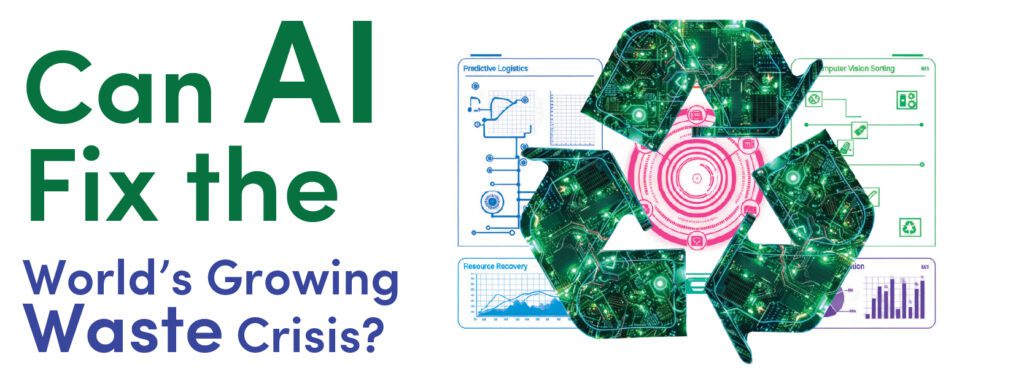
Computer vision and robotic sorters are a major step in the right direction. These systems examine the materials on conveyor belts or bins and can distinguish between plastics, metals, paper or glass better than human beings can. Research has demonstrated a ninety-nine percent accuracy in classifying in controlled settings. Smart bins with sensors that detect fill level transmit data to central systems, so trucks are not dispatched until the bins are filled. Predictive algorithms then use this information to determine how to gather as much trash as possible in the most optimal ways. Real-life AI systems have reduced transport distances and collection times by over a third and a fourth, respectively.
Another area of progress lies in waste-to-energy plants. Algorithms analyse the composition of incoming waste and estimate how much usable energy it can produce. In facilities like the Rorotan RDF plant in Jakarta, this predictive capacity allows more stable power generation and reduces downtime. The same principle applies to hazardous waste treatment and landfill monitoring, where AI helps predict gas emissions and structural risks.
AI also supports data tracking for circular supply chains. Companies use it to trace the origin of recycled feedstock, monitor contamination levels, and verify compliance with sustainability standards. In effect, AI turns waste into a continuous stream of measurable information that can be analysed and acted upon.
What The Evidence Shows
The impact of these systems is becoming clearer. Studies have shown reductions of up to 37% in transport distance, savings in cost and time, and sorting accuracy rates above 90%. In some regions, recycling rates have improved simply because AI can separate materials that humans misidentify. Neste, in its circular economy research, found that AI is helping increase the proportion of material that can be recovered rather than discarded.
However, the technology’s success depends heavily on the system around it. Installing sensors and cameras is not enough if the trucks, personnel, and recycling markets are unchanged. I have seen well-funded deployments where the technology functioned but the operational integration failed, and the gains evaporated.
There is also a growing awareness of AI’s own footprint. Data centres consume energy, sensors require manufacturing and maintenance, and the overall lifecycle cost of digital infrastructure is not negligible. A piece in the Harvard Business Review argued that if AI’s environmental cost is ignored, the benefits in waste management could be partly offset. The challenge, therefore, is to make AI both efficient and sustainable in its own operation.
Bangladesh’s Position And Potential
Bangladesh offers a valuable case study. The country generates more than twenty-five thousand tonnes of solid waste every day, with Dhaka alone responsible for the majority. Less than half of it is collected properly. The rest often ends up in open dumps, drains, or rivers. Informal recyclers handle much of what is recovered, which makes data collection almost impossible.
There are some promising pilot projects. The Dhaka North City Corporation has also started trying out the concept of digital mapping and smart bins with sensors. Image recognition AI is being implemented in some university projects to recognize plastic waste and monitor its movement on the Buriganga River. These initiatives are minor, yet they are the starting steps to data-driven waste management.
The second step may entail predictive models that estimate the amount of waste in each city area per day, using demographic and environmental data. These predictions would allow the city officials to distribute their collection resources more effectively. Optimising routes would reduce fuel costs and operating time. Digitizing the informal recycling industry would introduce transparency, increase the recovery rates, and offer better pay to workers who already constitute the cornerstone of urban recycling.
Bangladesh has a riverine problem as well. Much of the plastic waste is carried out of cities into the Bay of Bengal via waterways. To focus interception, AI may assist in surveillance of such leakage points by combining satellite data and monitoring sensors on rivers. By coordinating among local governments, private startups, and development partners, Bangladesh can establish a national waste data infrastructure that connects city-scale systems to broader environmental objectives.
This would not occur immediately, but the possibility is evident. Because Bangladesh is still establishing its urban systems, it can follow modern data-first models without the stagnation that older systems are burdened with. That is, the nation had the opportunity to gain even more from innovative waste management rather than retrofitting old-fashioned systems.
Challenges That Remain
AI’s potential is significant, yet several obstacles stand in the way. Data quality remains the first. AI models are only as good as the information they’re fed. In many cities, data collection still depends on manual logs and inconsistent reporting. Without standardised inputs, even the most advanced models deliver unreliable results.
Another issue is organisational inertia. Technology often arrives before processes are redesigned to make effective use of it. A city may install smart bins but continue using the same static truck routes. When operations do not change, the benefits of AI remain theoretical. In my experience, the most significant improvements come when technology and operational reform are implemented together.
There is also the question of resources. AI systems require electricity, connectivity, and maintenance. The equipment itself consumes materials and energy. Policymakers need to include these costs in any sustainability assessment. In low-income regions, financial constraints can make ongoing maintenance as challenging as initial deployment.
Inclusion matters as well. Many developing cities rely on informal waste collectors who operate outside official systems. Ignoring them when digitising waste management risks worsening inequality and reducing recovery rates. Any AI-driven model should incorporate these workers as partners, not replace them.
Finally, markets and regulation determine whether the effort pays off. AI can identify recyclable materials, but without buyers or processing facilities, that information has little value. Waste management depends as much on market incentives and enforcement as on technology.
From Waste To Resource
The perception change is what I am most excited about in this transformation. Waste has been considered a liability. It is an optimisable, measurable resource enabled by AI. They have a vision of a city in which the bins will report their fill levels, the trucks will move only when needed, the sorting lines will be nearly perfect at separating, and the waste-to-energy plants will know their performance in advance. Municipal dashboards could present real-time information on the waste streams, collection effectiveness, and their spillage on waterways.
This is not a distant future. These capabilities are already demonstrated in piloting programs in Europe, some parts of Asia and the Middle East. In the case of Bangladesh, innovation and governance should be joined. The technology is available, the information is coming out and the consciousness of the population is up. When the country links these threads, it could become a regional example of AI-based waste management.
The way out is to think of AI as a system and not a solution. City governments need to invest in digital infrastructure, training and collaborations. AI projects should be balanced with sustainability outcomes rather than short-term efficiency gains pursued by private companies. The policymakers should make sure that innovation is balanced between data, privacy, and environmental standards.
The Road Ahead
AI has no power to rid the world of waste, but it can transform the way societies treat it. Cities can predict, strategize, and avoid rather than respond to heaps of garbage. The future is about linking AI to circular-economy models that would transform waste into a raw material with information. In the case of Bangladesh and other developing economies, it should combine commitment with experimentation and evidence.
Data quality and integration will become increasingly significant, and AI will help transform waste management from a financial burden into a sustainable, even profitable service. The coming decade will show whether cities adopt data-driven waste systems or continue old practices. Such a distinction will not be determined by technology per se, but by leadership and desire to redesign our thinking of waste.
If the global community commits to that, AI could indeed help clean up the world’s waste problem and, more importantly, prevent the next one from forming.
Author: Rafsan Ahmed