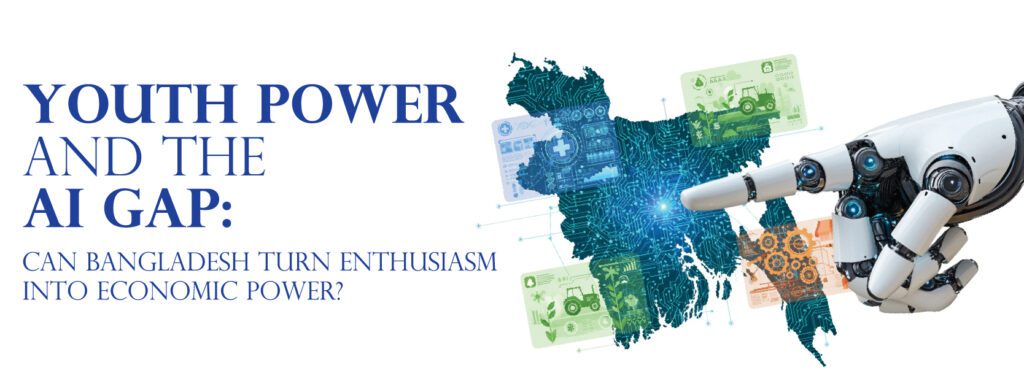
Bangladesh is at a pivotal point in its economic trajectory. Bangladesh’s demographic dividend is its booming and tech-savvy youth population. And their attention is increasingly turning to artificial intelligence. Over half the country is under the age of 28, creating a massive pool of adaptable and digitally literate talent. According to Bangladesh’s Ministry of ICT, Bangladesh is currently producing 25,000 ICT or computer science graduates every year. These graduates are ready to enter the workforce and make an impact in the digital technology industry. At VivaTech 2025, the ICT ministry also stated that the country is experiencing a new wave of transformation, driven by GenAI and other novel technologies. However, a large portion of the young population is using AI at a limited capacity and has yet to utilize it to the fullest. Let’s dive into the details of Bangladesh and its thriving AI landscape.
Bangladesh’s Youth and Early AI Wave
The young population has so far greeted AI tools with a mix of enthusiasm and caution. Most of the students and young professionals have rushed to chatbots like ChatGPT or Gemini to help write reports, debug code, or even brainstorm new ideas. Because of the massive user base Google gets from Bangladesh, it has recently announced a free one-year “Gemini Pro” account for Bangladeshi university students. Bangladesh’s young workforce has eagerly adopted AI tools (especially chatbots), but mostly for education and basic office tasks. Beyond these, broad adoption in industry is only in its beginning stage.
Key Sectors Where AI Can Create Impact
Global consultancy firm PwC estimated that AI’s total contribution to the global economy would reach USD 17 trillion by 2030. Given AI’s estimated contribution to the Indian economy, AI could generate billions of dollars for Bangladesh’s economy, a study by LightCastle Partners suggests.
The healthcare sector has traditionally faced challenges, including inadequate funding and staffing levels. AI can improve diagnostic accuracy and manage patient data. It can identify patterns that human doctors may miss when analyzing large datasets. Early detection of diseases like diabetes, heart attacks, and hypertension, prevalent in Bangladesh, can be much smoother with the use of AI.
In the agriculture sector, AI-powered tools are quietly transforming the “fields,” literally. Smart technologies like machine learning and computer vision are helping farmers keep a close eye on crop health. Moreover, Bangladeshi agri-fintech startups like iFarmer and WeGro are transforming the investment scene in agriculture by integrating AI and digital technology into the agribusiness ecosystem.
In manufacturing, especially in the garment sector (RMG), AI promises huge gains. The rapid use of predictive maintenance and smart quality control can automate factories. At the same time, demand-forecasting AI models can optimize supply chains. In fact, data-driven AI is already transforming Dhaka’s apparel hubs drastically. Generative design and trend analysis now help local designers keep up with global fashion giants like Zara and H&M. The best of it all, AI-powered inventory forecasting alone is cutting waste and cost significantly in Bangladesh’s RMG factories.
Challenges: Infrastructure, Skills and Mindset
Despite the buzz, experts note that AI adoption in Bangladesh is still in its infancy. It is mostly held back by infrastructure and awareness gaps. Only about 62% of the population has internet access. The World Bank says that Bangladesh’s low AI readiness puts its young workforce at risk. Their latest South Asia Development Update signals clear risk for a young, fast-growing workforce if skills and infrastructure do not catch up. Young and moderately educated workers are most at risk, especially in customer service, data entry, and software support-related jobs. The outmigration of tech talent is also adding more pressure to the situation.
But the upside is that about 70% of AI-exposed jobs in South Asia are complementary. That means both humans and AI can coexist to raise productivity without displacement in fields like teaching, law, and healthcare. Local analyses found that companies remain reluctant to embrace AI due to the lack of connectivity, computing power, and technical know-how.
There are other barriers as well. Data infrastructure is extremely weak for countries like Bangladesh. A huge amount of government data is either fragmented or offline. This makes it more difficult to feed machine learning algorithms. Conventionally, many Bangladeshis view AI primarily as a novelty chatbot or writing assistant, not as a strategic business tool. This “tool-only” thinking needs to be changed in order to overcome integration barriers. Fortunately, initiatives like university AI courses and free Google tools for students are steps in that direction. Recently, Prothom Alo, in collaboration with Google, hosted an AI training session at the University of Chittagong for the students. These initiatives indicate a step in the right direction to embrace AI.
Bangladesh’s Government and Industry Leadership in AI Advocacy
The ICT Ministry of Bangladesh is creating a National AI Center of Excellence and drafting new laws on data protection and cyber-safety to foster a secure innovation environment. Instead of developing this legislation independently, Bangladesh is bundling several key frameworks. These frameworks are aimed at including the Personal Data Protection Act, Cyber Safety Ordinance, and National AI Policy in a unified national strategy.
The private sector is following suit. Industry bodies are organizing AI summits and national-level hackathons. Home-grown tech startups like Intelligent Machines (IM), backed by local funding, demonstrate that viable AI businesses can thrive here. IM is a leading AI company in Bangladesh dedicated to using AI capabilities to solve problems and drive efficiency across various sectors. IM has successfully implemented AI in different companies across telecom, financial institutions, and fast-moving consumer goods. Their AI-based services are reported to provide solutions with over 90% accuracy.
Opportunities and Investment Appeal for AI in Bangladesh
Bangladesh’s profile is highly attractive for AI investment. Bangladesh has emerged as a fast-growing hub for high-quality, cost-effective tech talent. The country has a strong pool of skilled software engineers, product designers, and AI/ML experts. This pool of talent is increasingly sought after by startups and companies across Europe, the USA, and Australia, looking to scale quickly and effectively.
There is a promising growth of AI in Bangladesh. Global CSR and development funds are already piloting AI-enabled flood warning systems and telemedicine in Bangladesh. Local entrepreneurs have launched Bangla-language NLP tools and chatbots for e-commerce to serve underserved populations. Meanwhile, the country’s ICT export industry could integrate AI to move up the value chain from routine coding to more sophisticated software services.
All of this builds a compelling case for investment in skills training or AI startups in Bangladesh and also showcases how the investment could yield outsized social and economic returns. Indeed, some financial analysts highlight that the potential payoff is relatively high. And AI-driven productivity gains could add billions to the GDP. In fact, a World Bank report notes that South Asian AI jobs earn a roughly 30% wage premium, which suggests that AI professionals will become more affluent.
The South Asia Perspective
Comparing Bangladesh to its South Asian neighbors provides additional insight. India is the clear leader in AI adoption, with its market of 1.4 billion and a massive IT industry dwarfing others. But among smaller countries, Bangladesh is holding its own fort. A recent World Bank index found that Bangladesh is one of only a few South Asian countries (alongside India and Sri Lanka) ahead of Pakistan in government AI readiness.
However, the region as a whole lags richer economies. For instance, only around 60% of South Asians use the internet. In Bangladesh’s case, this means connectivity must improve to unleash AI’s promise. Although South Asia’s low-skilled economies offer a silver lining, only about 7% of jobs in the region are in highly AI-exposed roles, well below the global average of 15%. That means Bangladesh has more time to upskill workers rather than face mass displacement.
Bangladesh’s young demographic is a regional asset. And with the right training and support, the country could follow the path of tech-driven growth while avoiding the pitfalls of slow-moving traditional industries. Bangladesh’s youthful workforce could indeed power an AI boom, but only if the country moves beyond treating AI as a mere chatbot. The ingredients are in place. It has a digitally curious generation, ambitious policies, and early success stories in industry. In order to realize the full potential, steady investment in connectivity, computing infrastructure, and especially education is required.
Author: Irtiza Zaman