For millions of Bangladeshi families today, the monthly budget is no longer a calculation, it is an anxiety. The price of rice, oil, vegetables, and lentils has risen faster than wages, savings, or expectations. Even households that were once comfortably above the poverty line now find themselves cutting meals, delaying medical care, or borrowing just to make it through the month. Inflation has turned everyday survival into a balancing act.
It is against this backdrop of rising living costs that the government introduced the Family Card program. Framed as a welfare initiative to protect vulnerable households, the program aims to provide subsidized access to essential food items. But beyond its immediate relief, the Family Card opens up a larger and more important question: what does welfare really mean in an economy where prices move faster than policy?
This article uses the Family Card as a starting point to explore how Bangladesh approaches welfare in times of crisis, why inflation hits the poor hardest, and what economics tells us about the limits, and possibilities-of state support.
The Cost-of-Living Problem Before the Policy
Inflation is often discussed in abstract numbers, but its real impact is deeply personal. Food inflation, in particular, hurts low-income households far more than the rich. This is because poorer families spend a much larger share of their income on food. When the price of rice increases by even a few taka, it immediately reduces the quantity and quality of meals on the table.
Over the last few years, Bangladesh has experienced repeated price shocks driven by global factors war, energy prices, supply-chain disruptions as well as domestic pressures such as currency depreciation. While the economy has shown resilience in many macro indicators, household-level distress has been quietly expanding.
This is the economic space in which the Family Card program was born not in a time of collapse, but in a time of slow, grinding pressure on everyday life.
What Is the Family Card Program?
The Family Card program is designed to help selected households buy essential food items at subsidized prices. Typically, women are registered as cardholders, and the benefits focus on basic consumption goods that dominate the poor’s diet. In practical terms, the program reduces the price that eligible families pay during purchases from designated outlets.
The logic is simple: if the market price is too high, the state steps in to close part of the gap.
Yet, the program does not aim to eliminate poverty, raise income, or protect families from all economic shocks. Its goal is narrower but no less important—to prevent welfare from collapsing during inflation.
Understanding whether it succeeds at that goal requires going beyond headlines and into the logic of welfare economics.
Why Governments Intervene: A Welfare Economics View
In an ideal world, markets adjust smoothly. In the real world, sudden price increases leave households with no time and no tools to adapt. Welfare economics recognizes this problem and gives governments a rationale to intervene.
At its core, welfare policy tries to do three things:
- Protect households from sudden shocks
- Keep consumption above a minimum acceptable level
- Reduce inequality caused by unequal exposure to risk
Food inflation checks all three boxes. It creates a shock, hits the poor hardest, and threatens long-term human development by reducing nutrition and health.
From this standpoint, the Family Card is not generosity it is economic damage control.
However, welfare economics also warns that poorly designed programs can lose effectiveness over time, especially when prices rise faster than benefits.
Where the Numbers Matter Most
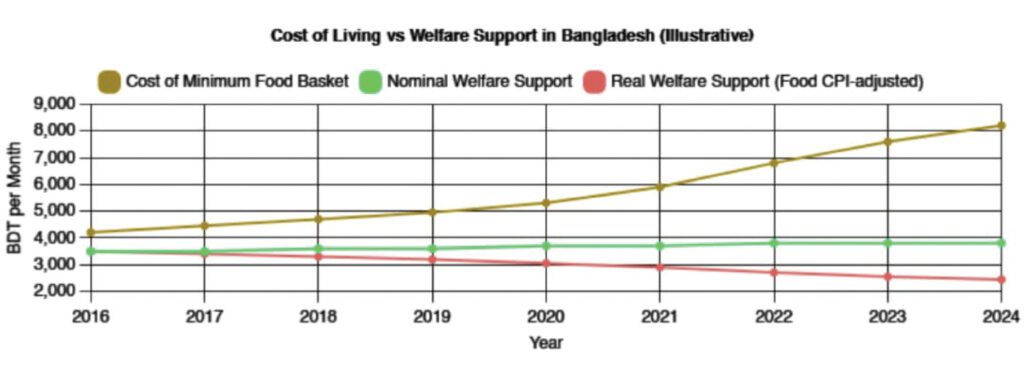
To understand this problem clearly, we need to look at how the cost of basic food has changed compared to the value of welfare support over time. Figure 1 captures this relationship in a single view.
The graph shows three lines:
- The rising cost of a minimum food basket
- The nominal value of welfare support
- The real value of that support adjusted for food inflation
The story it tells is simple but powerful. While the state provides support, its real purchasing power steadily declines. Welfare exists, but inflation quietly eats it away.
This single visual explains why relief program can feel helpful yet insufficient at the same time.
From Policy to Practice: How Effective Is the Family Card?
Seen through this lens, the Family Card works as a partial buffer rather than full protection. It reduces hardship, but it does not restore households to their previous standard of living. Families still face a gap between what they need and what they can afford.
This does not mean the program fails. In fact, even small subsidies can make a meaningful difference when households are operating close to survival thresholds. Preventing hunger, stabilizing consumption, and protecting children’s nutrition are major welfare gains.
The real limitation lies elsewhere: the support is not automatically adjusted when prices rise. Over time, fixed benefits lose value unless they are updated. This is a design issue, not a moral one.
Bangladesh’s Long Welfare Journey
The Family Card is not an isolated policy. Bangladesh has a long history of welfare programs, especially food-based ones. Initiatives like Vulnerable Group Feeding and Vulnerable Group Development were once central to fighting hunger in a poorer Bangladesh.
As the country developed, welfare slowly expanded into cash allowances for the elderly, widows, and people with disabilities. The shift reflected better markets, stronger institutions, and new policy thinking.
The Family Card sits between these two worlds. It keeps food at the center of welfare policy, while borrowing the targeting and administrative logic of modern transfer systems. In that sense, it represents continuity more than transformation.
Who Benefits and Who Is Missed?
No targeted welfare program is perfect. Some eligible households remain excluded, while some non-poor households manage to get included. These “targeting errors” are common, especially in economies where incomes change quickly.
Urban households are a particular challenge. Rising rents, transport costs, and food prices have created a new category of “near-poor” families who often fall outside traditional welfare lists. If welfare systems do not adapt, this group risks becoming invisible.
From an economic point of view, addressing exclusion is often more important than worrying about small inclusion errors. Missing the vulnerable harms welfare more than slightly over-covering.
Lessons from Other Countries
International experience offers useful lessons. Countries like Brazil, Indonesia, and India have shown that welfare works best when it is predictable, indexed to inflation, and integrated into a unified system.
What matters most is not whether support is given in cash or food, but whether it keeps pace with prices and adjusts to changing economic realities. Bangladesh’s system is moving in that direction, but slowly.
From Short-Term Relief to Long-Term Care
The real risk with programs like the Family Card is not failure, but stagnation. If welfare remains reactive—introduced during crises and quietly weakened by inflation it loses its protective power.
A more resilient approach would include:
- Adjusting benefits with food inflation
- Updating beneficiary lists regularly
- Linking welfare to broader employment and income policies
Welfare cannot replace growth, but it can make growth more humane.
 Conclusion: What the Family Card Really Tells Us
The Family Card program tells a larger story about Bangladesh’s political economy. It shows a state that recognizes distress, responds within its means, but struggles to keep pace with a changing cost structure.
Cash and care are being offered but the cost of living keeps rising faster.
Whether the Family Card becomes a foundation of a stronger welfare state or remains a temporary response depends on what comes next. Economics is clear on one point: care that does not grow with prices eventually becomes symbolic.
The challenge for Bangladesh is not whether to care, but how to make that care last.