
Search Engine Optimization (SEO) was once the holy grail of online visibility. For decades, creatives, marketers, and businesses alike danced to the rhythm of Google’s algorithms—optimising keywords, perfecting meta descriptions, earning backlinks, and crafting blog posts that answered trending search queries. But that era is rapidly evolving.
We are now stepping into a paradigm shaped by generative AI: a world where users no longer click through pages of search results, but instead get direct, summarised, and context-aware responses from AI models like ChatGPT, Gemini, Claude, or Google’s Search Generative Experience (SGE). In this new landscape, the classic playbook for visibility is being rewritten.
The new acronym that’s gaining traction among forward-thinking creatives is GEO – Generative Engine Optimization.
But what does GEO mean? How does it differ from SEO? And more importantly, how can creators and brands leverage it to remain discoverable, relevant, and uniquely human in an AI-dominated ecosystem?
The Death of the Click: Why SEO Alone No Longer Works
Generative engines don’t wait for you to visit a website. They preempt your search.
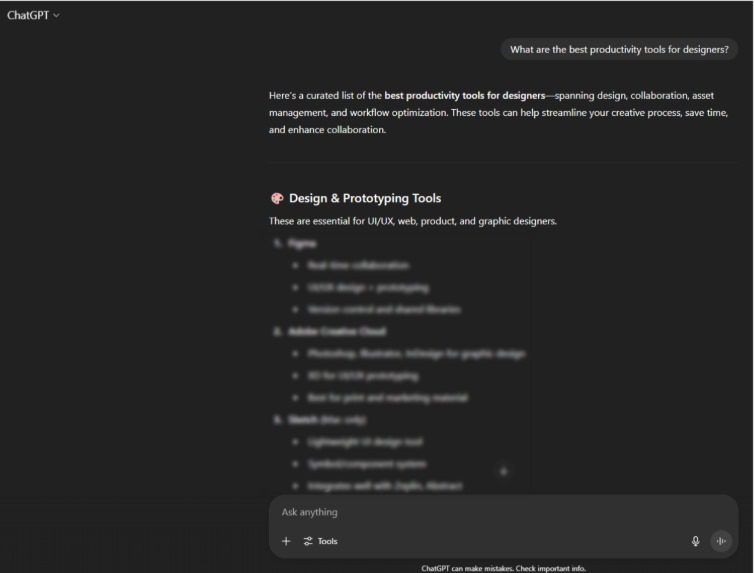
Type a question like, “What are the best productivity tools for designers?” and you won’t get a list of 10 blog links anymore. Instead, you’ll receive a rich, AI-crafted answer: summarised, cited (maybe), and personalised.
In this model:
- Clicks decrease
- Attribution gets murky
- User journeys collapse into seconds
The traditional SEO ecosystem, built on content creation, indexing, crawling, and page ranking, is being circumvented by AI layers that ingest your content, process it, and deliver bite-sized, zero-click outputs.
Who owns the traffic now? The AI engine.
Who wins visibility now? Those who optimise for the engine’s understanding, not just for humans.
What Is GEO?
Generative Engine Optimization (GEO) is the practice of crafting content not just for search engines, but for the generative engines that are now intermediating most discovery experiences.
Think:
- ChatGPT
- Claude
- Perplexity
- Google SGE
- TikTok’s “Ask AI”
- YouTube’s conversational assistant
- Amazon’s product summarizer
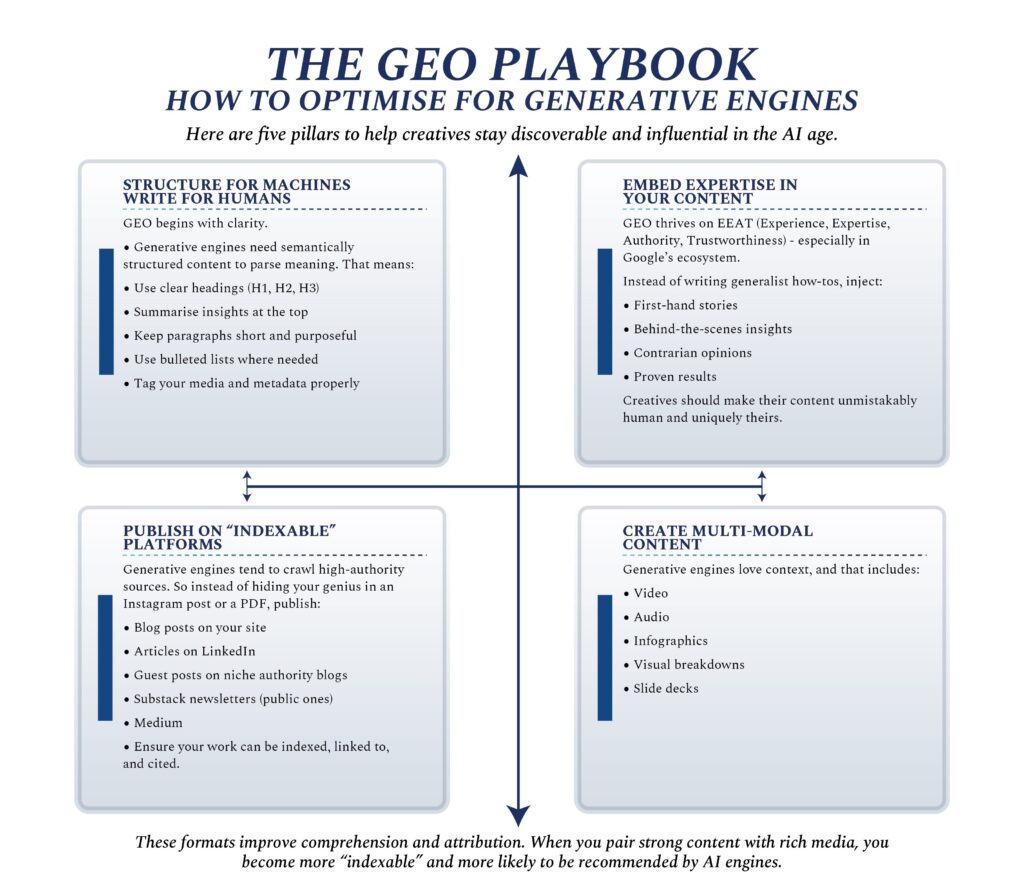
These engines don’t display content as-is; they synthesise it. That means content needs to be structured, context-rich, source-attributable, and semantically clear so that AI can not only understand it: but trust it enough to summarise and surface it.
In other words, GEO is the new SEO, built not for search crawlers, but for AI summarisers.
The Stakes for Creatives
If you’re a creative professional – a designer, copywriter, musician, filmmaker, or brand strategist – the implications are huge.
- Your work, thoughts, and content are at risk of being:
- Abstracted (used without credit)
- Generalised (boiled down by AI into basic summaries)
- Missed altogether (never surfaced unless optimized)
But flip the coin, and it’s also an opportunity: those who understand how generative engines work will shape what the world sees, hears, and consumes.
Case Study: How Notion Dominates GEO
Notion, the productivity software company, is a brilliant example of GEO in practice.
Problem:
Notion competes in a crowded space with giants like Microsoft and Google.
Strategy:
They didn’t just blog for SEO. They built a generative-friendly content ecosystem:
They published template guides in structured formats.
They launched a Notion Academy with expert voices and modular lessons.
Their help center is beautifully structured, cleanly tagged, and optimised for AI summarisation.
They partner with power users and influencers to write third-party content across forums, newsletters, and communities, creating high-trust, indexed content.
Result:
When you ask ChatGPT or Perplexity things like:
“Best Notion templates for writers”
“How to use Notion for project management”
Nine times out of ten, Notion is in the summary – and often linked directly.
They didn’t just win SEO. They won GEO by making their knowledge easy to summarize, attribute, and trust.
Beyond Visibility: GEO Builds Thought Leadership
Let’s shift the lens.
GEO isn’t just about being found. It’s about being remembered. In a world where AI feeds on millions of voices, being quoted, cited, or referenced by a machine adds to your digital authority.
For creatives:
- That could mean your blog being summarised in someone’s AI chat.
- Your portfolio being referenced in a design assistant’s recommendation.
- Your podcast quote being surfaced in a business report summary.
GEO isn’t vanity. It’s visibility + velocity. It puts your ideas in motion, even when you’re offline.
But What About Credit and Originality?
This is the flipside of GEO’s silver lining.
Right now, attribution is inconsistent across platforms. ChatGPT, for instance, doesn’t always cite. Google’s SGE may link to sources – but not always yours, even if the AI was trained on it.
So how do you protect and elevate your originality?
- Watermark your visuals
Use subtle branding on infographics or design templates.
- Mention your name in the content
e.g., “As Mohaimenul Nicholas explains in this framework…”
- Cross-publish your content
Make it easier for engines to connect your name with your work.
- Engage with the platforms
Google, OpenAI, and others are slowly adding author markup systems and digital content verification protocols.
The more consistent your digital signature, the more likely you’ll be credited as the origin, not a remix.
GEO Is the Future of Content Discovery
The web is changing. Instead of a vast ocean of links, we’re moving toward conversational clouds, where knowledge is condensed, personalised, and delivered instantly.
In that world, creatives who master Generative Engine Optimization will:
- Be cited more often
- Have their work used in AI responses
- Build trust faster
- Stay top-of-mind in a world with shrinking attention spans
GEO Isn’t Just Technical—It’s Strategic
Yes, you’ll need to learn a few new tricks – structured data, schema markup, and formatting. But at its essence, GEO is about making your content usable, trustworthy, and unforgettable in an AI-first world.
And unlike the SEO arms race of the 2010s, this isn’t about gaming a system. It’s about meeting the moment – understanding that the tools we use to discover knowledge are evolving, and so must we.
To all creatives: this is your call to innovate, educate, and adapt.
In a sea of machine-made summaries, let your work still feel human, but speak AI fluently.
That’s how you stay seen.
Author: Mohaimenul Solaiman Nicholas


